


Hospital Officials Grilled at Courthouse
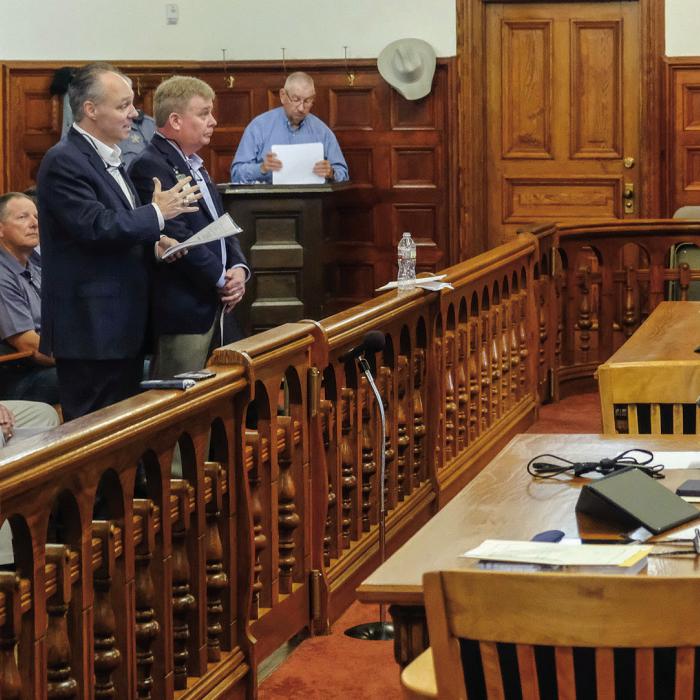
Leadership at St. Mark’s Medical Center said the hospital will not make enough money to pay for its mortgage, even after the recent changes to become designated as a Rural Emergency Hospital (REH).
Jim Kendrick, CEO of Plano-based Community Hospital Corporation (CHC), the company that manages St. Mark’s, delivered the news to Fayette County Commissioners at a meeting last Thursday, March 9.
Commissioners invited Kendrick, along with St. Mark’s CEO Mark Kimball and hospital board chairman and CHC board member Dudley Piland, to speak at the meeting on March 9 about the shakeup at St. Mark’s. The hospital slashed services and laid off more than 60 employees last month as part of the transition to the REH designation.
The Commissioners placed the topic on last Thursday’s agenda mainly to question St. Mark‘s about how it spent $500,000 in American Rescue Plan funds that the county awarded the hospital back in October 2021. (Kimball said the hospital used the money to purchase one piece of equipment for $135,500 and has plans for additional purchases and upgrades, leaving an unallocated balance of about $143,000 inARP funds.)
But the discussion quickly shifted to the underlying financial problems facing St. Mark’s and the hospital’s role in the community.
Kendrick said the hospital owes upwards of $13 million on its mortgage. Debt service on the loan amounts to $1.9 million a year.
The new REH designation will provide the struggling hospital with a much-needed injection of cash. Kendrick said the Centers for Medicare and Medicaid (CMS) will give St. Mark’s a $272,000 monthly “facility fee.” In addition, CMS will increase St. Mark’s medicare reimbursement to 105 percent. But it won’t be enough to pay off the loan.
“With the $272,000 going into operations, after we pay the bills, what’s left at the end of the year won’t be enough to service the debt,” Kendrick said.
Kimball said the new designation buys the hospital time to fix its financial problems. He said the hospital has seven years to pay off its mortgage under the current terms of the loan.The mortgage is guaranteed by the Federal Department of Housing and Urban Development (HUD).
Kimball said St. Mark’s worked out a deal with HUD to, in essence, suspend mortgage payments for 12 months.
“So between now and the next 11 or 12 months, that’s what’s got to be addressed – the mortgage on the hospital,” Kimball said.
“If we get through this transition, the performance data we’re seeing now shows a positive bottom line,” Kendrick said. “That number is somewhere around $600,000 (annually).
That’s not enough to cover the $1.9 million annual debt service on the mortgage.
“There will possibly be a path to work with HUD,” Kendrick said. “So far HUD has worked very cooperatively with us. They don’t want to close hospitals, but they also have a fiduciary responsibility to manage that debt issue.”
Kendrick said St. Mark’s hopes to negotiate with the borrower for more favorable terms during the next year.
“What’s your long-term outlook look like?” Pct. 4 Commissioner Drew Brossmann asked Kimball.
“The long-term plan for St. Marks is this community needs to support the hospital,” Kimball said. “That’s what we need. We need support. If people need healthcare services, they need to come to the hospital. If they need emergency care, they need to see our emergency room. If they need labs, they need to come and get their lab work done. If they’re getting surgery in Austin or some other facility, they can still come and receive lab works here. Any imaging services, any outpatient services, we’re asking the community to support us.”
Brossmann took issue with Kimball’s answer.
“That’s what the citizens have been doing,” Brossmann said. “We’ve been coming to the hospital. We’ve been putting our trust in you. It’s just my opinion, but I don’t think it’s the citizen’s job to bail you out when there is poor management, from the top down. Everytime something’s not right, you can’t come to the citizens and expect them to foot the bill. I feel this way, and numerous constituents have called me, and that’s how they feel.
“Another part of it is that the majority of the people who called me do not trust CHC one bit,” Brossmann added.
Brossmann said he believes the failure of the 2019 referendum for a hospital property tax was due to public distrust of CHC.
“I’ve heard things over the years like, ‘The money is going to Plano,’ but that’s not an accurate statement,” Kendrick said. “If money is going to St. Mark’s, it’s going to help St. Mark’s. Over my tenure, We’ve had expenses that the hospital wasn’t able to pay. We have $1.5 million that we weren’t paid but we put out on St. Mark’s behalf. We haven’t been paid back.”
Besides the donation from the County, St. Mark’s received $13.8 million in COVID- related funding in the form of grants and loans. Kendrick said CHC did not take any of the COVID-related financial assistance that went to St. Mark’s.
“We are truly here to help St. Mark’s be sustainable,” Kendrick said.
“This is not a managerial issue. This is a state-wide issue,” Kendrick said. “One in four hospitals in rural Texas are at imminent risk for closure. That’s a statewide issue. It’s not because CHC is pulling money out. The dollars that are spent are spent very efficiently. The costs are the bigger problem that we’re facing right now.”
Kendrick said the St. Mark’s board considered selling the hospital in 2019.
“We tried selling it to an Austin-based system,” Kendrick said. “That deal fell through. It was at imminent closure then. When it didn’t sell, they went out for the tax referendum. That failed. If nothing else had changed, the hospital probably would have closed.”
Kendrick said St. Mark’s then hired a consultant to help them sell the hospital, but he said the consultant could not find anyone willing to buy the facility.
“But then COVID came and these relief dollars took us from where we were in 2019 to now, where we’re in the same spot,” he added. “But then the legislature passed something, the Rural Emergency Hospital designation. That’s another chance for keeping as many services in this community as possible. And that’s what we’re doing.”
Commissioners allowed members of the public to comment and ask questions to St. Mark’s leadership. Many of them focused on the perceived lack of transparency at the hospital.
“There is probably a group of Fayette County citizens who would pony up the money to salvage this hospital, but you’ve got to have transparency so we can see what you’re doing,” said county resident Steve Hillhouse.
“When this issue came up to the voters and failed miserably, one of the problems was a lack of transparency, certainly a perception from the public that there was a lack of transparency,” said County Judge Dan Mueller.
“This is a community hospital with a community board, so why weren’t we having this meeting six months ago or a year ago?” asked Dr. Daniel White, a surgeon who has worked in La Grange since 1979, first at Fayette Memorial and now at St. Mark’s. “Maybe we could find out as a community if there was anything we could do to help the board.”
Earlier in the meeting, Dr. White’s daughter, local attorney Mary Gunn, noted that her father has likely spent more time at St. Mark’s and its predecessor, Fayette Memorial, than anyone else in the community. She asked Kendrick if he had ever met Dr. White. Kendrick admitted that he had not.
Former County Judge Ed Janecka asked Kendrick how much money CHC has made since taking over management of St. Mark’s in 2011.
“The direct cost associated with personnel, things like the CEO, CFO, and CNO, those costs are passed through and I don’t know the answer off the top of my head, but those costs are going to be the largest costs,” Kendrick said. “The next cost is going to be the management fee. The management fee has fluctuated and it has actually gone down. It was something like $25,000 a month and we lowered it to $21,500, and we have suspended it entirely for the 2023 year.”
Janecka asked for a total number. Kendrick said he did not know the number off the top of his head, but he said he would find out and return with that information. Janecka then asked how much money CHC pays board members for salary, travel and expenses. Kendrick said he did not know. Janecka then asked Piland how much he makes each month from CHC.
“I don’t know, judge,” Piland said.
“Wait, you don’t know how much money you make?” Janecka asked.
Kendrick said board members earn $20,000 to $25,000 a year. He said they meet four times a year. He said each meeting lasts from two to four days.
“That’s a hell of a deal,” Janecka said.
Pct. 3 Commissioner Harvey Berckenhoff said that if St. Mark’s had gone through bankruptcy in 2019, the hospital could be on a better financial footing today.
“I don’t know if we’re doing any at all other than kicking the can down the road,” Berckenhoff said.
“We are truly here to help St. Mark’s be sustainable,” Kendrick said. “If people say they don’t want to support it from a tax perspective, that’s the voters’ choice. All we’re saying is, we’re trying to find a path to sustainability.”
La Grange area resident Ken Dernehl asked if the hospital has tried to raise private money to pay off the debt.
St. Mark’s Foundation President Michael Corker said the Foundation is planning a capital campaign to buy down debt and pay for new equipment.
“We’re trying to get through the hurdles here before we go out and ask,” Corker said. “The community spoke during the (vote for the) taxing district, and I think its probably premature to ask for funds, transitional or otherwise, until we have a clearer path.”
Dr. White said the REH designation would allow St. Mark’s to conduct many types of outpatient surgeries. He asked why the board decided to cut outpatient surgeries anyway.
“We think it’s something that would be profitable,” Dr. White said.
The St. Mark’s officials did not respond to Dr. White’s question at the meeting.
“The community needs a hospital desperately,” Dr. White said. Everyday it’s tearjerking to see people transferred and you have 80-yearold people trying to figure out how they’re going to get to Austin to see their spouse or relatives. The community will really suffer without a hospital. We need to do everything we can do to get our hospital back.”