


Hope on a Hill
Hurricane Harvey: Five Years Later
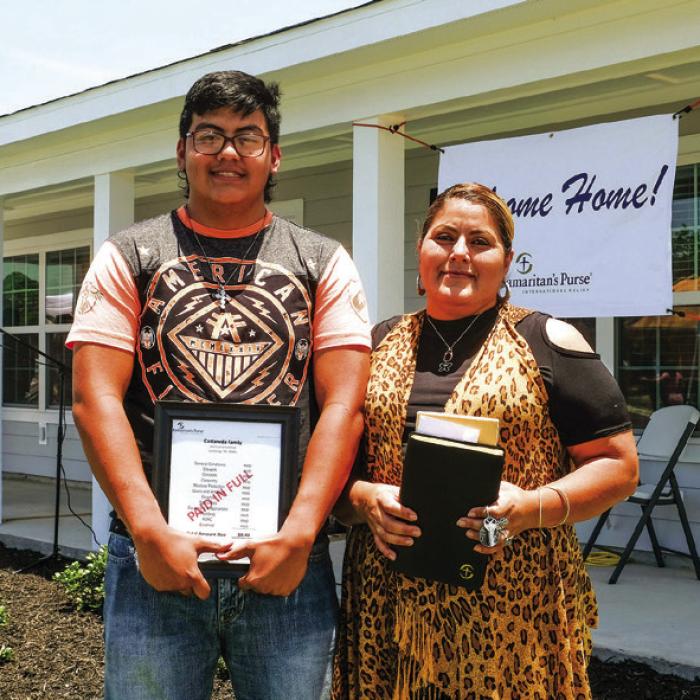
When the Hurricane Harvey flood swept through La Grange in late August 2017, lots of people stepped up to help.
“Growing up in Houston, I’ve seen people flood left and right my whole life, so helping people clean up their houses seemed like something you’re supposed to do in a community,” said Kenny Couch, an early flood volunteer who went on to help lead recovery efforts in Fayette County.
Couch now serves as Executive Director of Fayette County Habitat for Humanity. He had moved to Schulenburg not long before the flood. When the disaster struck, he drove to La Grange to lend a hand. At the time, the Second Chance Emporium resale shop became a hub for donations in La Grange. “My in-laws told me Second Chance Emporium needed
some help,” Couch said. “They were drowning in donations. I remember they had so many diapers. You get 10,000 of one thing and two of another thing, and you really need 200 of each. When you have 10,000 size 3 diapers, you only need so many of those. So we ended up taking some of that stuff to other communities, to the coastal communities that were struck, just vanloads of stuff.”
Couch praised all of the local volunteers and civic organizations that stepped up to ensure no one in the community went hungry or without clothes after the disaster.
“Once those immediate needs were met, then it transitioned into the long-term recovery,” Couch said.
The La Grange Ministerial Alliance initially handled monetary donations for the flood recovery. But the Ministerial Alliance had little experience dealing with disasters. A group of volunteers came together to form the La Grange Area Disaster Recovery Team, which later became the Fayette County Disaster Recovery Team (FCDRT). Couch began working with the new organization.
“That’s when we started talking about Hope Hill and doing repairs with Mennonite Disaster Service,” The disaster recovery team envisioned a new neighborhood where victims of the flood could rebuild on high ground. That vision eventually became Hope Hill – the neighborhood on Horton Street largely that was mostly completed last year.
FCDRT acquired a roughly 23-acre lot on Horton Street in 2018. At first, FCDRT worked with Mennonite Disaster Service to develop the neighborhood. Some neighboring property owners raised concerns about the proposed ownership model. In initial discussions, FCDRT proposed a building the neighborhood as a land trust, whereby the flood victims would own the homes and the non-profit land trust would own the land underneath the homes. The idea was proposed as a way to provide affordable housing to the flood victims, many of whom previously lived in La Grange’s flooded mobile home parks.
That idea didn’t sit well with some neighbors to the property, who formed an organization called the La Grange Citizens Alliance. They raised concerns at city council meetings about how the project would impact property taxes and city services (a land trust could gain a nonprofit exemption for property taxes on the land). They also worried about impacts to their property values, traffic and aesthetics of the neighborhood. In addition, they raised concerns about FCDRT’s finances and their ability to build. Samaritan’s Purse, the international Christian non-profit headed by Franklin Graham, offered to partner with the FCDRT to complete the neighborhood, which alleviated concerns from many of the Alliance members. Samaritan’s Purse completed the first home in Hope Hill in July of 2020, and members of the Alliance were in the front row at the home blessing ceremony. Samaritan’s Purse eventually completed 20 homes in the Hope Hill neighborhood that went to victims of the Hurricane Harvey Flood. By that time, Couch moved on to another organization, Fayette County Habitat for Humanity. “We had huge plans before COVID,” Couch said. “A lot of our volunteers are 70 to 75 years old, and they were not going to risk it, and I didn’t want them to. Basically, we had to push a lot of our stuff back.” Couch explained that recipients of Habitat homes do not get them for free. Instead, Habitat builds the homes at low cost using volunteer labor. Home recipients must earn “sweat equity” in the home by working with the volunteers. Once complete, the recipients pay a mortgage they can afford. “As a community, we can’t just pretend that it’s lazy people who can’t afford housing,” Couch said. “That’s just not the case. And it’s really not been the case for a long time. A lot of people think Habitat give away homes for free. But that’s not the case. We sell houses, and we don’t sell houses to anyone who is not a worker.” Couch said Habitat slowed its home building efforts as their volunteer base dwindled during COVID. He said the organization took on other smaller projects such as home repairs and painting. The recent economic downturn also affected Habitat’s operations. “Everytime we raise a dollar, concrete goes up two dollars,” he said. “We’re bidding houses right now for $160 a square foot, and that’s nuts. It’s not like we’re putting in six foot chandeliers.”
Couch said Fayette County already had an affordable housing problem before the flood. Hurricane Harvey, COVID and the recent economic downturn have exacerbated that problem.
“Housing has gotten so bad – it’s no longer the typical folks who you think need housing help that are reaching out to us at Habitat,” he said. “Teachers can’t afford houses. Police officers can’t afford houses. Harvey got that on everyone’s mind. It shows that housing has been an issue. It’s always going to be an issue. I’m not going to pretend I know how to fix it. But at least Habitat has this one area where we can make a difference.”
To be continued ...