

The Guy Who Wrote The Book on The Chicken Ranch
Many people like to believe that they know the complete story of the Chicken Ranch, but in reality, that’s just not true.
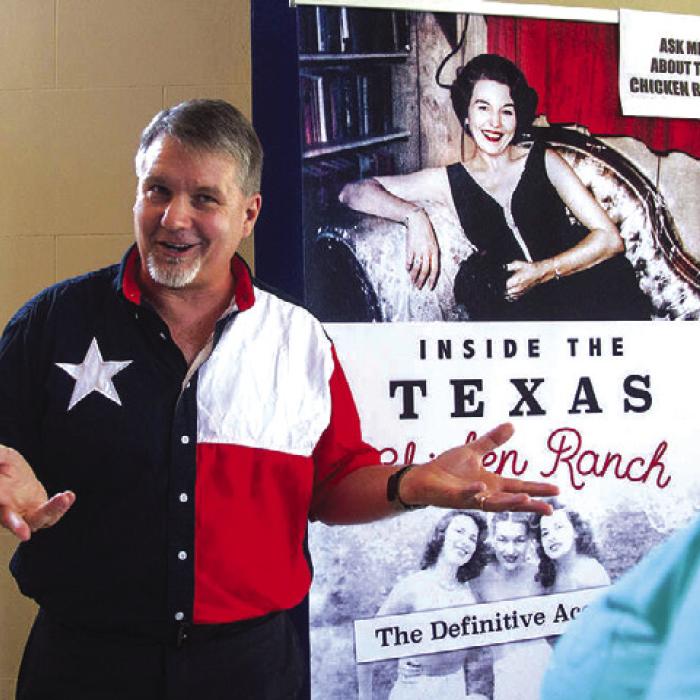
Jayme Blaschke is a journalist and writer from the Columbus area who spent years of his life asking what the true story of the Ranch was. Of course, the Broadway musical, and later on star-studded film, told a version of the story, but not one that was accurate in any sense. So, Blaschke’s wife encouraged him to write a book.
“We realized that there had never actually been anyone to sit down and chronicle the story in a serious manner,” said Blaschke. “That bothered me from a journalistic point of view, because… all these people who had direct knowledge and first hand experience with it, all these sources, were gone and were being lost.”
Blaschke decided to pursue this idea, and it ended up taking him nearly six years to write the book, ‘Inside the Texas Chicken Ranch: The Definitive Account of the Best Little Whorehouse.’And what he realized throughout those years was just how wrong the public had the story.
“In the process when I was writing it, I was blowing up a whole lot of the myths, the commonly repeated stories. ‘Oh, this is why this is and this is the story behind this’ so I realized, OK, I was going to have to document everything,” said Blaschke. “...Young people could have made things up out of whole cloth, just invented it, you know, sitting in a bar somewhere, and I didn’t want to be accused of that.”
For example, it’s widely believed that Marvin Zindler began his coverage of the Chicken Ranch because of an anonymous tip, or because the Texas attorney general at the time asked him to. However, Blaschke discovered that Zindler had already known about the Chicken Ranch for decades before discussing it on-screen. A “corrupt officer” in the Houston Department of Public Safety who offered him private Chicken Ranch case files was the real reason behind why Zindler began his infamous exposé, according to Blaschke’s sources.
Another inaccuracy regularly mistaken for fact was the far-reaching corruption that the Chicken Ranch was entangled in. Yes, Edna Milton, the last house madam, regularly donated to local businesses and the city of La Grange, that is true. However, this was not in an effort to keep the town quiet about the Ranch. Rather, it was a way to give back to the community that Milton knew and loved.
Blaschke also explained that the economic impact of the closing of the Ranch was both “overblown and underestimated.” After Zindler’s campaign successfully shut the Chicken Ranch down, he and a TV crew returned to La Grange to see just how the economy in the area was affected, but nowadays, it isn’t really discussed.
“The biggest impact, which never really gets mentioned much, was the secondary revenue that they would get from all the people who were driving in to visit and patronized the Chicken Ranch,” said Blaschke. “...Businesses may or may not have noticed the dip in their income and their revenues in the following year, but after, the economy recovered to equilibrium. I’m sure they just carried on as they have always had.”
However, the brothel didn’t find itself closed for long. Three short years later, the Chicken Ranch found itself reopening — but not in the same state, nor with the same owner. In Pahrump, Nevada, a man by the name of Walter Plankinton decided to establish a brothel under the same name, merely for its notoriety. Even though Plankinton had no relation to the Texas Chicken Ranch, he made claims that this new brothel was merely a relocation of the permanently closed original.
Blaschke, who had slowly become known as the “Chicken Ranch Guy” even before releasing his book, was contacted by investors around 2011 wanting to purchase the new brothel. When those investors had begun looking into purchasing the brothel, they discovered that the Chicken Ranch name had not been officially trademarked and were worried that Plankinton had not actually gotten permission from Milton to claim naming rights. So, naturally, they contacted Blaschke to see if he could get them in contact with Milton, who hadn’t been seen publicly since roughly 1974.
According to Milton, “there were no rights to buy.” When the investors asked her if they could have permission to use the name, she told them that she had never actually used or claimed ‘The Chicken Ranch’as the official name for the brothel and refused to take the money they offered her for it.
That gives you insight into her character because she was very scrupulous, and she wasn’t going to cheat anybody,” said Blaschke. “And that, in her mind, if she was taking money from them for a name she didn’t have any legal claim to, even though she owned it for a decade, then that would be wrong, so she refused.”
Now, in the 50th year of the Chicken Ranch’s closing, Blaschke has released a 50th anniversary edition of the book, which hit the shelves on Monday, June 26. In this new edition, information about family histories and locations of events in the Ranch’s timeline have been updated or corrected.
Naturally, with each publication of a history book, there will be those who find inaccuracies within it and provide sources to back up those claims. After Blaschke’s book was initially published, he received loads of new information from readers and approached his publisher to see if they’d be willing to rerelease a new edition of the book with all of the corrected facts. Though this book may not be a perfect anthology, it is one step closer to understanding just what went down at that old Chicken Ranch.
For further information about Jayme Blaschke or his book, visit https://www.jaymeblaschke. com. To contact Jayme Blaschke, email him at jblaschke@hotmail.com.
His original book is also sold at The Fayette County Record office.