

The Great Train Heist at Flatonia in 1887
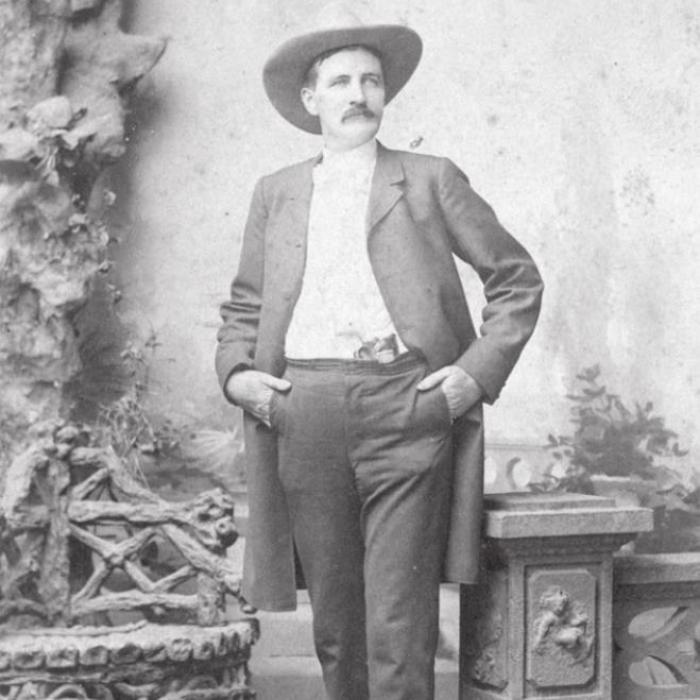
In September, 1888 George Whitley brazenly attempted another train robbery in Harwood, in Gonzales County. But this time, law enforcement officers were ready for him. According to historian David Johnson, it is likely that Eli Harrell, one of his criminal associates, betrayed Whitley to the authorities. The train targeted by Whitley was carrying U.S. Marshal John Rankin, nine deputies, and a Southern Pacific detective. As Whitley and his men attempted to rob the train, shots were exchanged between the gang and the lawmen, and a few of the men were injured. Once Whitley knew that the robbery was going to fail, he called it off and escaped with his men. The lawmen had prevented another train robbery, but they had to continue their manhunt.
Marshal Rankin and his men made their way to the Harrell brothers’ house in Floresville, in Wilson County, where Whitley headed after the attempted Harwood heist. The lawmen waited in the dark house for Will Harrell and Whitley to arrive. When the two men entered the house, Rankin pointed his shotgun at Whitley and demanded his surrender. Whitley responded by firing at Rankin, but missed. Rankin blasted Whitley in the head, ending his career of crime, and his life. Whitley’s descendants disputed this version of events, saying that Rankin executed Whitley without warning, shooting him in the back of the head. Once again, the reader will have to imagine which is the more likely scenario, and may never know for certain.
One by one, the rest of the gang met their demise. Ike Cloud was convicted of larceny and sentenced to three years in Arkansas. Ed Reeves was convicted of the Flatonia and McNeil station train robberies and sentenced to life in prison. Will Harrell was arrested in Floresville on a count of train robbery. Bud Powell hid out in Montana for years until he was finally arrested there in 1892. He served five years in prison, and died in Medina County, Texas in 1936. Sion Secrest stood trial in La Grange, likely in 1889, but the case was dropped due to a lack of witnesses. He met his end while crossing the Llano river, drowning under the weight of his ammunition. In December, 1889 deputy U.S. Marshals met up with John Barber in northeast Oklahoma. Barber opened fire, but received a hail of bullets himself, meeting the same fate that his compatriots Cornett and Whitley had met. The Cornett-Whitley gang would no longer terrorize Texas, and the perpetrators of the violence at Flatonia would finally be brought to justice.
The lawmen who tracked down, arrested, or killed the gang members, were not immune to the wanton violence of the era. Alfred Allee, the deputy Sheriff of Frio County who gunned down Cornett, started drinking heavily and killed more men. He claimed to be haunted by ghosts, including that of Cornett. Allee was arrested in Starr County, in Laredo, in 1896. While out on bail he started threatening people and city marshal Joseph Barthelow stabbed him to death in Reiwald’s Saloon. Barthelow was acquitted and would go on to be a Deputy U.S. Marshal and a Starr County Commissioner. John Rankin, the man who brought George Whitley to justice with a shotgun blast to the head, also met a tragic fate. In November, 1897 he was walking unarmed in Austin when a police officer shot him four times, killing him. Reports suggest that the killing was due to either local politics or a personal dispute of some kind. Rankin’s killer was acquitted of the crime. The U.S. Marshal and former Fayette County Sheriff would be remembered for his deeds in life, and for the nature of his tragic death.
The Flatonia train robbery of June 18, 1887 was one of many train robberies in the post-Civil War era; the era of the railroads, renegade gangs, and gunslingers. While names like Jesse James, John Wesley Hardin, and Sam Bass are quite familiar, the Cornett-Whitley gang is less well-known in the annals of Texas history. But it terrorized citizens, frustrated the railroads, and kept law enforcement officers busy all over the state. The train heist at Flatonia made international headlines, sparked a massive manhunt, and put pressure on local and state officials to do something to put a stop to train robberies, and to bring the gang to justice. Unfortunately, surviving editions of the Flatonia Argus from that era are virtually nonexistent, so we may be missing some pertinent details of the robbery and its aftermath. But thanks to various books, newspaper articles, letters, and other historical documents, historians can piece together what happened, who was involved, and how the gang was finally dismantled.
One source in particular is vital to this research, David Johnson’s The Cornett-Whitley Gang: Violence Unleashed in Texas. Johnson’s painstaking research and writing have brought this otherwise littleknown story to light, as well as the historical context of the train robbery at Flatonia. The author sifted through many newspaper articles that had information that turned out to be incorrect, and he did a masterful job of finding well-documented facts to set the record straight when possible. Historical research is an ongoing process, and every discovery raises more questions and inspires new ideas on how to discover, or re-discover, the past.
Sources:
David Johnson, The Cornett-Whitley Gang: Violence Unleashed in Texas (Denton: UNT Press, 2019), 83.
Author Unknown, “All Hands Up: The Order of the Train Robbers Promptly Obeyed,” Houston Daily Post, June 19, 1887.
Johnson, The Cornett-Whitley Gang, 71.
Johnson, The Cornett-Whitley Gang, 72.
Johnson, The Cornett-Whitley Gang, 73.
Johnson, The Cornett-Whitley Gang, 78.
Johnson, The Cornett-Whitley Gang, 87.
Johnson, The Cornett-Whitley Gang, 149-150.
Author Unknown, “He Will Rob No More: A Bad, Bold Highwayman Shot to Death – ‘Captain Dick’, Leader of the Flatonia Train Robbers, Killed by Deputy Sheriff A.Y. Allee – Something of the Bandit’s Career,” San Antonio Express, February 14, 1888.
Johnson, The Cornett-Whitley Gang, 141.
Johnson, The Cornett-Whitley Gang, 166.
Johnson, The Cornett-Whitley Gang, 172.
Johnson, The Cornett-Whitley Gang, 190.
Johnson, The Cornett-Whitley Gang, 195.
Johnson, The Cornett-Whitley Gang, 196.