

Governor Visits LG as Election Day Looms
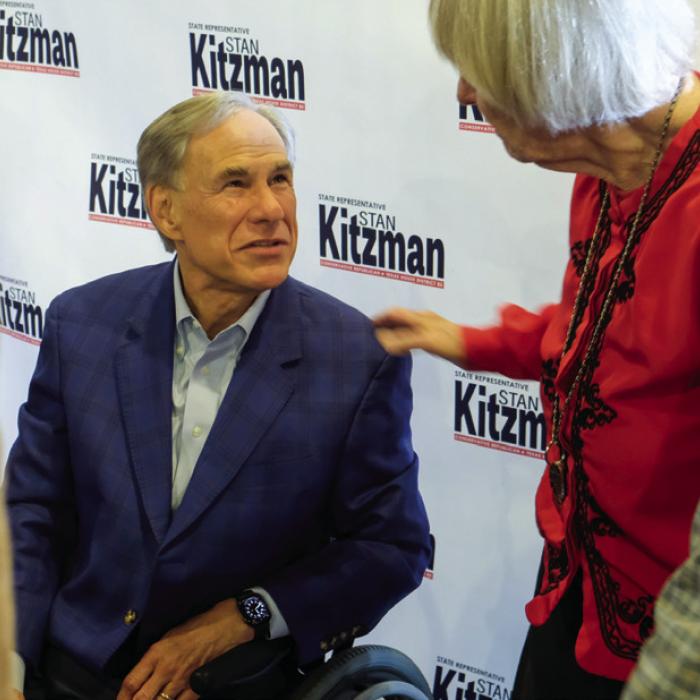

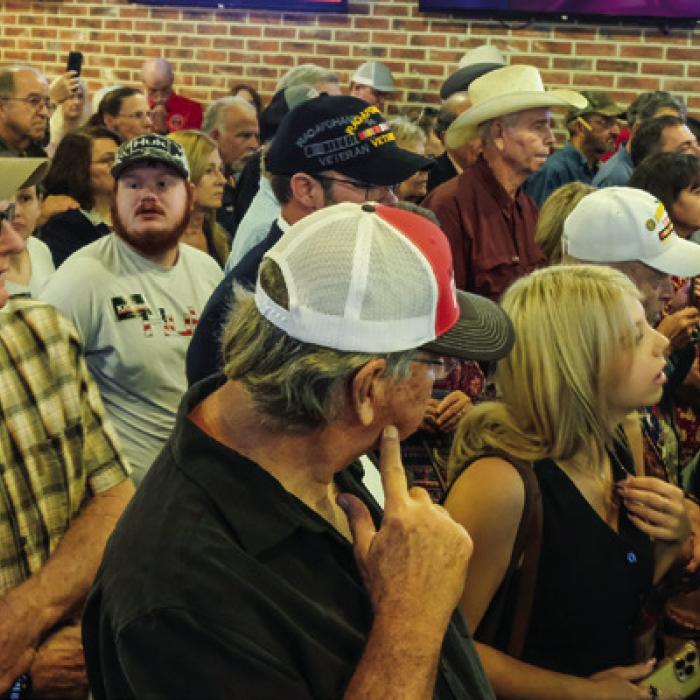
Governor Greg Abbott stopped in La Grange Thursday morning for a campaign event at Jay Dee’z Sports Grill.
The Governor appeared alongside State Senator Lois Kolkhorst, Acting Texas Comptroller Kelly Hancock and State Rep. Stan Kitzman, who are all up for election this year. An estimated 200-plus people crammed inside the restaurant to hear the dignitaries speak.
Rep. Stan Kitzman has faced some tough competition, at least in Fayette County, from his Republican Primary opponent Dennis Geesaman of Flatonia. Governor Abbott has endorsed Kitzman, and their appearance together in La Grange last week might indicate how close that race really is.
“One person I’m here for is Stan Kitzman,” Abbott said. “He’s done a fantastic job in the Texas House of Representatives. You have to have a strong conservative voice fighting for you in Texas, and that is exactly what Stan Kitzman does.”
Abbott spoke about how he worked with Kitzman to pass legislation to keep violent offenders behind bars and to cut funding to cities that defund police. The Governor also praised Kitzman for voting in favor of a bill to prevent Chinese foreign investors from buying land in Texas.
“The people who are trying to take over the state right now are trying to impose things like girls in boys sports,” Abbott said at the event. “They want to deny the ability right now for U.S. citizens to be the only ones who can vote. This is crazy stuff.”
Abbott used much of his speech to focus on his priorities for his fourth term in office. If re-elected, Abbott said one of those priorities will be to lower the cost of insurance for Texans “Insurance is a pain for small businesses,” he said. “It’s a problem for homeowners and people who are driving cars. Everyone has to pay for insurance. Insurance, I hear, has doubled or tripled in a matter of a year. It’s time we go to Austin an cut in half your insurance costs At one point, the Governor quipped about the age of the audience members in attend- ance.
“If you’re a senior, and not many of them are here today, but if you’re a senior, the first $200,000 of your homestead will be exempt from school district property taxes,” Abbott said, to which the audience responded with laughs and a big round of applause.
The main part of Abbott’s speech centered around his four-point plan to reduce property taxes for Texans.
“I have solutions this next legislative session that will more than cut in half your property tax bill,” Abbott said.
First, Abbott said the government needs to rein-in spending.
“Stop the spending that leads to property tax increases in the first place,” he said.
Second, Abbott said any property tax increases should be ratified by voters.
“You should not have to pay for property tax increases on your homestead unless you have the ability to vote in an election for that,” he said, adding that such increases should only be allowed unless citizens approve it by at least two-thirds of the vote.
Third, Abbott said the state needs to tame the property appraisal system.
“Current Texas law allows your appraisals to go up ten percent a year,” he said. “You can do the math and it doesn’t take long to get priced out of your home. We need to reduce the 10 percent a year appraisal to no more than three percent a year.”
He also proposed limiting appraisals to no more than once every five years.
“If that is all we did, your property taxes would be going down,” Abbott said. “But when you add in this last component – this last component alone – will slash your property taxes in half.”
Abbott’s fourth and perhaps most sweeping reform proposal would involve a historic change to the way Texas funds public schools.
“Your property tax bill is using your and your homestead to pay for public schools,” he said. “I say it should be the State of Texas, not your homestead, that pays for public education in this state. You will finally be able to live in your own home.”
Abbott did not go into much detail about that last point at his appearance in La Grange. After his speech, the Record attempted to ask Abbott about how the State will be able to pay for school district funding without local property taxes. He stayed around to take photographs with anyone in the crowd who wanted one. But when the Record approached him, one of his campaign staffers said the Governor was on a tight schedule and didn’t have time for questions. The staffer asked us to send our questions in an email, which we did after the event. We await their response.
Two of the other candidates at the event did take some time to speak with the Record.
State Senator Lois Kolkhorst said she has been closely following the Record’s coverage of alleged abuse at one local nursing home – Paradigm at the Oak in Schulenburg. In a series of articles last year we reported on the unusually high number of convicted sex offenders living at the facility, along with at least two allegations of sexual assault by these offenders against innocent elderly residents inside the nursing home.
Kolkhorst said she is looking into drafting legislation to address this problem. Look for more on that story as we follow her efforts in the legislature.
In addition, the Record asked State Comptroller Kelly Hancock about a sales tax issue that has perplexed local leaders for many years: sale tax collections, or rather the lack thereof, at the twiceyearly antiques shows in Round Top and Warrenton.
“They do get audited,” Hancock said. “We have a very large auditing team. But there’s a lot of businesses across the state of Texas. They do get audited and we catch some from time to time.”
Hancock said local governments can refer cases to the Comptroller’s Office.
“If they want to let us know about them, we’re happy to work with them,” he said. “Our audit teams are out there all the time. We work with local governments. We just had a sting operation down in the Rio Grande Valley, working with local law enforcement on some sales tax issues. Some companies were basically cheating the state.”
Several Dennis Geesaman supporters attended the event. Some of them wore shirts with Geesaman’s name. Event organizers allowed them inside only if they changed clothes or covered their shirts, which many of them did. There were no disruptions.