


Five Years After Hurricane Harvey Questions Remain
Hurricane Harvey: Five Years Later
This is the fifth and final installment in a five-part series looking back at the storm and its impact.
The Fayette County Record
Fayette County promised buyouts for dozens of property owners flooded by Hurricane Harvey five years ago. Last Friday, Sept. 2, the County received a deposit for the first two buyouts.
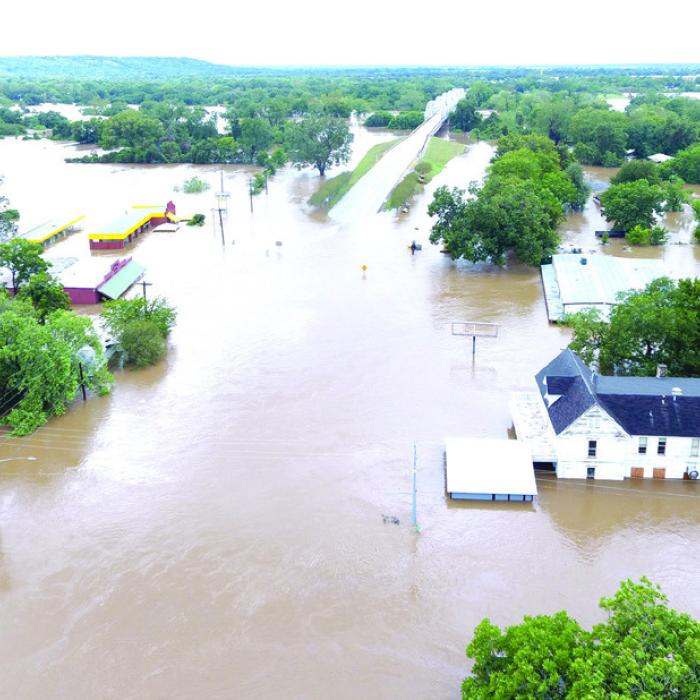
But why has it taken five years? That’s a question many people are asking now at the fifth anniversary of the historic flood. We posed that question to several current and former local officials, and the answers we got were many: bureaucracy, political patronage, leadership changes at the County and State level, and the COVID pandemic. County Judge Ed Janecka was finishing his last term in office when the flood struck La Grange. He arrived to work before dawn on Monday, Aug. 28, 2017. That day, the Colorado River crested at 54.14 feet, the third highest level on record and the highest La Grange had seen in a century. “When light broke I was at the courthouse and saw Adamcik’s Service Station was under water,” he recalled. “The KC Hall was underwater. It was hard to imagine that the river could come up that high.” Janecka said the Hurricane Harvey flood caught officials by surprise. “In the past we always had a warning,” Janecka said. “A bunch of rain would fall in the Hill Country and we would know the arrival time. This was so unusual because all the rain fell below the dams between here and Austin.” Despite the short notice, Janecka and his team at the Courthouse got to work organizing relief efforts. City governments, non-profit groups and masses of volunteers joined together in the initial recovery efforts. The City of La Grange and Fayette County became an example in the State for neighbors helping neighbors in the days after the flood. Days turned into weeks. Victims picked through their watersoaked homes and saved whatever valuables they could find. The rest went into dumpsters. Then they wondered, “What now?”
The County soon developed a plan to buy-out many of the flooded properties, especially those on Country Club Drive.
1998 vs. 2017
Janecka had been through this once before. Back in 1998, torrential rainfall above La Grange caused the river to spill out of its high banks on Oct. 20 of that year. But that flood wasn’t as bad. The crest reached 45.5 feet, nearly ten feet lower than the Hurricane Harvey flood.
Still, it devastated the Fritsch Auf! Subdivision. Back then, houses lined River Road, which runs along Buckner’s Creek on north side of the golf course. More than a dozen of them flooded. The County obtained funding from the U.S. Department of Agriculture to offer voluntary buyouts of the properties on River Road. The project was aimed at preventing future development in the flood-prone area. It took some time, but eventually, the County purchased all but one of the homes and several undeveloped lots. Things didn’t go so smoothly after the 2017 flood.
“It was the State of Texas that bogged all of this down,” Janecka said. “They determined how they dished out the money. The Feds sent money down to the State, then the
State determined where it was going to go. Most of it ended up in the GLO (General Land Office), then the cities had to fight for the money. To be honest, we never got our share.”
After the storm, the U.S. Congress approved $4.3 billion in disaster aid with $2.6 billion going to Texas. Congress selected the U.S. Department of Housing and Urban Development (HUD) to distribute the funds to the state in conjunction with the Federal Emergency Management Agency (FEMA). Governor Greg Abbott assigned Texas Land Commissioner George P. Bush the task of divvying up those funds to flood-affected regions. The money was supposed to be used for drainage improvements, flood buyouts, and housing development.
Bush’s handling of the recovery money attracted state and national media attention. Last year, the GLO stunned many across the state when they announced a $1 billion disbursement of Hurricane Harvey recovery money in which the City of Houston and Harris County received nothing. Elected leaders in Harris County and Houston, who are predominantly Democrat, accused the Republican Bush of playing politics with disaster aid.
Bush also ran for Attorney General in the Republican Primary against the incumbent, Ken Paxton. Some observers thought he had a chance given Paxton’s long-unresolved legal issues and accusations of corruption in the AG’s office. Bush ultimately lost in the March primary.
The lingering problems in Fayette County didn’t attract much attention between Bush’s election campaign and the situation in Houston.
That wasn’t always the case. On Sept. 19, 2018, Bush hosted a “Hurricane Harvey Recovery Roundtable” at Casino Hall in La Grange. That visit was the first time a statewide office holder came to La Grange and met with elected leaders here about Hurricane Harvey. Officials from Fayette, Bastrop and Colorado Counties attended the closed-door meeting with Bush. At the conclusion, local media were summoned for a big announcement.
“Resources continue to arrive to La Grange,” Bush told reporters that day. “A multifamily redevelopment has been greenlighted: 36 units, $8.7 million allocation from the first housing block grant, one of the first permanent housing structures in the tri-county area that will be assisted post-Harvey.” Bush said the new development would be built to replace affordable housing options that were lost in the flood. Many in the community were later surprised to learn that the housing development would be built not in La Grange but in Schulenburg.
“They built a subdivision in Schulenburg with some of that money, and that was nice,” Janecka said. “But that was Harvey money and Schulenburg didn’t have flooding.” The developer, DSW Homes of Galveston, built the new subdivision using Harvey relief grant funds from the GLO’s Affordable Rental program. DSW Homes had previously completed several similar projects using GLO money in the Galveston area. In an unusual practice, GLO did not award the affordable rental grants based on the merits of each application after a filing deadline. Rather, it awarded funds on a “first come, first served” basis. The application for the Schulenburg development was the first one GLO received for this area. Terms from the GLO stipulated that the money had to be used to replace housing lost in the flood. The developers accomplished this by purchasing and rebuilding one flooded home in La Grange. On paper, the GLO considered that home part of the 35-unit development in Schulenburg.
Terms of the grant stipulate that the developer must offer reduced rents on a portion of the units to lower income tenants. However, they do not have to repay the $8.7 million in grants they received to build the 35 homes.
DSW Homes completed the project and began leasing the homes in 2021. Meanwhile, homeowners on Country Club Drive continue to wait on their long-promised buyouts.
“The length of time it’s taken to move this process forward is actually pretty standard for FEMA/HUD assistance because of the red tape,” said Angela Hahn, whom the County hired in 2021 to handle all the red tape that comes with receiving grants. Prior to that, Hahn worked for the Capitol Area Council of Governments (CAPCOG), a consortium of city and county leaders in the Austin region. Hahn recalled a CAPCOG meeting she attended in March 2018 between county leaders and GLO officials.
“A county judge from a coastal county made the point to the GLO that he hadn’t even received funding from Hurricane Ike yet,” Hahn said.
Hahn blamed the long delay on burdensome stipulations that HUD pushed onto grant recipients like Fayette County. For example, all of the buyout properties had to undergo extensive studies to ensure the project doesn’t harm the environment. All for a project aimed at returning the properties to a natural environment free from any future development. The grant funds also came with stipulations requiring the project to benefit a portion of low to moderate income (LMI) residents. Many of the flood-damaged properties in the City of La Grange qualified under the LMI requirements, but those along Country Club Drive did not. Complicating matters, the Fayette County Commissioners Court adopted new rules just before the flood in 2017 that required all new construction to be built at least three feet above the base flood elevation, or the so-called “100-year flood” level. The new rule was aimed at lowering flood insurance costs for County property owners. However, it effectively prevented the flooded homeowners on Country Club Drive from rebuilding. Most of those homes were built on concrete foundations before the County had any flood regulations. The cost to raise them would have been prohibitive.
The City of La Grange never adopted those rules. The City’s building code merely requires structures to be built at or above the base flood elevation. That made it a lot easier for La Grange homeowners to rebuild after the flood. Fewer of them were interested in the voluntary buyouts, which made it difficult for the County to achieve the right mix of LMI recipients in its grant application.
After the flood, though, County officials never thought they’d have to deal with environmental reviews or LMI requirements. That’s because, at first, the County applied for the buyout grant using FEMA funds administered by the Texas Department of Emergency Management (TDEM).
Janet Carrigan was the Fayette County Chief of Emergency Management at the time. Carrigan said she spent weeks collecting information from the affected property owners. She developed a plan and budget for purchasing the properties, demolishing the homes and returning the land to greenspace.
“Our cost (estimate) at that time was right at $1.2 million,” Carrigan said. “We wouldn’t have had all the constraints of the EPA (Environmental Protection Agency). There would have been some oversight, but it wouldn’t have been so strident like we had to with the GLO. We could have gone in there, finished buying everybody out, and knocked the houses down. Let’s say $1.2 million was low. Let’s say it would have been $2 million, we could have done that. We were told by their recovery chief we could have the money as soon as January 2019.”
A TDEM official appeared before the Fayette County Commissioners in November of 2018 and assured the County that it had complied with all the requirements of the buyout grant. By that time, Joe Weber had succeeded Janecka as County Judge. The County’s application languished at TDEM until June of 2019, when TDEM Chief Nim Kidd informed Weber that FEMA decided it wanted TDEM’s funds to go to buyouts in high impact areas along the coast. Fayette County did not qualify for the grant.
“Imagine the slaps in our faces,” Carrigan said.
At that point, the County started over and applied for the grant through GLO.
“Unfortunately, when you’re talking about that much money - billions - small rural communities get put to the bottom of the list,” Carrigan said.
The long-awaited money is finally starting to trickle in. Hahn reported that GLO deposited its first draw from the grant funds into the county’s account last Friday. That deposit will cover the buyouts for two properties, one on Country Club Drive and another on River Road. The County hired the firm Grantworks to administer the buyout purchases. Hahn said a representative from Grantworks was working with the property owners and the title company to set closing dates. Carrigan retired in 2019. Craig Moreau took her place as Fayette County’s Chief of Emergency Management during the middle of the buyout debacle. Then the COVID pandemic swept across the nation. Federal and state agencies sent their employees home, including the GLO. Some of those government employees are still working from home.
“The excuse everyone will give you is COVID,” Moreau said. “But I’ll tell you, it was already frustrating before COVID. They kept saying it was right around the corner. Having three years of excuses for COVID pushed a lot of stuff back.”
Moreau said the biggest lesson he learned from the County’s experience after Harvey was to look for local solutions before reaching out to the state or federal government.
“We got told by all these different agencies that these are the paths you need to take, when really, our local responders, our local volunteers and our local groups should have been given first dibs at serving their community,” Moreau said.
If a major disaster strikes Fayette County again, Moreau said he would include a representative from churches and charities with the command staff at the County’s emergency operations center. “There’s some things we can’t do locally, like the hazmat overturned 18-wheeler at the Bluff a few weeks ago,” Moreau said. “We have to bring in a professional to handle something like that. But there are a whole lot of people in Fayette County who know how to take down a house or help their neighbors rebuild a house. I think we need to look at that a lot differently.”
Looking forward, Moreau said he hopes the buyout properties can eventually become a public greenspace. “You look at other places where they’ve had buyouts by a river, they’ve turned them into a place that the community can enjoy,” he said. “ We should look into that. It’s a big opportunity.”