


The Excellent Adventures of the Turf Man From the Bog Lands
John McCourt hails from the lowlands of Northern Ireland where peat was once cut and dried to fuel homes. He found his life partner, Eileen, just seven miles up the road from his childhood home.





By ELAINE THOMAS Special to the Record
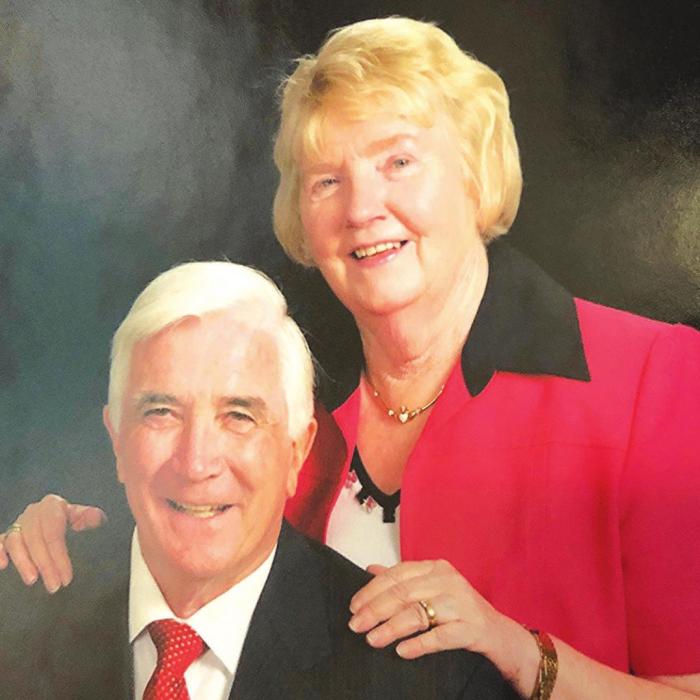
Immigrants John and Eileen McCourt of La Grange were sworn in as U.S. citizens in 2019. This milestone marked the pinnacle of the couple’s American odyssey that began in 1974. That year, the McCourts left Northern Ireland in pursuit of financial security, as well as civil and religious freedom for themselves and their growing family.
It had been a long, arduous journey.
John was 34 years old and Eileen was 30 when his employer offered him an opportunity in Minneapolis, Minnesota, a long, long way from the Emerald Isle. At the time, the McCourts had five young boys and Eileen was pregnant with their sixth child.
“America sounded like the Promised Land we read about in the Old Testament, and unlike that land, one did not have to fight for it,” John remembers. “I think what attracted me was this country’s sense of adventurism and independence.”
Politics Intensely Backed Protestants over Catholics
At the time, Northern Ireland, which was under British rule, favored Protestants over Catholics. Unemployment was high, and if a man was Catholic, opportunities for advancement were practically non-existent, no matter how hard he worked. Catholics couldn’t hold government jobs. Protestant politics dictated that Protestants were to be favored over Catholics in all manner of government-controlled programs such as housing, as well.
It’s not surprising that the blatant political human rights discrimination felt by young and old alike stoked the fires of despair and discontent. This seething undercurrent of unrest that smoldered just below the surface could and did erupt into violence.
John and Eileen feared how the political unrest in Northern Ireland would affect their boys as they grew to adulthood and likely impair their futures because they were Catholic.
“I could see no way to improve our lives or to have hope for a better future,” John says. “There was way too much hate, conflict and discrimination, which was sad as Ireland, then and now, is a beautiful country with its mountains, rivers and 40 shades of green.”
John, who was the eldest in his family, had left school after the eighth grade to help his parents and five brothers and sisters. In his first job as an errand boy, he delivered groceries on the bicycle his employer furnished. The satisfying parts of the job were earning modest tips and getting to know his customers.
John’s Aunt Isabella eventually got him a job in the shipping department of Moygashel Linen Green, a linen manufacturer that produced men’s and women’s clothing for the American market. Both Catholics and Protestants were employed there.
“Here I was packaging garments to send to America, never dreaming I would be shipping myself there one day,” he adds.
The U.S. had always fascinated John, who had been an avid reader as a boy. He often would be so engrossed in a story written by Louis L’Amour or Zane Grey that he wouldn’t hear his mother speak to him. He would be riding with a sheriff’s posse that was chasing cattle rustlers or bank robbers until she got his attention.
“These were fictional stories, of course, but I enjoyed the authors’ description of the countryside, the towns and the people. Most of all, I learned about ordinary people doing extraordinary things,” he recalls.
John had been with the linen company four years when he was notified that he was being appointed to a supervisory position. Being offered a promotion was a rare event for a Catholic at any Protestant-owned business.
“I was very excited and could not wait to get home and share the good news with my parents. I was to take up my new job on Monday of the following week. That morning, I came to work dressed in a suit, all ready to take on a new challenge.
“When I came to my desk, another young man was already there. He told me that I was to train him on how to manage the department. Then he showed me his letter of appointment, which was almost identical to mine. When I went and spoke to the managers who had recommended me, they went to the head office, nearly as upset as I was.
“Upon their return, they said they were very sorry, but the job had been taken away from me because I was Catholic. I knew at that moment that I would immediately look for another job. I think this experience changed me and gave me added determination to succeed in life,” John says.
Next, the coal company owned by his Uncle Jim and Aunt Isabella McElkenny hired John to deliver bags of the heating fuel weighing 140 pounds to their customers’ houses in all kinds of weather. While it was filthy, backbreaking work, he enjoyed serving his customers, some of whom offered him tea and sandwiches.
However, John realized he was not getting ahead as he longed to do.
A Salesman’s Mindset
The key message from American author Zig Ziglar’s 1974 book, “See You at the Top,” stuck in the Irishman’s mind. Ziglar believed the fastest way to succeed in business was through sales.
“From that moment on, I decided to try a different path,” John recalls. “What I needed to do was find a forward-thinking company, a company that would think outside the box and be willing to take risks to achieve goals. Somewhere like that, I would have a better chance to advance.”
John found those attributes in a business that had designed a revolutionary product to screen materials such as rock and gravel. Although he turned down the company’s offer to start his career operating a forklift, John still was offered a job.
“I arrived at work on Monday morning wearing a suit, white shirt and tie. When I went to see the director, he took me outside, gave me a broom and told me to sweep the yard. You could imagine what was going through my head. Should I tell him what to do with his broom? Instead, I took off my jacket and tie and began sweeping the yard. About an hour later, the director came out, invited me into his office and told me that sweeping the yard had been a test to see if I would be willing to do as I was asked.”
Starting that day, John began to work his way through the company’s departments, learning the responsibilities of each. At the end of two years, he had earned the position of head demonstrator, as well as the ire of some employees who claimed he worked so hard that he made them look bad.
Then John was offered a job in Minneapolis, Minnesota. He traveled to the U.S., liked what he saw and convinced Eileen, who was somewhat reluctant to undertake such a big step, to move in a matter of a few weeks.
“I think the message was made pretty clear, ‘if you’re coming here, you had better be willing to work because there are no free lunches,’” Eileen adds.
“I didn’t have a passport and the boys didn’t have passports, so we had to go immediately to Belfast and get that sorted out. Fifty years ago, the government put all five boys on my passport.
“When we arrived, the boys looked really Irish, in a sense. They wore little Irish caps and jackets, not the kind of clothing suited for winter in Minneapolis, but we soon had them bundled up,” Eileen remembers.
“Faith is what grounded us when we got to Minneapolis. We made a friend who was also an Irish immigrant. Her name was Christina Gannon and her husband’s name was John. We’re still friends to this day. Christina introduced us to the local Catholic Church and so we went on from there,” she recalls.
The original plan was for Eileen and the boys to come for six months to see how John’s job was going to work out, but they stayed a year.
“And Eileen reviewed that option to return every six months for the next 10 years!” John says with a laugh.
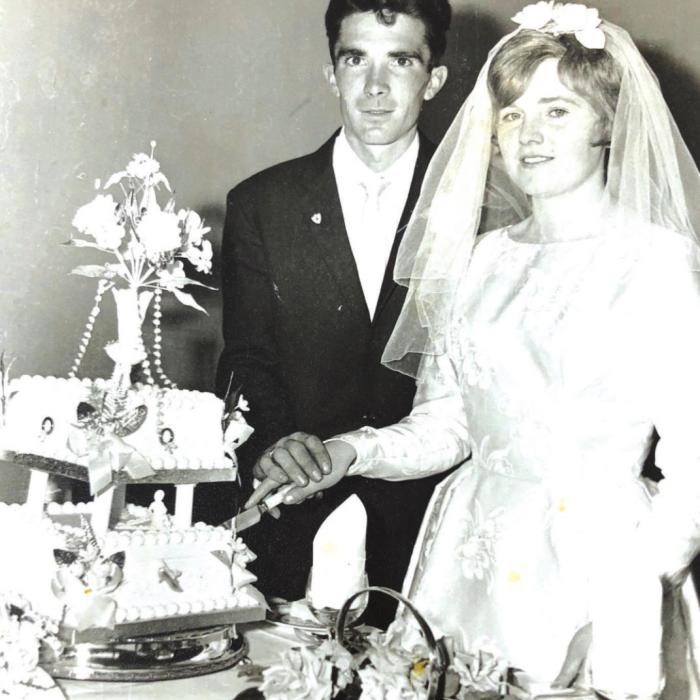
John first caught sight of Eileen when he walked through the linen factory where she, too, worked. They dated for four years and the four-year difference in their ages never crossed his mind. At the time, he drove a little motorbike and loved to dance, as did the quiet Eileen.
An Irishman on a Mission
John’s mission was to sell material screening equipment in a part of the U.S. where the ground is frozen solid for several months each year. It took some ingenuity to outwit the weather, but before long, John was making substantial sales. He also was constantly traveling across the country to meet potential customers.
Although he had only an eighth-grade education, John understood the strengths and limitations of the equipment he sold. Perhaps even more important, he grasped far more than the rudi ments of engineering associated with their operation. Rather than opening sales pitches with a rehearsed spiel promoting the attributes of a piece of equipment, he asked the company decisionmakers to describe the challenges they faced. John’s willingness to listen and come to the table as a problem-solver rather than a slick salesman made him very effective at his job.
John’s career in the material screening business took several turns. Along the way, he became an expert on hydraulic-driven equipment that would replace antiquated belt and chain-driven methodology. One of those career moves brought John to Texas and ultimately to La Grange.
“Although we’d come to Minnesota with five or six suitcases, when we decided to come here, we had to hire a moving van that went on ahead of us. Since it was June, we decided to camp our way from Minnesota to Texas in June, so we bought a big, old tent,” Eileen says.
“I drove a pickup truck filled with our stuff and Eileen drove the SUV,” John explains. “She had only been driving in the U.S. a couple of years before we undertook that cross-country expedition. Outside of Kansas City, we found a nice camp that had trees where there were other campers. We heard a storm was forecast and we could hear it in the distance,”
Eileen was uneasy and couldn’t sleep, so she went outside, leaving John in the tent with the boys. He woke up and followed her outdoors.
“Suddenly, I recognized something was very wrong. I looked up and the wind had blown our tent up like a big balloon. We started to grab the boys and take them out one by one to the car, but Eamon kept running back in again. I thought I had the last of them moved to safety when away went the tent, rolling down the hill. Then I realized Eamon was still inside, so there I was, chasing after that tent! It was a frightening experience, but he was fine.”
After the thunder, lightning, rain and wind finally subsided, nearby campers came over to check on the McCourts.
“Our campsite neighbor wanted to know how many kids we had. When I told him we had seven children, he shook his head. ‘Well, sir, a lot more kids were coming out of that tent than seven!’ he said. The man didn’t realize that our eldest kept running back in every time we took him out.”
Local Introduction Unsettling
The family settled into a big house seven miles north of La Grange and John got very involved in local affairs to assimilate into the community. He joined the Knights of Columbus. He joined the Lions Club. He joined the La Grange Chamber of Commerce to name a few.
Meanwhile, Eileen and the boys were feeling a tad neglected so far from their Minnesota friends and no longer within walking distance of fun, leisuretime activities. The McCourts also found it challenging to make friends because in 1979, Fayette County was in the midst of an oil and gas boom. More and more people who weren’t from here were pouring in.
One native Fayette County resident put out a giant welcome mat. That was realtor Gus Lindemann.
“When I told him we had seven boys, he told me we didn’t need a house; we needed a hotel!” John recalls.
On the first St. Patrick’s Day in Fayette County, Gus lightened up a decidedly tense period in the McCourts’ lives.
“Gus came down and said, ‘John, what are you doing for St. Patrick’s Day?’ We didn’t have anything planned, so Gus said we had to do something. ‘I’ll come here,’ he said. God bless him.
“I said I’d get a keg of green beer. So Gus arrived with a bunch of people, really good people,” John recalls.
“We had a great party together and it got to almost midnight and Gus got out his trumpet. He marched around the house and out around the pond playing his trumpet and everyone lined up and marched behind him. It was amazing!” John recalls.
The family’s quality of life improved immensely after the McCourts negotiated a favorable purchase of a home on the Bluff, where they reside to this day. However, John spent a great deal of time on Interstate 10 commuting to his work in Houston. He also traveled as his career continued to evolve while Eileen cared for their children.
Then, as if Eileen didn’t have enough to do at home, John built her a convenience store on the corner of Country Club Drive and Hwy. 77.
“Security, that’s why we started the store. What if something happened to John? I couldn’t run the equipment business, so what would I do? How would I look after my family?” Eileen says.
For a few years, the McCourts partnered with La Grange banker Larry Korenek. The first part of the name Kort’s Korner includes letters from both the original owners’ surnames. The second word was capitalized because the alliteration sounded pleasing.
“A convenience store is 24/7, I’ll tell you that,” Eileen said.
Although John loved it, he spent most of his time with the material screening business in Houston and beyond.
“I would be out with Eileen and the kids on a Saturday and when we’d be going past the store on the way home, I’d say, ‘Hold on, let me go in for a moment.’ Sometimes I’d be in too long and when I would come out, Eileen and the kids would have gone to the house without me,” John adds.
“I would have worked the store during the week, so I didn’t want to spend Saturday there,” Eileen explains.
John admits, though, that he couldn’t work behind the counter on a daily basis; it was too confining for this man of action.
Kort’s Korner soon became a gathering place for the community. At the time, it had an onsite beer consumption license, which led to some lively evenings in addition to fun events for the whole family. These included Easter egg hunts and Christmas parties.
“One St. Patrick’s Day, I decided I would serve O’Doul’s non-alcoholic green beer. The guys were drinking as usual, but finally, somebody said, ‘Where did you get this beer?’ I told them I flew it in from Ireland. ‘That beer tastes different than anything we’ve ever had,’ they said. Eventually, somebody caught on that it was non-alcoholic. They weren’t getting a buzz out of it!” John says.
John always looked forward to the time his sons might join him in business. Eventually, that goal resulted in the formation of McCourt and Sons in La Grange, one of the largest material handling equipment manufacturers in the U.S.
Seeking Citizenship
Although John had a job when he came to the U.S., the couple entered the country on visitors’ visas. After four years, John hired immigration attorneys in Minneapolis and New York to help him and Eileen wade through the paperwork to qualify for permanent residency. He also had to advertise in a national newspaper that his knowledge of hydraulic-operated material handling machinery was highly specialized. Therefore, he would not be taking a job away from an American citizen.
Being granted American citizenship several decades later was a big deal. That was one goal John and Eileen were never confident they’d attain.
Other aspirations have been a challenge, too. The family had to devise how to get by with less when financial roadblocks appeared insurmountable.
“I just would say to myself, you need to get out there and you need to do your job. There’s work out there; there’s money to be made out there. Just get on with it,” John says.
John and Eileen have made a good team.
“Back in the days when I was a lad, I would go to a dance to meet girls 20 miles away. You didn’t just look around your neighborhood. As it turned out, the best partner for me was seven miles up the road. I fell in love with Eileen the first time we danced,” John says.
“Our parents would tell us, ‘Make sure you make the right choice in a partner because it’s going to be a lifelong commitment. Is this person someone you want to spend the rest of your life with?” Eileen recalls.
Answering the Call
In 2001, John was called to become a deacon in the Catholic Church. Preparation involved one year of spirituality education and four years of university. He was ordained in 2006.
“It was a challenge for me as I had only an eighth-grade education,” John explains. “It was only through the grace of the Holy Spirit that I graduated.”
At that time, John retired, turning the company over to the couple’s sons.
“They were young and ambitious and wanted to take it to the next level. The shiny new office building of McCourt Equipment is a result of our sons’ hard work, ingenuity and integrity,” John explains.
“Eileen has been with me 100% throughout the years. She may not always have agreed with me or been excited about the choices I was making, but she trusted me. That gives a man an awesome strength to know that his wife trusts him. And still, after 58 years, it’s powerful, and as I get older, I appreciate it even more.
“I loved this woman from the first time I saw her and that love has grown over the years and still is deep within my heart.”
If you’d like to read more stories written by Elaine, visit www.elainethomaswriter.com/ blog/ and sign up to receive new posts. You can also call Elaine at 979-263-5031.