

Drought Makes it Tough for Ranchers To Make Ends Meat
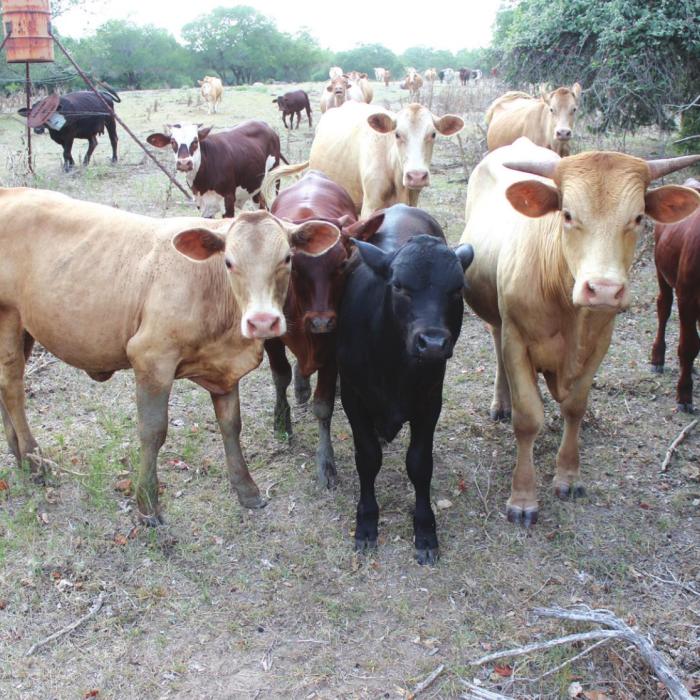
There’s an old joke that cattle ranchers have told for decades, in different versions – especially during times of drought.
It goes something like this:
It’s an especially dry Texas summer. A rancher knows he’s not going to get much by selling his calves at the auction barn, because everybody’s selling. But he’s gotta get rid of them because he’s out of hay, and out of money to keep feeding ‘em. So he loads three calves up in trailer and drives to the auction barn, puts a sign that says “Free” on the outside of the trailer, and goes inside the cafe to have lunch. He walks out, and not only are those three calves still in his trailer, but somebody’s put four more in there.
Ok, so things aren’t that bad around here – yet.
But the exceptional heat and drought are making it awfully tough to be a cattle rancher in Fayette County these days.
Prices are dropping for those who want to sell.
Hay is scarce and expensive for those who want to hold on.
Ronnie Beck, whose family owns Flatonia Livestock auction, describes the life of a rancher these days like this: “It’s a fight.”
Beck is 80 years old and he’s seen droughts before.
“I’ve been through these a few times and we’ve always recovered, but it’s a slow process,” he said.
Beck said the last summer he remembers like this was 2011 – but there’s one difference now.
“2011 was bad, but people were able to put up some hay early in the year back then. That didn’t happen this year. The price of fertilizer was too high,” Beck said.
That’s not the only thing that’s costly.
Molasses tubs for cattle were $90 but now they’re about $130.
Normally a round bale of hay can be bought for $35 to $50.
Now it’s going for $90 to $120.
And there’s little grazing food out there for the cattle right now, so all they’re surviving on is hay.
Meanwhile, the price of fuel looms over everything too.
Beck said he’s seeing a sharp increase in the number of cattle being sold at his market.
“People don’t have hay. They aren’t liquidating their whole herds, but they are cutting down,” Beck said. “The market is in decline because there’s so many cattle... If people keep selling cattle at this rate, we won’t have anything to sell in October, November, December.”
Scott Willey, a Fayette County Extension Agent, and a cattle rancher himself, is seeing and hearing the same things as Beck.
“There’s a lot of cows going to the market right now, but it’s hard to pull the trigger yourself because prices are so low. It adds insult to injury to cull cows,” Willey said. “You cull cows to buy hay, but this year that won’t buy you a lot of hay. You gotta worry, are you feeding all your winter hay to just get through the summer?”
The longer it doesn’t rain, an even greater worry arises, as pond levels drop.
“The big thing I’m worried about is people running out of water,” Willey said. “It comes down to the quality of pond and where you are at.”
People with access to rural water and water wells have a back-up. Cattle on places with just ponds could be in trouble if the drought drags on.
This, of course isn’t just a Fayette County issue.
In a recent article by Cary Martin of Texas Farm Bureau Radio, he stated “this level of cow herd liquidation hasn’t been seen since the drought of 2011, and a 4% decline in the nation’s cow herd could be expected next year” because most of the cows being sold aren’t headed to other ranches but rather the slaughterhouse.
But there is a long-term reason to be optimistic, Martin says:
“While this is a sad situation for the Texas cattle sector, there could be a silver lining for those ranchers who can stay in business, this is a scenario similar to the 2011 drought, where the cow herd was reduced, and cattle prices hit record highs in the years that followed.”
Meanwhile, local farmers have it even worse than ranchers because of the drought, with nearly non-existent crop yields.
Very little farmland in Fayette County is irrigated.
“For the crop tour this year, there was no crop tour,” Willey said of the annual event, which was held June 27 this year, where local farmers can get continuing educational units for attending a class that includes visits to farms around the county. “We just had an inside program.”
The severe droughts in recent years have had a dramatic effect on the landscape of Fayette County agriculture.
“In 2008, Fayette County was in the top three cow-calf counties in the state,” Willey said. “We had 75,000-80,000 head back then.
“A year or two ago, the most recent data I’ve seen, that number was down to 55,000-60,000 and we were sixth or seventh in the state. There’s been a lot of land-use changes here in the last few years.”
But folks like Willey and Beck know that being a cattle rancher is not for the faint of heart.
“All you can do is hold your head up,” Beck said. “The Good Lord didn’t make us choose this profession. We decided on it ourselves.”