

Diggs Turns Passion into Career With Workforce Resources
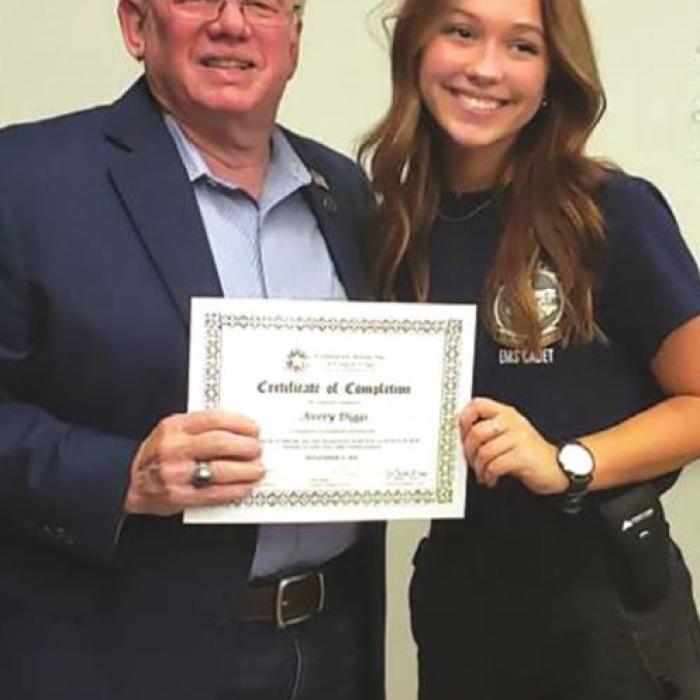
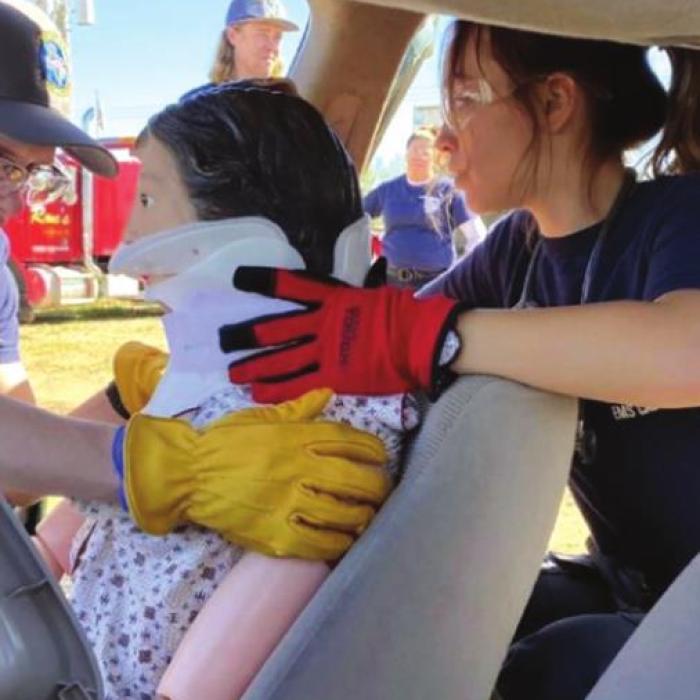
As the man lying in the center of the roadway regained his pulse and took a breath, Avery Diggs had a moment of clarity as she stopped her compressions: the CPR she learned had saved his life, and she had found her calling.
After completing her 12- week intensive training, Diggs is now a full-time Emergency Medical Technician (EMT) with Fayette County Emergency Management Services and shared her inspiring story with the Fayette County Workforce Alliance Council at its recent meeting in La Grange.
The Council, which comprises workforce, industry, and training stakeholders from across the County and is supported by Workforce Solutions Rural Capital Area (WSRCA), helped raise awareness throughout the community of the nocost EMT training that Community Action, Inc. of Central Texas offered. The same free training that Diggs was able to enroll in to realize her career goal.
At 18 years old, Diggs would likely be wrapping up her senior year at Fayetteville High School and planning her summer vacation right now. But having graduated a year early from secondary school and pursuing her passion for emergency management services (EMS) shortly after, Diggs is now serving as an EMT with the County, with certifications in Basic Life Support, with more to come.
Diggs doesn’t consider herself a superhero, but her career does have an origin story.
“I was in the midst of trying to determine if I was going to pursue a career as a first responder or in a hospital setting when my friend and I drove up on a rollover crash in the median of State Hwy. 71, and I just took action,” Diggs recalled. “The adrenaline definitely hit. I don’t remember everything. But my friend who was there said that I was extremely calm and in control and that I didn’t have any facial expressions as I treated the man in the overturned truck. That was when I realized I had passed the test. My body could handle the stress, and I knew I wanted to be a first responder. I knew I wanted to help people.”
Diggs shared with the Council that she struggled at first to find an EMT program in the area that met her needs, but after contacting Craig Moreau, Chief of Emergency Management and Homeland Security for Fayette County, and Chairman of the Council, she was able to connect with Community Action, Inc. and immediately enrolled in the career training program at no cost to her.
“Avery Diggs is a splendid example of what can be accomplished by our local young adults if we as a community invest our time and resources into them,” said Moreau. “Training Avery as an EMT not only affords her a career, it also will undoubtedly save lives as she cares for the community.”
Diggs said the timing was perfect and most of her expenses were paid by the program.
“Community Action paid for the entire course, the only thing they didn’t cover was our gear. They paid for our clinical locations, they paid for our studying resources, lectures, stethoscopes, blood pressure cuffs, and training shirts. All we had left to buy were our tactical pants and our boots—it was amazing,” added Diggs.
One of the training aspects that Diggs said she enjoyed the most, was how open, available, and supportive the instructors were.
“The instructors made it very clear that EMS is a family and that we need to be united because of the types of traumatic experiences we regularly encounter on the job. I had probably six or seven phone numbers that I could have called at any time during my training,” said Diggs.
“Community Action develops opportunities for people and communities to realize their potential by providing resources and comprehensive services to empower individuals of all ages to become self-sufficient,” said Montie May, Integrated Education and Training Coordinator with Community Action, Inc. of Central Texas. “The key role of adult education is to allow individuals to develop their skills and acquire new ones.”
Diggs said the key to her success in training was the patient contact during her clinicals, which she excelled at, and channeled into a stronger skillset by taking on additional shifts beyond the course requirements.
“My clinical shifts were the best experience,” said Diggs. “I even had the opportunity to work in the triage tent at the Ironman Triathlon Race in Houston, and experience all the insanity of a massive event like that. I absolutely loved it—I felt so at home there.”