


Crowd Questions County’s Participation in Operation Lone Star, Officials Push Back
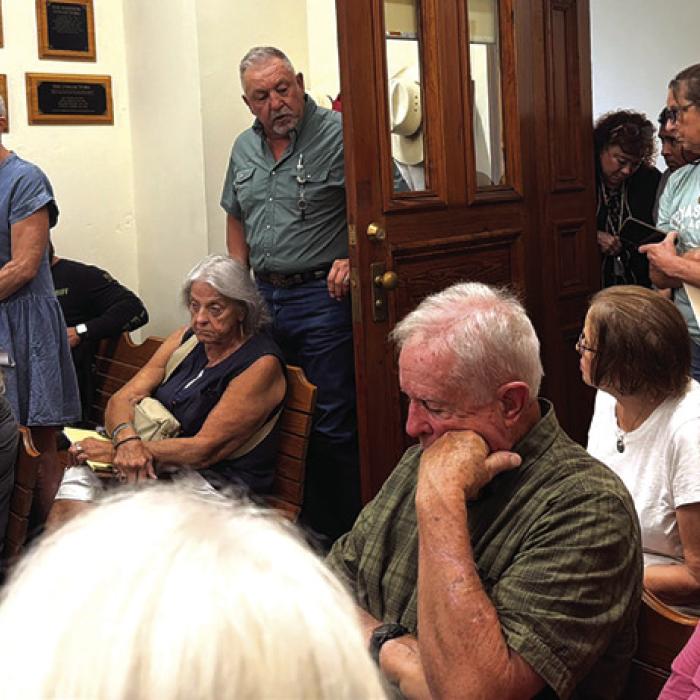
A large crowd showed up to a special meeting of the Fayette County Commissioners Court last Friday, Aug. 28, to oppose the County’s participation in Operation Lone Star.
Governor Greg Abbott launched Operation Lone Star in 2021 to combat illegal immigration, human smuggling, and the drug trade along the Mexican border. Fayette County joined the operation last year. Friday’s meeting included an item to renew a disaster declaration related to the County’s participation in the Governor’s border initiative.
Participation in Operation Lone Star makes Fayette County eligible to receive federal funding through the BIDEN Grant, which stands for Bridging Immigrationrelated Deficits Experienced Nationwide. The BIDEN grant is part of President Donald Trump’s signature legislation, the One Big Beautiful Bill. As reported previously, Fayette County is applying for tens of millions of dollars through the BIDEN Grant that could possibly be used to build a new County Jail.
At Friday’s meeting, several citizens spoke against the County’s recent participation in federal immigration enforcement. One of them, Lane Gosnay, questioned whether Fayette County was really experiencing a “disaster.”
“Fayette County is approximately 264 miles to the nearest Mexican-American border,” Gosnay said. “Where is the statistical proof showing the need and urgency to implement this unprecedented type of disaster declaration in this county?”
Another citizen, Mary Frances Agnello, noted the County’s participation with Immigration and Customs Enforcement (ICE) operations, which in some cases have resulted in the deportation of Fayette County residents.
“And I’m afraid that based on what I learned by studying the Holocaust and visiting the Holocaust Museum in Houston and going to Anne Frank’s house in Europe that sometimes projects like the Lone Star will become conflated with the ICE projects,” Agnello said. “We do not need to detain people, put them into horrible conditions, starve them, deny them medical care. And these things are happening in our country right now.”
Sheriff Keith Korenek and County Judge Dan Mueller pushed back on that accusation. Korenek said some of the biggest expenses in his department involve medical treatment for jail inmates. He said the deputies and jailers treat inmates “very well.”
“They have so many rights, it’s unbelievable,” Korenek said.
“I don’t deny that in the United States of America we hear stories about mistreatment of people arrested, but it’s not happening in Fayette County,” Mueller said.
La Grange resident Laura Logan said she reviewed the Sheriff’s monthly activity report in the Fayette County Record for the past 12 months. Logan said she found 11 arrests for narcotics, one mention of human smuggling and one case of a large sum of money suspected to be illegal proceeds from criminal activity.
“I have a question about whether this is a disaster,” Logan said.
Sheriff Korenek said his deputies respond to many more cases than the highlights listed in his monthly activity report.
“There’s so many arrests that are unknown that don’t go to the newspaper,” Korenek said.
He went on to say that Fayette County ranked second in the nation for the number of deportations three weeks in a row. He said the vast majority of those people were traveling through the County on the major highways and that less than one percent of those were Fayette County residents. Korenek said the vast majority of those detained for immigration reasons were serious criminals, including rapists, drug smugglers and human smugglers.
“These are the kind of people we’re catching,” Korenek said. “And don’t get me wrong, I love our local citizens more than anybody, and we do all we can to try to ensure that they’re not mistreated or abused.
“I was condemned back in the ‘60s because I was a trashy white boy running around with the Mexicans,” Korenek went on to say. “But you know what? It doesn’t matter. They were my friends. They still are.”
Rebecca Hegar said the Sheriff’s Office should not target law-abiding people based on their immigration status.
“These people are our school friends, neighbors, employees, relatives, coworkers,” Hegar said. “In the vast majority of cases, they are productive members of our community who rent apartments or houses and therefore pay property taxes, fill up their cars and trucks and therefore pay gas taxes. Those are the kinds of taxes that Texas depends on. And our immigrant neighbors, whether they have papers or not, are paying those taxes and are contributing members of the community, and they deserve to be treated with respect and not linked with the declaration of disaster.”
Some members of the audience asked if the disaster declaration could lead to arrests or searches without warrants.
“Law enforcement is not going to change how they do business, or how they’ve been doing business,” Mueller said. “Am I right, Sheriff?”
“Exactly,” Korenek said. The Court ultimately voted 3-0 to approve the renewal of the disaster declaration. Judge Mueller, Pct. 2 Commissioner Clint Sternadel and Pct. 4 Commissioner Drew Brossmann voted in favor. Pct. 1 Commissioner Jason McBroom and Pct. 3 Commissioner Harvey Berckenhoff were absent from the meeting.
“We’re not out there every day doing what the Sheriff’s Department does, so we lean on their expertise and what they have to say,” Brossmann said. “They’re the ones that are out there on the street, in the vehicles, doing this job every single day. I’m not going to step in front of them and say that ‘you need to be doing this, you need to be doing that,’ because I’ve never been in their shoes, and I respect them for what they have to deal with on a daily basis.
“So that’s where I lean my decisions on,” Brossmann added. “If the Sheriff, who is an elected official, and along with all of his colleagues say that this is what the Sheriff’s Department needs to run their department properly, well, I have to support that.”
Sternadel said the disaster declaration has nothing to do with a particular race of people.
“I kind of think that’s what’s being implied,” Sternadel said. “The declaration is against bad actors in general, no matter what color they are, what race they are. I think there’s a lot of implication that this has to do with Mexican immigration, and that is absolutely not the case, if I’m correct. The declaration is bad actors related to smuggling and drugs, no matter who they are and where they come from.”
Mueller said that if Fayette County doesn’t participate in Operation Lone Star, potential grant funds could go to other communities instead.
“I think it ought to be used here in Fayette County to help our taxpayers,” he said.