


Courthouse Clash
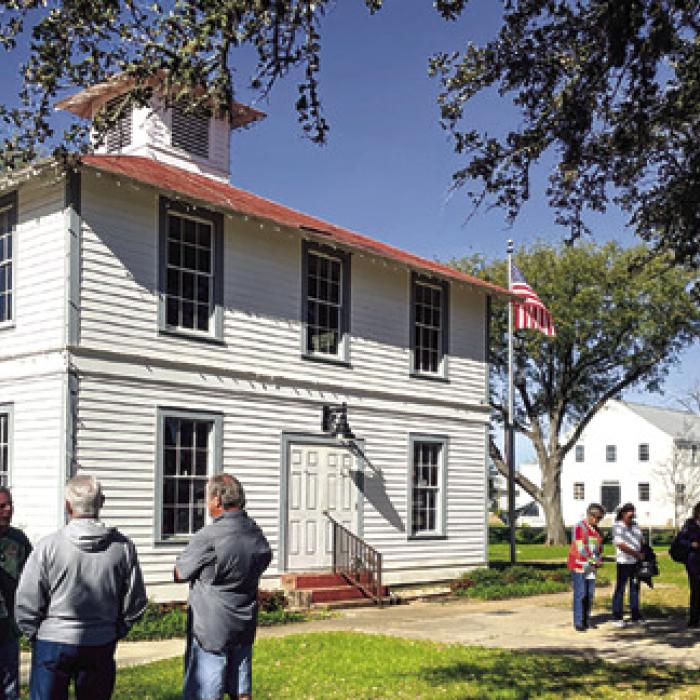
The Town of Round Top filed suit against members of the Fayette County Commissioners Court in their official capacity to settle the ownership dispute over the Round Top Precinct Courthouse.
The dispute began last year when Round Top Mayor Judith Vincent and the Town Council began discussions about possible renovations to the historic Precinct Courthouse in Round Top. Several Round Top-area citizens concerned about preserving the structure petitioned the Commissioners Court for assistance.
Around that time, a discrepancy was discovered in the 1984 deed that purportedly transferred ownership of the courthouse and town square from the County to the Town of Round Top. In the early 1980s, the County sought to divest itself of the property, which no longer served a governmental purpose for the County. The County Judge at the time, Dan Beck, signed the deed. However, there is no record in the official Commissioners Court minutes from that time that Commissioners ever authorized the transfer.
When this was discovered last year, County Attorney James Herbrich advised the Commissioners Court that he believes the County still owns the Round Top Courthouse. After that, the Commissioners offered the Town a new deed to the property with some deed restrictions aimed at preserving the Courthouse and its traditional uses by the Do Your Duty (DYD) Club and Round Top Rifle Club. The Town of Round Top rejected that offer and insisted that they own the property.
Then a different strategy emerged. Back in March of this year, members of the DYD applied for a historical designation for the Courthouse through the Texas Historical Commission. The application requires a property owner authorization form. Members of the DYD asked the Commissioners Court to sign the form, which they voted to do so at a meeting on March 12.
Two members of the Court were absent that day: County Judge Dan Mueller and Pct. 3 Commissioner Harvey Berckenhoff. All members present – Pct. 1 Commissioner Jason McBroom, Pct. 2 Commissioner Clint Sternadel and Pct. 4 Commissioner Drew Brossmann – voted in favor of signing the document. McBroom, acting as County Judge Pro Tem, signed the document.
That vote lies at the center of Round Top’s lawsuit.
In the Plaintiff’s Original Petition filed on July 2, the Town argues the following: “Although Fayette County had no ownership interest in the Property, on March 12, 2026, it submitted a Recorded Texas Historic Landmark Property Owner Authorization to the Texas Historical Commission, representing that it owned the Property ... County Judge Pro-Tem Jason McBroom signed the authorization, making it an official sworn assertion of county ownership and control. That assertion was unauthorized, contrary to the Property’s historical and legal status, and beyond the lawful authority of the County and its officials.”
Moreover, the Town says it has evidence that the County never owned the Courthouse to begin with.
The lawsuit cites a 1854 survey that “depicts the town square as unplatted, confirming its status as common public space rather than a privately held lot.”
It goes on to cite the 1870 Act of the Texas Legislature that granted the Town “complete and perfect control over the common, and all property belonging to the town, real or personal,” along with an 1877 Map of Round Top filed at the County Clerk’s Office.
“The historic record thus reflects continuous municipal recognition of the Property as part of Round Top’s public square and commons, not as County-owned property,” the petition states.
Concerning the Courthouse itself, the lawsuit alleges that the County did not build the Courthouse. Rather, “Commissioners Court voted to contribute $500.00 as a gift to Round Top to assist in construction. The County’s own action characterizes the payment as a contribution or gift to the Town’s project, not as consideration for the acquisition, retention, or confirmation of any county ownership interest in the Property.”
The petition goes on to say, “Since its construction in 1925, the Round Top Courthouse has been used, occupied, controlled, and maintained exclusively by Round Top, further evidencing the Town’s longstanding dominion over the Property.”
Concerning the 1984 deed, the Town argues that the County never owned the property. Therefore, the County “did not hold any transferable estate or interest in the Property, and therefore had no title or authority to convey.”
The petition states, “Because Fayette County lacked title or authority to convey the Property, and because the purported authorizing action did not occur, the Deed is ineffective, invalid, and void.”
“Defendants’ claims of ownership and control have impaired, and continue to impair, Round Top’s ability to exercise its statutory authority over the Property, have caused confusion in the public records, and cast an ongoing cloud on Round Top’s title, possessory rights, and authority to manage the Property as public commons,” the petition says.
The Town asks the District Court to settle the property dispute in favor of Round Top. It also asks the Court to declare that the members of the Commissioners Court have no right to claim ownership or control over the property. Furthermore, it asks the District Court to force the Commissioners Court to withdraw the application for a historical marker. The suit also seeks court costs and any “other and further relief” to which to which the town may be entitled. Notably, County Judge Dan Mueller was not named in the suit. Mueller was not present for the vote on March 12. However, Pct. 3 Commissioner Harvey Berckenhoff was named as a defendant even though he wasn’t present for the vote.
The Record spoke with Berckenhoff on Friday, July 10. He said he’s had no communication with the Town’s attorneys, or the Fayette County Attorney’s Office, which is charged with defending County officials when they are sued in their official capacity. Berckenhoff said he believes he should not be a defendant in this case.
The Record reached out to the Town’s attorney, Andrew Messer of the Frisco-based municipal law firm Messer-Fort. We had not heard back from him in time for this publication.