

Where Mammoths Once Tread

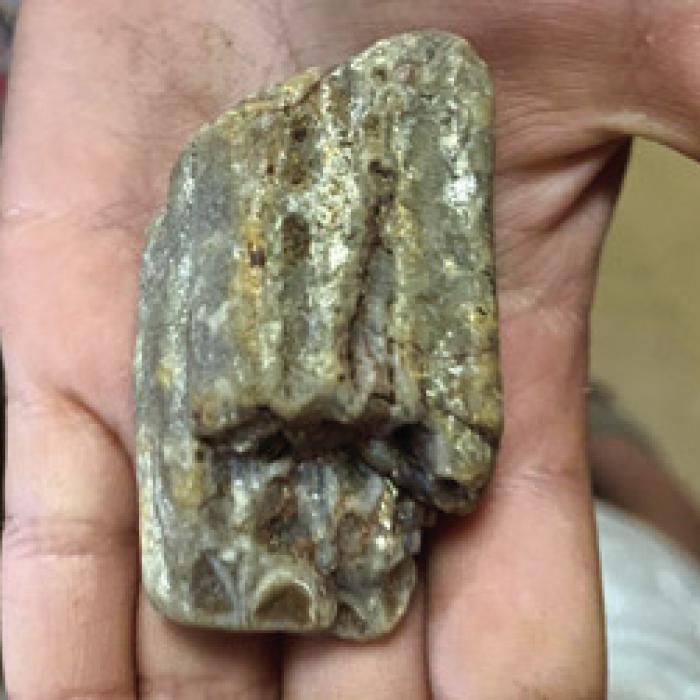
Fossils met Artificial Intelligence in an old gravel pit on my sister’s 60th birthday recently.
What a marvelous convergence of the very old and the very modern.
As a kid one of my fondest pastimes was exploring the old gravel pits in my families’ woods in the Mullins Prairie area.
There, in embankments exposed by the sale of gravel by my grandparents, my siblings and I found all manner of arrowheads – and things far older – fossils of ancient ocean life (from when Texas was covered by an ocean during the Cretaceous period 100 million years ago) and bones we imagined belonged to dinosaurs.
My own kids and my nephews now scour the same gravel pits my siblings and I did.
Recently my sister Wanda, who lives near Conroe, said that she would like to combine her upcoming 60th birthday celebration with a Mothers’ Day weekend picnic back in the woods of her youth.
“Most of my kids and grandkids have never even been to the woods and I thought that would make for a nice family outing for the extended Wick family. I haven’t been to the woods in decades either,” she wrote to everyone in the family as part of the invitation.
It was a great event, even in spite of a unexpected rainstorm that drenched everyone.
We were finding all sorts of interesting arrowhead chips and rocks that looked like fossils.
But who really knows what this rock or that rock from millions of years ago actually was. That was always left up to our imaginations when we were kids.
But not anymore, apparently.
My niece Tess – who in her 20s is far more technologically proficient than I will ever be –- took out her smart phone, and using some sort of ChatGTP software, was IDing rocks like a professional geologist.
The neat-looking rock my grandniece Piper found that I told her looked like a piece of fossilized coral, was in fact a mammoth tooth, Tess’ phone told her after she uploaded a photo of it.
Who knew? I actually never really thought of this area of Texas as a place where mammoths/ mastadons lived. But in some quick research I found out that the Columbian Mammoth, a large, extinct creature roamed Texas (and in fact all over North America and even as far south as Costa Rica) some 2.6 million to 11,700 years ago. They were up to 13 feet tall and weighed up to 20,000 pounds, larger than woolly mammoths, but mostly hairless.
Another rock Tess found that I previously would have labeled merely “interesting” was identified by ChatGPT as a mammoth/mastadon vertebrae.
Another rock that looked like a lump of other rocks, ChatGPT analyzed as a possible “fossilized poop.”
I’m not a big fan of artificial intelligence in most situations. But in this case, it actually enhanced the experience of four generations of Wicks walking around some old gravel pits.
As a kid my imagination always ran wild thinking about how I was walking around in the same woods as Native Americans.
Now, when walking in the woods, we can also think about how we’re strolling around where mammoths used to tread.