

The Record Reader at the Heart of A&M Controversy
Long before Kathleen McElroy was the central figure in a national controversy about the convergence of journalism, diversity and academia, she was just a lady trying to find a copy of The Fayette County Record.
In case you haven’t heard, McElroy is at the heart of a recent scandal that last week resulted in the resignation of the Texas A&M president M. Katherine Banks and the college’s interim dean of Texas A&M’s College of Arts and Sciences, José Luis Bermúdez.
McElroy, is a journalism professor at UT, who last month was hired by TexasA&M to restart its journalism department (students haven’t been able to major in journalism at A&M since 2004). They held a big public signing ceremony for McElroy, as if she were some prized football recruit.
But not everybody was a fan of McElroy’s hiring (some things she had said about the need for greater diversity in newsrooms particularly rubbed some people the wrong way as did her career at the left-leaning New York Times) and after pressure from some alumni groups and members of the administration, the terms of her hire were so amended (from a five year contract to a one-year deal) that she said thanks but no thanks, I’m staying at UT.
The ripple effects of the botched hiring, and how and why it was done, is resulting in A&M getting bashed on national news shows and on newspaper pages across the country.
I’m not really interested in getting into that in this column, but I would like to share some thoughts about McElroy, who is someone I have known for several years – and why specifically it’s such a loss for A&M that she’s not going there.
McElroy is a 1981 Texas A&M grad with a 2014 Ph.D. from UT and has worked everywhere from The National, an all-sports daily, to The New York Times to the Austin American-Statesman.
I first met her at a Texas Press Association event and when she learned that I was from The Fayette County Record, she said she loved our paper and that whenever she was traveling from her home in Austin back to her hometown of Houston, she would stop at the same place in La Grange and buy a copy of The Fayette County Record, and she mentioned the specific store.
At the next year’s convention I told her she would have to find a new place to buy the Record. The owner of that local place where she would buy our newspaper had asked us to remove the rack because we had printed a story about their friend being charged with a crime.
“I noticed,” McElroy told me about the missing rack.
She said she planned to call the business owner to complain.
Not sure if she ever did, but I appreciated her words of support.
In her affiliation with the Texas Press Association, I remember McElroy being a vocal advocate of two things:
• Trying to set up the framework for a two-yearAssociate’s Degree in Journalism at Texas colleges rather than a four-year degree, she said, because it’s frankly too expensive a commitment to pay for four-year college degree and then get a journalism job that often pays barely more than minimum wage. It was driving good potential journalists away from the business.
• Helping to set up a system at UT where young journalism graduates could be hooked up with older owners of community newspapers looking to get out of the business as a sort of work-to-own program to keep small town papers open.
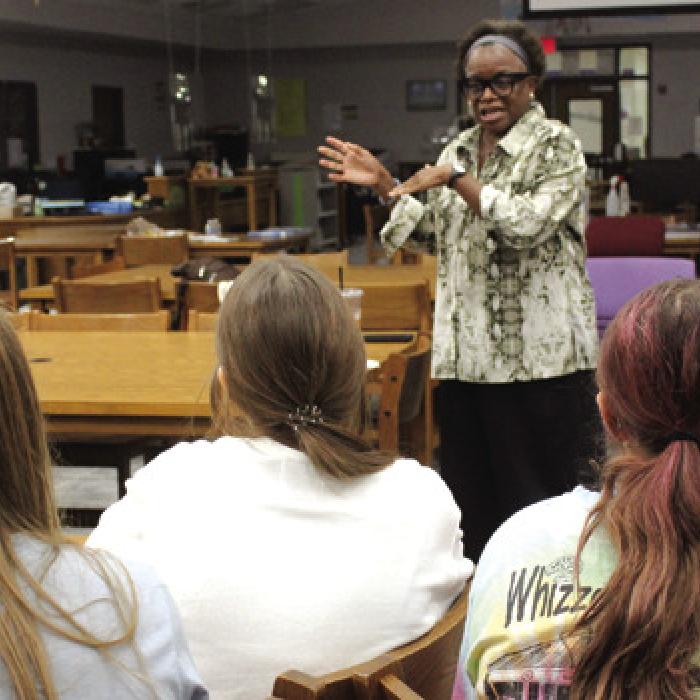
These don’t seem like controversial The next time our paths crossed was last year at the La Grange High School library, when McElroy spent an entire day speaking to journalism and English classes.
I sat in on one of the talks and wrote a story.
She was a really entertaining speaker and kept the kids’ attention as she talked about her adventures in journalism, particularly as the Dining Editor, Deputy Sports Editor and Page 1 editor at The New York Times.
She told the students the fact that she didn’t know how to drive initially led her from her native Houston to New York (because of the public transit). Even traits about yourself that you’re not proud of can lead you on great adventures, she said, so embrace your quirks.
“It’s part of your narrative. The not-driving thing worked for me,” said McElroy, who has since learned to drive.
McElroy tried to impart some aspects of media literacy to the students.
“Know what the good stuff is on here,” McElroy said, holding up a smart phone. “If you don’t know the source of your information, you are part of what’s deteriorating in this country. Know where your information comes from.”
I think McElroy would have been a great asset in restarting the Aggie journalism department – and I’d say that even if she wasn’t a faithful reader of this newspaper.