

Our First Corn Picker
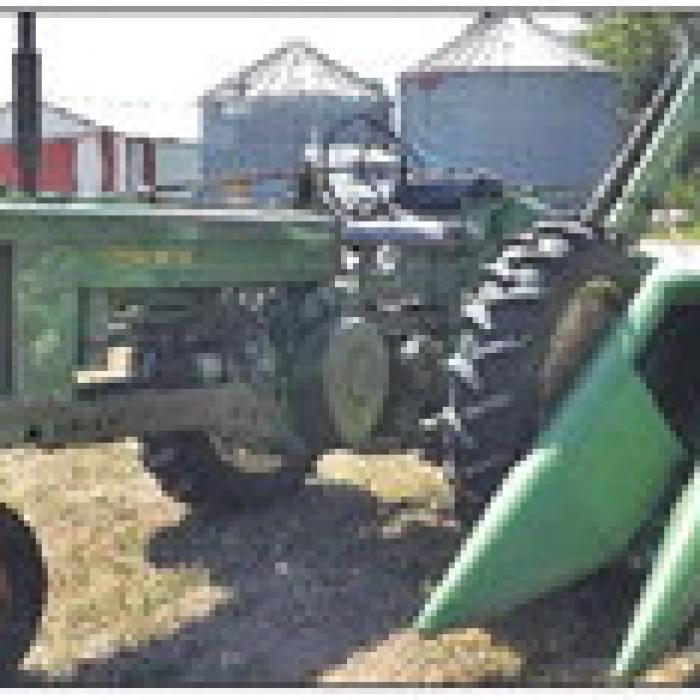

Around 1953 Dad acquired his first corn picker. A God send? Not quite! Up until then, every corn crop was harvested by hand. This involved two mules pulling a wagon row after row after row. As many of us that were available, we broke off or pulled every ear of corn – one at a time and tossing it into the wagon. Later on we used a Farmall Super C tractor to replace the mules.
Now they say that after horse-drawn equipment the more modern equipment came along to lighten the chores for the farmers! Not for our family – at least not as far as I was concerned. The first corn picker of Dad’s was a John Deere “pull behind” model. It was a one row clunker that hooked up to the draw bar and stuck out 6 feet to the side of the tractor. One would then hook up a 16’-4 wheel trailer to this contraption which made the whole setup very wide and very long! (Remember the song: “Give me 40 acres and I’ll turn this rig around”?) Well, imagine turning this picker around in a forty acre patch.
Here’s problem # 1. I mentioned in a previous story how Dad had a very narrow “turning row.” Well, since this side mounted picker took up six feet more than the tractor, that meant as he went from row to row, he knocked down six feet of corn stalks on each row. He also couldn’t turn very sharp so by the time he straightened out, he needed about 20 feet of “turning row.” Before he started harvesting mechanically, we had to physically go and break - by hand - 20 feet of corn on each turn row!
Problem #2: Since this was a one row picker and the tractor was a two row, that meant one row would always be ran over before it got picked. Therefore, we had to go and physically pick two rows of corn every 24 rows or so throughout the whole corn patch. At 10 years old, I always figured we ended up picking half the crop by hand even before he got his mechanical beast in there.
But wait, there’s more! This first model had two long rollers installed in it’s long snout. They would spin real fast towards each other. As the cornstalks were sucked into the spinning rollers, they would pop the ears off and, as they fell backward, they would travel up a metal conveyor belt inside of a chute and be deposited into a trailer being pulled behind. There was no blower on this early model so much of the corn tops with their tassels also wound up with the corn inside the trailer. Dad didn’t care for all that trash as it caused a problem unloading the load. So, what were we to do? For many years we actually harvested these corn tops and stored them either in hay stacks outside or in the barn to be fed to the cattle in the winter months. Over the years we discontinued harvesting the tops because our hay patches got larger and more productive. But to eliminate the trash problem, dad sent us kids to the corn patch and before these corn stalks got dry, he gave us each a large butcher knife. We had to walk every row, one at a time and cut these corn tops off right above the ear letting them fall to the ground. I often wonder if in these days, one could find a 10 year old to go and do this kind of work in the heat of the day. It may not seem like hard work, but try swinging a 12” butcher knife at eye level thousands of times row after row for hundreds of rows. Then there were always the many paper cuts one acquired brushing past the long green leaves rubbing one’s body!
One more problem: sometimes after a heavy rain or heavy wind, the corn stalks would lean over and actually extend into the next row. This caused a problem when that long snout came along. The stalk would get rattled and before the rollers got to the ear of corn, it actually broke off prematurely and fell to the ground.
Now, Dad was from the old school. He wasn’t one to be wasteful. He always said that if he went to the trouble of planting his corn, then he wasn’t about to let perfectly good ears of corn laying on the ground behind his picker and go to waste. So he had me walk behind that trailer and pick up every ear and toss it into that trailer where it belonged. So here we go again! Using “Kid Power” to atone for the misgivings of a machine. Now walking behind that trailer row after single row wasn’t much fun. It got pretty tiresome! I even tied a 10 foot rope to that trailer with a large knot on the end and while holding on to that rope, I let it pull me along. That helped some but still pretty tiring. Then I got the bright idea of building a small sled with 2×6 runners. It was just big enough for me to kneel on. I’d hold on to that sled with one hand and with the other hand, would pick up those ears of corn and toss them into the trailer in front of me. Now once the broken off ears got too numerous for me to keep up with, that sled and “walking behind” idea was abandoned! We just had to cover the whole field taking four or six rows at a time using a tractor and another trailer after the patch was harvested. Whatever method we used, it was up to my brothers and sister and me to make sure there were no ears of corn left on the ground. When dad finally shredded the corn stalks, if there were any ears left behind, you can be sure we heard about it!
In the years following, dad replaced that green clunker with a brand new International Harvester corn snapper. This was a much improved machine taking two rows at a time. This enabled dad to turn into any row without running over any stalks. It was mounted on the tractor with one snout on each side making it much easier to maneuver.
By this time, I was much older and strong enough to unload the trailer with my older brother, George, while dad was loading another trailer in the patch. Of course we were expected to have the trailer unloaded and waiting for him by the time he finished loading his!