

No-Work Gardening
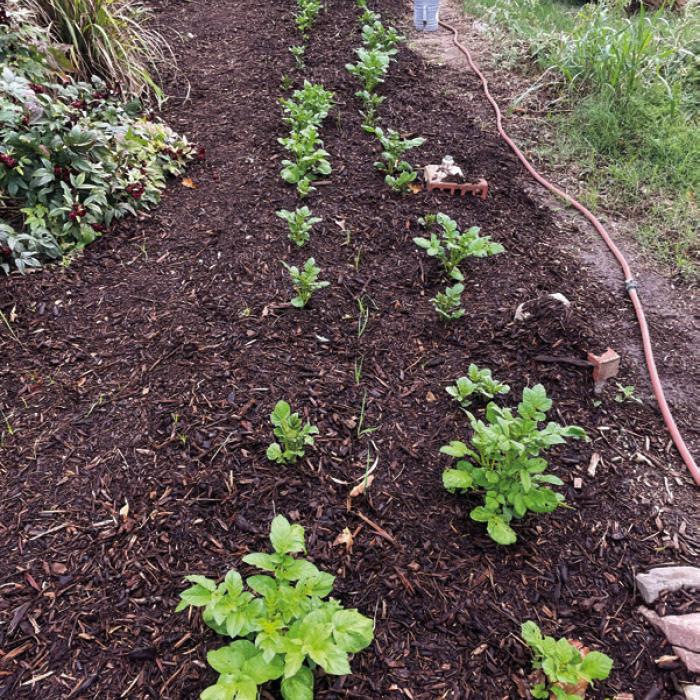

As the season changes, lots of us need to protect some plants from the cold. Of course we can move our potted plants into a warm garage or greenhouse. And we can always cover our tender ground plants with plastic or cloth sheets during cold periods.
I’m growing some fall potatoes right now. I planted them in late September, and they’ll probably need at least another 45 days to produce a decent crop. Potatoes can usually survive a light frost. But if the weatherman says a hard frost is coming between now and late December, I’ll need to protect them. I have a couple of options. I could set up some hoops and cover the row with plastic. Better yet, I could follow the advice of Ruth Stout, the venerable American green thumb who pioneered the thick-mulch method of gardening.
In the spring of 1944, as the story goes, Stout, then around 60 years old, got tired of waiting on the ploughman to till her garden. And she didn’t feel like tilling it herself. So she decided to try an experiment. She sprinkled some seeds directly on top of the soil and covered it with mulch. She used hay for mulch. To her surprise, the seeds not only sprouted but thrived. She continued to develop this method, which she called “No-Work Gardening,” and wrote several books about it. She was certainly not the first person to ever use mulch in their vegetable gardens, but she seems to be one of the first gardeners to write extensively about it.
Potatoes respond exceptionally well to the Ruth Stout method. And if you are growing them this time of year, the layer of thick mulch can protect the foliage from a frost.
Farmers and gardeners have long known that “hilling- up” potatoes protects the tubers from sunlight, which turns them green and inedible. It may also encourage the plants to produce more tubers. Hilling-up potatoes involves covering the plants with soil as they emerge from the ground. Stout did the same thing, but instead of soil, she used mulch.
I usually shy away from using locally-produced hay for mulch. Most local hay is produced from fields that have been sprayed with broadleaf herbicides, and the residue can harm garden plants. I have used compost in the past to hill-up potatoes, with good results. But right now, I have a pretty big pile of wood mulch from the Fayette County Recycling Center. I’m going to try using it.
In addition, I still have a few peppers, eggplants and tomatoes growing in the garden and around our porch. Cooler weather in the last few weeks really kicked them back into production. The tomatoes are loaded with green fruit right now. These plants have grown quite large, and I’d have to build a sturdy greenhouse to effectively protect them. I know I will eventually lose them to the cold. But I want to protect them as long as possible.
You might be in the same situation. Liquid seaweed extract applied every two weeks can help plants survive a few degrees of freezing temperatures. Frost kills plants by freezing the water inside the plant cells. The water turns into sharp ice crystals, which puncture cell walls and kills the cells, eventually leading to plant death. Compounds in the liquid seaweed extract act sort of like antifreeze by slightly lowering the freezing point of the liquid inside the cells. Some gardeners claim it provides two degrees or more of frost protection.
If you’re still growing some tomatoes, peppers and eggplants this fall, you might want to start spraying them with liquid seaweed. I apply it at a rate of at least two ounces per gallon of water. Mix it in a pump-up sprayer. Apply it to all of your plants in the garden – it contains all sorts of micronutrients. Be sure to spray all of the plant – the stems and under the leaves as well – to a heavy drip. Reapply every two weeks.