

Gardening Patience Rewarded With Roselle

Gardening often involves a lot of patience, as I learned recently with my roselle plants.
Roselle ( Hibiscus sabdariffa), as its scientific name implies, is a member of the hibiscus family, and as such are distantly related to okra and cotton. Roselle shares some interesting characteristics with okra and cotton as well.
All of these plants are native to the tropical and subtropical regions of the Old World, and they are all widely grown in Africa. Okra and roselle, in particular, are likely native to Africa, though all three crops seem to have been grown in the Middle East and Asia since antiquity. It’s probably not a coincidence that all three of these plants became staples in the American South during the time of slavery.
For whatever reason, okra and cotton are much more well-known than roselle here in Texas. But in other places of the South, roselle is a common garden plant. It’s sometimes called “Georgia Cranberry” due to the pleasant tartness of the plant’s calyxes and fruit.
I planted a variety called “Thai red” roselle back in the spring. I directly seeded it into the garden. As I recall, the seedlings emerged after a few days. But then it took forever to grow. Early on, I neglected them to the point where they became overwhelmed with weeds. I cleaned up the bed and watched them grow – at a snail’s pace – for months on end.
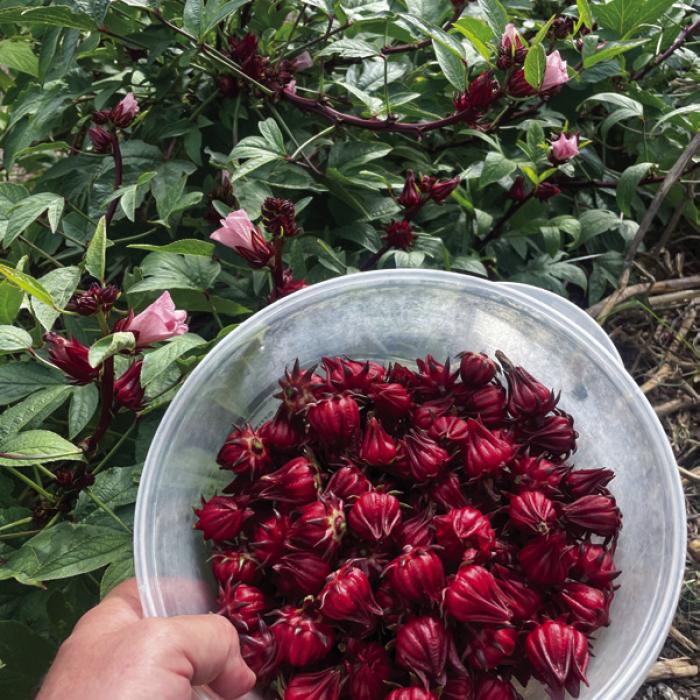
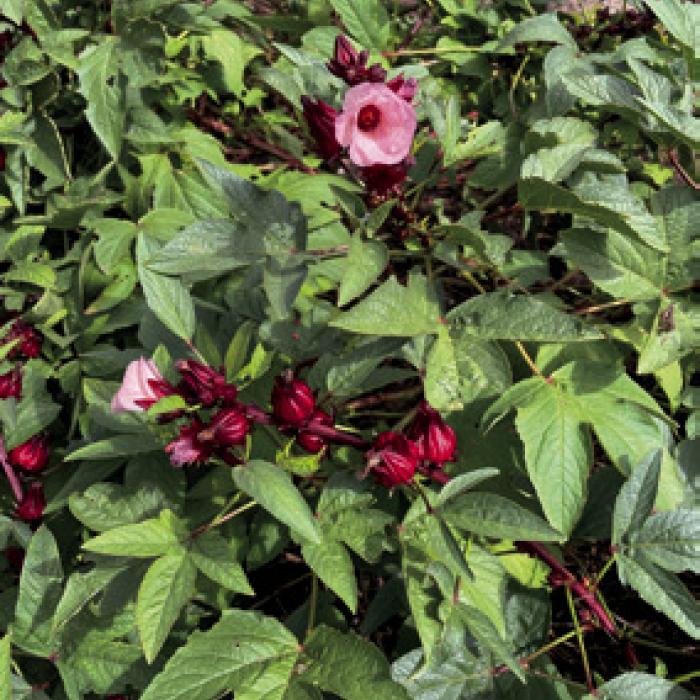
I didn’t think they would ever bloom and make fruit. I even forgot to water them for a while during the peak of the drought this summer. I was about to give up on them. Then in August I noticed a little growth spurt. Their stems started to take on a crimson hue. All of a sudden, about two weeks ago, they began flowering. Now the stems are loaded with fruit.
And the flowers are beautiful. They resemble an okra flower, but they’re pale pink in color. They don’t really have a scent. But what they lack in smell, they make up for in copious blooms. Unlike an okra, which flowers and fruits from a terminal bud at the end of a stem, the roselle flowers all along the length of the stem. The flower eventually drops from the fleshy red calyx and a fruit emerges inside, usually about one inch in diameter. I cut my first harvest this week.
Some gardeners recommend growing these plants in a raised bed, and I can see why. This time of year, when the stems are loaded with flowers and fruit, they tend to droop and touch the ground. The fruits can get dirty and rot, or get eaten by insects.
You’ll need more than one or two plants for a decent harvest. I have five growing, but I think seven is a better number. Try to plant them about a foot or two apart because they can get quite big. But some of mine are only six inches apart and they are growing fine.
From what I understand, roselle often fruits in two “flushes,” with the second flush producing much more than the first.
People around the world use roselle in a variety of ways. You can steep the calyxes in hot water to make a tea. You can also boil the calyxes in water and mix the resulting juice with orange juice, lemon juice and honey for a refreshing summer time drink. Some people make wine out of roselle. Dehydrate the calyxes to use them anytime in teas or drinks.
The dehydrated seed pods supposedly taste like sunflower seeds, but I’ve never tried them this way.
You can also make roselle jam. Place the roselle calyxes and fruit into a pot with water. Use just enough water so that the roselle is not completely covered. Boil for about 30 minutes. The seed pods contain a lot of natural pectin, so you don’t need to add any. Strain and measure the juice. Add the same amount of sugar to the strained juice and return it to the stove. Simmer it until it gets thick. You can use the “plate test” to determine the proper thickness. Spoon some of the jam onto a ceramic plate.Allow it to cool and tilt the plate. If the jam spreads on the plate, cook it a little longer. When it’s thick enough, it will no longer spread or “run” on a tilted plate.
Then ladle the jam into clean mason jars leaving one inch of headspace. Place a lid on the jars and twist the rings until they are just finger tight. Boil the jars in a water bath for 10 minutes. Take the jars out of the water bath to cool. Check the lids to make sure they are sealed before storing in the pantry.
In Southeast Asia, the young tender leaves of the roselle plant are cooked and eaten as a vegetable, especially in Burmese cooking. The Burmese call it “Chin Baung Ywet,” which literally means “sour leaf.” Try stir frying them with garlic, hot chilies, shrimp and bamboo shoots – a dish known as “Chin Baung Kyaw.” The Burmese also add the leaves to a variety of soups.