


La Grange Girl Scouting History
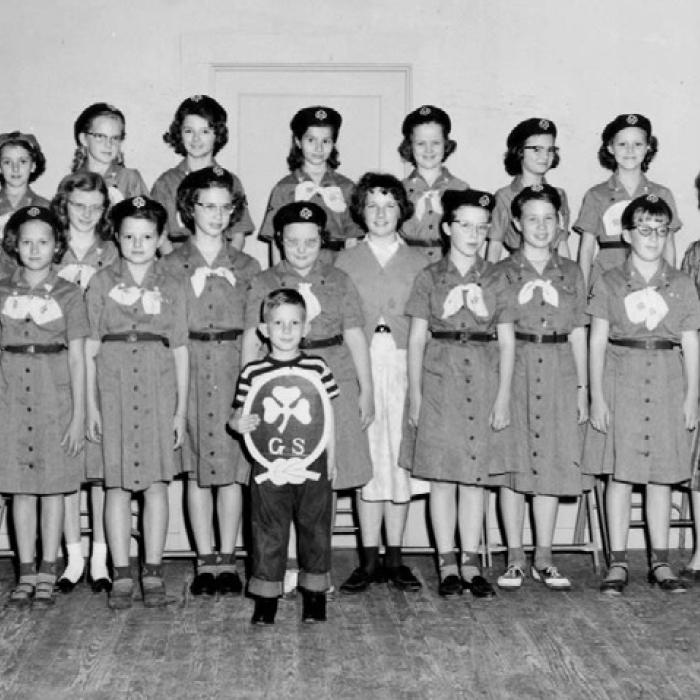
Juliette “Daisy” Gordon Low founded Girl Scouts in 1912 in Savannah, Georgia. At a time when women in the United States could not yet vote and were expected to stick to strict social norms, encouraging girls to embrace their unique strengths and create their own opportunities was game-changing. By October 1937 six La Grange girls - Marjorie Logan, Isabel Palmer, Sue Jane McCollum, Doloris Patton, Helen Hausler, and Lucia Logan - were already Girl Scouts but no local troops had been formed, so Lucille Duff and Johanna Walling invited interested girls between the ages of 10 and 18 to an informational meeting. The first official meeting of the Girl Scouts of La Grange was held on October 13, 1937. The Girl Scout Troop Committee members were elected, and two troops were formed with 19 girls in the High School troop and 20 girls in the Grammar School troop. Sponsors were the Lions Club and the American Legion Auxiliary. The La Grange City Council provided a meeting space in a corner room of City Hall.
Less than two weeks after forming, the troops undertook their first activity when twenty-three scouts hiked along Cedar Creek. In less that a year, an investiture ceremony was held where the girls were awarded their tenderfoot pins.
In the summer of 1939, the scouts held their first overnight camp, “Camp Juliette Low,” on the bank of the Colorado River near Plum.
By May 1940 the first Brownie troop was organized with 14 members, and as the organization continued to grow, the Troop Committee began seeking a site for a new home.
During the War years, the La Grange Girl Scouts participated in a “Molly Pitcher Day” sale of War Stamps and Bonds raising over $3,700. They also served as nurses’ aides at the La Grange Hospital and worked with the Red Cross by knitting Afghan squares, making baby blankets, and folding blankets.
Prominent citizen William Hermes offered a plot of land adjoining the La Grange Public School grounds along with $1,100 towards securing a Scout House. On January 6, 1947, Mr. Hermes, with admiration for and towards the La Grange Girl Scouts, their aims and objectives, deeded to Trustees Alfred R. Ehlers, Myrta Hermes, and Miles L. Moss, and their successor trustees, 0.63 acres of land at the corner of Milam and Vail streets. The property was held in trust with four conditions: 1. Property for the use and benefit of the La Grange Girl Scouts, and such local Girl Scout groups only, as a meeting place. 2. If they should stop using the premises for their meeting place within 10 years the property would revert to Mr. Hermes. 3. If within 10 years they ceased to use the property, they would have the right to remove any buildings or structures placed by them. 4. The number of trustees shall be kept at three. Whenever a vacancy arose, the surviving or acting trustees would appoint a person in their judgment suitable to act as a trustee via an instrument recorded in the Office of the Fayette County Clerk.
In 1949 Mr. Hermes purchased a building from Camp Swift at Bastrop and Dr. L. D. Boelsche paid to have it moved to the deeded lot. The Lions Club sponsored a fund drive to raise $2,000 to lay a foundation, provide utilities, equip a kitchen, and other things needed to complete the building. By March 1951 the work was done, and the La Grange Girl Scouts had a new forever home. Their first public event was a Games Party.
The La Grange troops started selling Girl Scout cookies in 1952 with three options: Peanut Butter Sandwich (Do-sidos), Shortbread (Trefoils), and Chocolate Mints (now Thin Mints).
The La Grange Girl Scouts celebrated their 25th anniversary in 1962 with a tea at the Scout Hut. It was believed that over a thousand girls had been scouts during that quarter of a century.
By the late 1970s there were 67 girls in two Brownie Troops, three Junior Troops, and one Cadette Troop. Twentyfour adults also participated.
The 75th Anniversary of Scouting was celebrated in 1987 with a Promise Circle and recitation of the Pledge on the front lawn of the hut. There were 97 girls and 22 adults participating in local troops.
Scout Megan Collier received the Girl Scout Gold Award in 2004, the highest level in Girl Scouting. Her community project was painting a mural at the La Grange City Pool depicting sea life in vivid color and realism.
Over the decades the Girl Scout hut has been maintained by the La Grange Girls Scouts with a lot of financial and sweat equity support from the community. One of the last major renovations was completed in 2006, a nearly $20,000 project that was funded by Sanford Schmid, The Texas Women’s League, and Betty Bauer, along with many smaller contributions from businesses and individuals. The La Grange Rotary Club racked up 126 volunteer hours painting the building while other service organizations and individuals pitched in another 95 volunteer hours to complete the work. Of the total amount raised, less than a third came from the state council. A gazebo was donated by the Shimek family and moved to the grounds by John Kana in 2007.
Generations of girls, their families, and our community continue to support and participate in the activities of the La Grange Girl Scouts. They hope to continue the journey and as the Girl Scout law says, “I will do my best to be honest and fair.”
Sources: La Grange Girl Scout Minutes 1937-- 197.
Troop scrapbooks.
La Grange Journal newspapers 9-30-1937, 10-28-1937, 2-17-1938, 8-19-1938, 6-5-1941,10-11-1962, Fayette County Record 9-30-1949 Fayette County Deed Records Vol. 207, Pg. 311-313 https://www.history.com/articles/thegirl- scout-cookie-a-delicious-tradition.) https://www.girlscouts.org/en/discover/ about-us/history.html
Footprints Of Fayette
Fayette County is one of the most historic counties in Texas. In this weekly feature from the County Historical Commission, a rotating group of writers looks back at local history.