


Before the Randolph School, 1903-1934
Footprints Of Fayette
Fayette County is one of the most historic counties in Texas. In this weekly feature from the County Historical Commission, a rotating group of writers looks back at local history.
On Saturday morning, February 7, 1903, the “little red schoolhouse on the hill” was destroyed by fire, forcing young African Americans in La Grange to study at the local Baptist Church. The following Monday a committee consisting of H. Wagner, Will McKinney and I. Rosenthal was appointed by Mayor Robert Sample to buy a lot for a new school. On February 16, 1903, a special meeting was called and Mayor Sample appointed a Building and Ground committee.
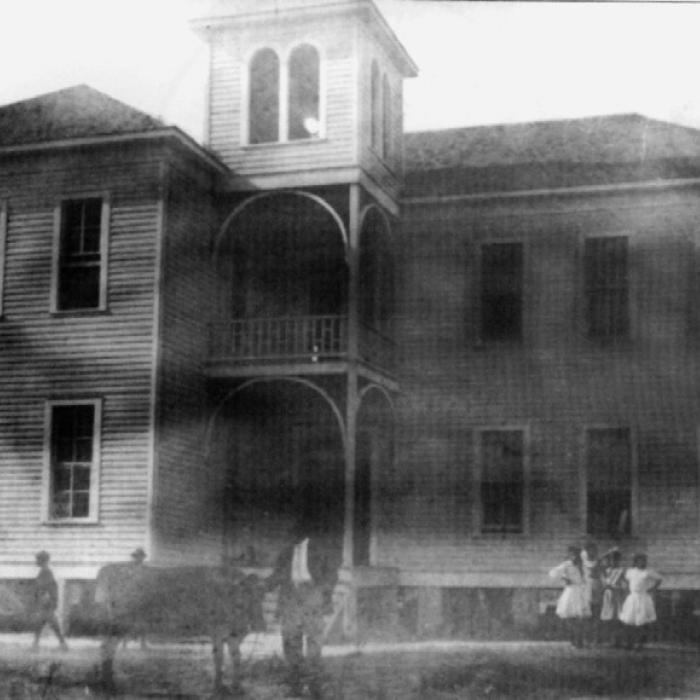
In a deed signed on June 22, the Town of La Grange swapped the two lots in Block 512 of the Faison and Ligon addition, where the school had burned, for four lots in Farm Block 36 of the original town tract of La Grange owned by John Schuhmacher and H. B. Kaulbach. This new tract spread from East Pearl Street to Camp Street. Joseph Ehlinger drew the building plans that were selected. They called for a two-story frame building with four rooms, an auditorium, two halls, and a porch at each entrance. Wilhelm Letzerich and Ferdinand Schulze won the construction bid, signing a contract on July 1, 1903. This may be one of the first times the school for African-American students was referred to as a high school.
The schoolhouse was erected by the city for $2,000 and contained $500 worth of property like desks and stoves. According to the October 25, 1906, La Grange Journal, the insurance was $60 per year, which was a burden to the school board because the city had withdrawn support even though the city held the deeds. The new school building was located at the site of the current Randolph Recreation Center. However, it sat farther back from Pearl Street.
Mrs. L. E. Moore, a longtime teacher at the school, later stated that this is when the school term was extended to nine months, which gave each teacher more instruction time—albeit, without a salary raise. She continued, saying Prof. A. R. Jefferson was the school principal when the first graduates received diplomas given by the school board.
The June 6, 1907, La Grange Journal reported that state laws required white and colored schools be maintained for the same length of time.Article 7, Section 7 of the State Constitution: “Separate schools shall be provided for white and colored children.” The same article mentioned that the La Grange school was an independent district school, and the boundary limit of the school was the boundary lines for the city of La Grange.
Newspaper reports were sporadic, but the June 10, 1909, La Grange Journal reported there were 195 students attending the last term and 177 attending the current term. Despite those numbers, in those early years the number of students who managed to stay in school long enough to graduate was low. For instance, the Class of 1914 graduation booklet for the La Grange Negro High School showed only three graduates: Susie V. Grant, Mary Price, and Sallie Williams.
Professor G. A. Randolph became principal of the school in 1910, at which time the faculty consisted of the principal and three or four teachers. According to Mrs. Moore, Professor Randolph had been inspired by the work of Booker T. Washington and set about making productive changes. For instance, he was able to secure water mains connected to the school, instead of having to rely on water pumped from a well. Local black citizens pitched in $50 to make that project a reality. Even more important, Randolph promoted industrial education, a relatively new concept. Clubs were formed to learn skills for making things like furniture, bricks, and clothing. The Mothers’ Club placed the first sewing machine in the school.
Eventually, the boys’ industrial clubs became known as the Manual Training Department, fitted with the appropriate equipment. The girls’ industrial club became a well-equipped Home Economics Department. Emmett Randolph, the first African American Farm Demonstration Agent appointed in Fayette County, was a graduate of the La Grange Negro High School and Mrs. Moore stated the school could point to numerous other graduates who had gone on to become teachers, doctors, dentists, and other prominent professions.
The graduation rate steadily grew as illustrated by the 1933 ceremony held in Ebenezer Baptist Church with ten graduates: Lawrence Marion Sims, Troy Williams, Julia Vastie Taylor, Blanche Eveline Mazon, James Alfred Ford, Velva Mae Williams, Ruby Louise Poole, Susie Mae Ulrich, Ruby Moore McKenzie, and Cleopatria Palmer.
In 1933, the Texas Department of Education designated the “negro school at La Grange” as a “training school” for Fayette County, which meant it would serve as a high school for the African American youth of the entire county. This set the stage for the construction of a more substantial school, which was to be built at the same location. When work began in March 1934, the two-story schoolhouse was razed and classes met in the nearby parsonage, as well as in the Knights of Pythias lodge hall just west of the school, for the remainder of the term.
Sources: Fayette County Deed Records, Volume 74, p 79 [6/27/1903, John H. Schuhmacher and H. B. Kaulbach to City of La Grange, 4 lots in Moore Farm Block 36] “Lest We Forget: History of the La Grange Negro High School—1934,” La Grange Journal, September 25, 1941, page 7, containing a manuscript written by Louise E. Schermack Moore for the 1934 dedication of the new brick school building that currently serves as the Randolph Recreation Center.
Sanborn maps, 1914 and 1933 La Grange Negro High School graduation program, newspaper clippings, and July 1903 building contract in files of Fayette Heritage Museum and Archives, La Grange, TX