


Going for the Marigold

Marigolds are some of the easiest flowers to grow. Most folks are familiar with French marigolds ( Tagetes patula) – the short-statured varieties with orange or yellow double- bloom flowers that come in a variety of color patterns. These grow well in pots or in the ground.
There are several other species of marigolds. One of the more famous are signet marigolds ( Tagetes tenuifolia), which grow up to 20 inches tall with lots of small, single-bloom flowers.
Then there are the Mexican mint marigolds ( Tagetes lucida), a valuable herb that grows well in Texas. These plants produce small yellow flowers. More importantly, their leaves taste like tarragon. True French tarragon cannot grow in Texas. Some folks opt for its cousin, Russian tarragon, but this herb loses its flavor and becomes quite brushy in the heat. Mexican mint marigold is the only reliable tarragon-flavored herb that we can grow here.
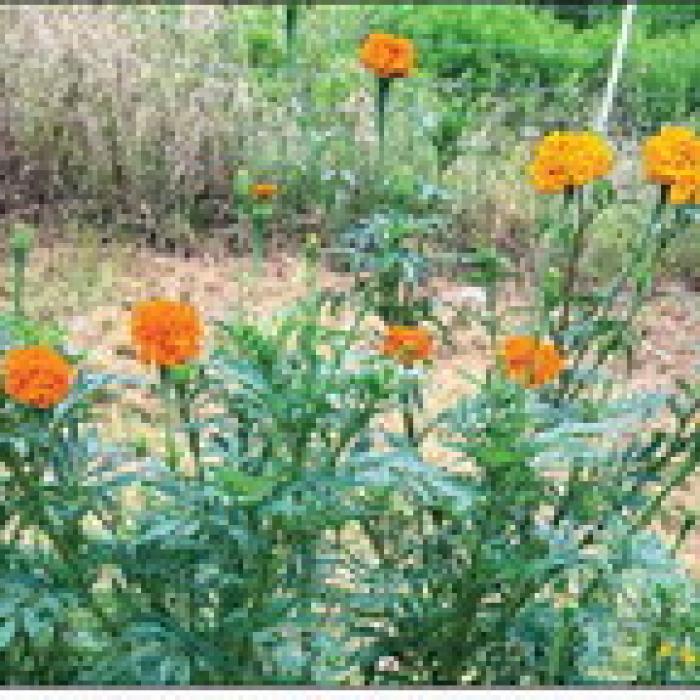
This year, I’m growing another marigold species in my garden – African marigolds ( Tagetes erecta). As the scientific name implies, these marigolds grow quite tall. Mine have gotten about three and a half feet tall. And their flowers are huge – about four inches in diameter.
Marigolds have an interesting history. Despite the names “French” marigolds and “African” marigolds, they’re all native to Mexico. The French and African names seem to be the result of trade patterns during the age of sail. Portuguese traders apparently passed these plants through ports in Africa on their way from the New World to Europe.
In Mexico, the flowers of African marigolds are used in the famous Day of the Dead displays.
My dad, Kenneth Behlen of Schulenburg, found some African marigold seeds and started them in his greenhouse during the late winter. He gave me a bunch of transplants back in the spring, and I planted them in clumps around the edges of my vegetable garden. They’re now exploding in color.
Marigolds of all types are said to be good companion plants. Some folks believe the strong scent of their foliage repels pests like whiteflies, aphids and nematodes. There’s not a lot of scientific evidence to back up those claims. There is some scientific literature that suggests they repel nematodes. But as for the other pests, the evidence is less conclusive. Nonetheless, gardeners have planted them among crops for centuries.
I really love the look of marigolds in the garden. They tend to flop over when they get really tall. You can stake them. But I’ve noticed that the plants grow adventitious roots along the stem when it touches the ground. Soon enough, the plant sends up new shoots that reach three feet tall with even more blooms. Just give them some space. I’ve been saving the spent flowers to plant a solid border around my garden next year.
Unfortunately, most nurseries and garden centers don’t sell African marigold plants. That’s probably because they get so large and unwieldy. French marigolds are much more suitable for container growing. If you want to grow African marigolds, you’ll probably have to plant them from seed. Thankfully, they’re very easy to grow. Just sprinkle some on the ground and water them in. You don’t really need to even cover them with soil.