


Get to Know the Heat-Loving Mexican Petunia – At Your Own Risk
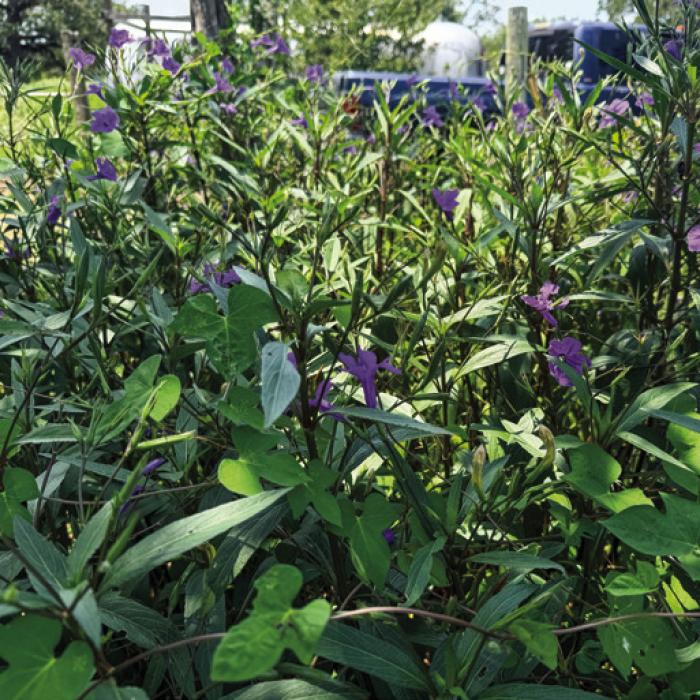

Last week I wrote about summer gardening depression and how a few hardy shrubs are helping to keep the blues away. That got me thinking about some other heat-loving plants growing around my place. Now, I’m not necessarily suggesting that anyone grow this plant I’m about to write about. It’s quite invasive. If you plant it, give it a space and just know that it’ll probably spread and you’ll never get rid of it. But it is quite beautiful this time of year.
I’m talking about Mexican petunia ( Ruellia simplex).
At maturity, the plant sends up shoots about three feet tall. They’re speckled in purple blooms this time of year.
I used to work with Mrs. Jo Ann Mueller here at the Record before she retired. Several years ago, she gave me some cuttings from a Mexican petunia. I recall her warning me at the time about the plant’s propensity to spread. Boy, was she right.
I planted it in a flower bed in our yard. It had a mix of ornamental sages in it. Today, Mexican petunias have nearly taken it over. The plant spreads by rigorous rhizome shoots. A metal or plastic barrier buried a few inches into the soil will keep the rhizomes contained. Our flower bed is bordered by old blocks of limestone that have sunk into the ground a few feet. It does a fairly good job of keeping the Mexican petunias inside.
However, the flower heads turn into an exploding pod that will scatter seed many feet in all directions. Every spring, I find a few solitary shoots growing in the yard, sometimes 20-plus feet away from the Mexican petunia patch.
It has now taken over a second flower bed.
Regular mowing seems to kill it eventually. But once established in a bed, it’s probably not going away.
It has survived temperatures as low as the teens, snow and ice storms, and the scorching heat of summer. Supposedly it prefers moist environments. I never water it, and it thrives. If you have an area surrounded by concrete or a gravel driveway, it could make a nice filler. But don’t say I didn’t warn you.