


120 Years in America (1904-2024)
The Martin and Rosalie Hodulak Prihoda Immigration Story
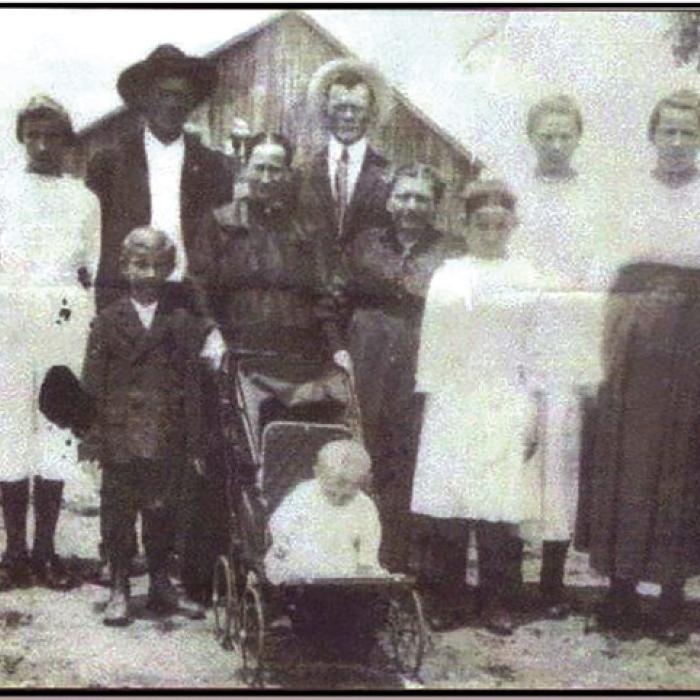
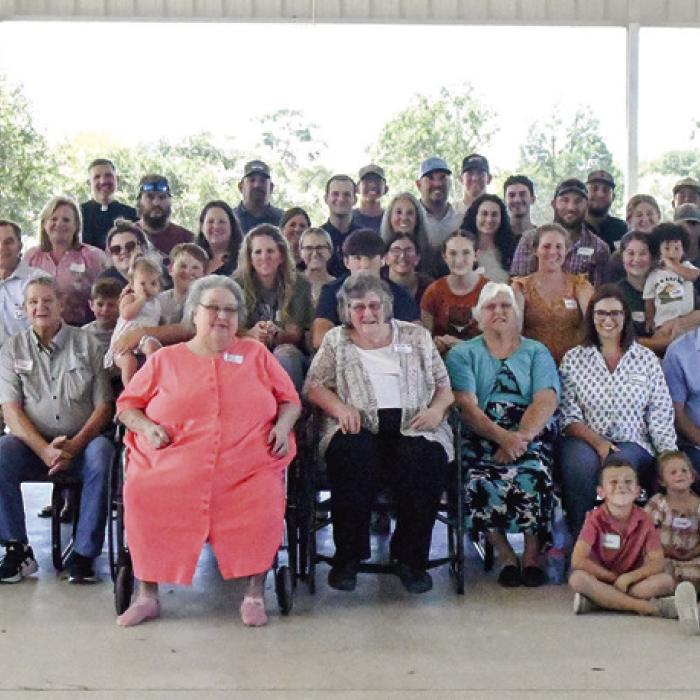
(Left to right): Anne, Martin, William (in front of Martin), Rosalie with Frank in the stroller, man and woman who were neighbors, Agnes, Mary, and Rosie. The photo was taken at the funeral of their son, Joseph, in 1920. Descendants of Martin and Rosalie Prihoda gathered at their family reunion on Sunday, September 29, in Plum, to celebrate their 120th anniversary in America. Starting in groups from left side: the descendants from Mary Prihoda Sedlacek include the Zbranek, Palla, Zigal, Wostarek and Howell families; from Agnes Prihoda Zaeske include the Zaeske, Koll, and Wenck families; from William Prihoda include the Prihoda, Meysembourg, Mendel, Roger, Ahrens, Southerland, and Norrell families; and from Frank Prihoda include the Kneupper and Schmedding families.
Martin Prihoda (1872-1923) and Rosalie Hodulak (1873-1962) were both natives of Nový Hrozenkov in Moravia, a historical region in Central Europe. At the time of their immigration, Moravia was part of the Austro-Hungarian Empire. Martin married Rosalie Hodulak around 1897 in Moravia and they had three children there, Joseph, Mary, and Rosalie. We do not know the exact reasons why Martin decided to immigrate to America, but Bohemians and Moravians started immigrating as early as 1848 as they fled to the United States to escape political persecution by the Habsburgs. Another large wave of Bohemian migration occurred in the late 1800s and early 1900s, when Midwestern farmland was widely available at low prices. Whatever the cause, Martin’s sister, Mary Prihoda Sira, immigrated with her husband Vincenc Sira and daughter Ludmila in August 1904, settling in Fayetteville. Martin’s family, along with his sister Francis Prihoda, followed soon after in November 1904.
The following is an edited narrative of Martin and Rosalie’s journey from Europe to America. Originally documented in Bohemian by (cousin) Frances A. Prihoda, the daughter of Martin’s sister, (Aunt) Frances, the account was subsequently translated into English by Agnes (Prihoda) Zaeske, a daughter of Martin and Rosalie. The English translation was edited by Agnes’ son, Louise W. Zaeske Jr., and again by Michele Prihoda as part of the family history project.
The Voyage: Martin and Rosalie Prihoda, accompanied by their three children Joseph (6 years old), Mary (4 years old), and 2-year-old Rosalie (Rosie), departed from their home in Novy Hrozenkov, Austria-Hungary at midnight on November 8, 1904. They were joined by Martin’s sister, Aunt Frances Prihoda, and her two children, cousin Frances (11 years and 8 months old) and Henrietta (7 months old). Their journey commenced with a wagon ride to Vsetin, located in Northeastern Moravia, near the border of Moravia and Slovakia, which served as their county seat. From there, they embarked on a two-day, two-night train journey to the German Bremen Harbor. They spent two days in Bremen being vaccinated against diseases such as measles and waiting for the ship to be loaded.
The large vessel, named the Hannover, accommodated a substantial cargo and approximately 3,000 passengers. On November 12, 1904, the ship departed from Bremen Harbor bound for America with Martin and his companions assigned to the third deck. During the third day at sea, they encountered a severe storm, navigating what they believed to be the eye of the storm, causing the vast ship to dance on the water. Fearing for their lives, the passengers united in prayer and hymns.
The crew prohibited children from playing on the deck. Heavy fog led the ship off course, yet miraculously, they survived. Every day a limited number of individuals were permitted on the deck for fresh air. The quality of food on the ship was not good. Upon reaching New York, amidst snowy conditions, the ship could not dock at the port due to insufficient water depth.
Over the next two days all passengers destined for New York were transferred to smaller vessels to continue their journey - many sought employment in local factories – and the ship’s doctor was changed out. Finally, the ship continued its voyage to Galveston. With fewer passengers, the food improved. After five additional days at sea, Martin and his group arrived in Galveston on December 12, 1904, where they found the weather to be really warm.
Rosalie and her daughter, Rosie, along with Aunt Frances and her daughter, Henrietta, were taken to a hospital and put under quarantine because the girls had the measles. The hospital staff included Catholic nuns and a German agent named Karez Stacky. Martin, Joseph, Mary, and cousin Frances left for Fayetteville by train and arrived early in the morning.
Martin left his group at the railroad station while he walked downtown to see if he could find someone he knew. He was lucky, the first person he met was Mrs. John (Jan) Kovar from Bordovic in Austria- Hungary; they knew each other. She also knew Martin’s sister, Mrs. Vincenc (Mary) Sira, and where they lived. Mrs. Kovar took Martin in her hack (a two-seated buggy) to pick up his group at the station and take them to Mrs. Sira’s house. About two days before Christmas, Rosalie and Rosie arrived by train in Fayetteville late in the evening and had to spend the night in the railroad station. The next morning Martin came and took them to Sira’s for Christmas Eve. Aunt Frances and Henrietta arrived on New Year’s Day and a man by the name of Joseph Malik brought them to Sira’s home. After a few days, Martin and his family moved on to Plum, while Aunt Frances, cousin Frances, and Henrietta stayed in Fayetteville. Martin found a job in Plum as a day laborer. As payment, he received a house to live in and 60¢ a day. He milked cows early in the morning and at night. The days were long, but the people he worked for were nice. Every evening the lady would give Martin a bucket full of milk and some freshly baked food, like bread, sweet rolls, or doughnuts to take home to his children. Aunt Frances did not know the name of the family he worked for. This is the end of cousin Frances’ account of the voyage.
Once settled in Plum, Martin and Rosalie (Generation 1 in America) had four more surviving children - Annie born in 1905,Agnes born in 1910, William born in 1913, and Frank born in 1918. Additionally, there are four unnamed children who died at birth buried in the old Plum Cemetery. In June 1923, Martin was kicked in the head by a mule and died a short while after the accident. Rosalie went to live with her daughter, Rosie Zapalac, in Smithville until she died at the age of 88 years in 1962. Martin and Rosalie are buried in the Sts. Peter and Paul Catholic Cemetery in Plum.
The six children of Martin and Rosalie making up Generation 2 in America were:
• Joseph Prihoda (18981920), the oldest child, who immigrated with his parents, died at the age of 22 in March 1920 of a burst appendix. He was not married and did not have children before his death.
• Mary B. Prihoda (18991985), immigrated with her parents. She married Joseph Sedlacek (1892-1935) on September 21, 1926, and they had five children: Agritina, Mary (Zbranek), Joseph, Martha (Palla), and Annie (Wostarek).
• Rosalie Martha Prihoda (1902-1994) immigrated with her parents. Rosie married Willie Zapalac (1899-1938) in 1923, and they had three sons: Johnny, Willie, and Adolph.
• Annie Prihoda (19051997) was the first child born in America. She never married.
• Agnes Veronica Prihoda (1910-1999) was born in West Point. She married Louis W. Zaeske Sr. (1906-1991) on January 16, 1941, and they had one child, Louis Jr.
• William Louis Prihoda (1913-1989) was born in West Point. William married Mary B. Srubar (1915-1998) on May 6, 1941, and they had five children: James, William Jr., Johnny, Raymond, and Dorothy (Bacak).
• Frank John Prihoda (1918-1982) was also born in West Point. He married Edith Srubar (1926-2014) on April 15, 1947, and they had two children: Barbara (Kneupper) and Patricia (Schmedding).
The family has since grown to six generations in America. The family meets in Plum every September for the Martin and Rosalie Family Reunion. This year they met on September 29, 2024, with over 60 descendants attending. The day began with a Mass at Sts. Peter and Paul Catholic Church with intentions for the living and deceased members of the family, followed by a visit to the cemetery to place flowers on family graves, a potluck lunch at the church hall, and time to reminisce and socialize.