


The Work of Destruction in Fayette County, 1909
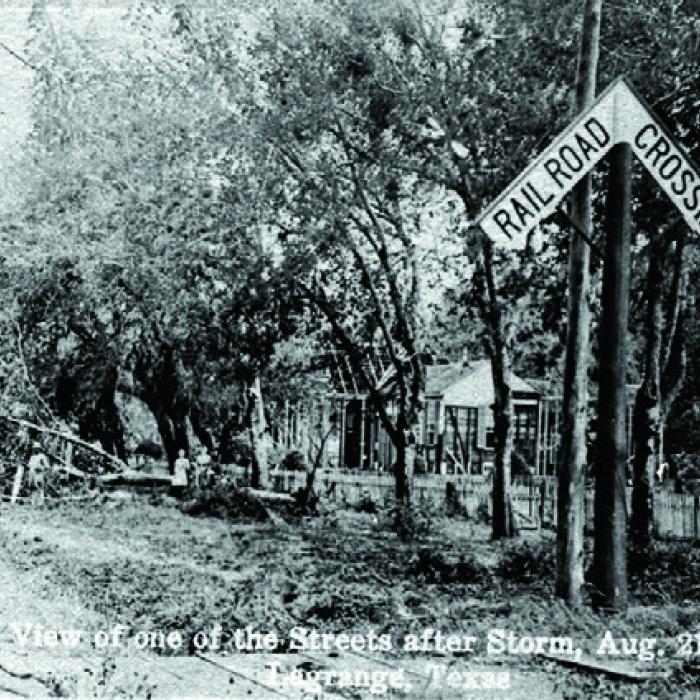
Our modern day meteorologists inform the public that hurricane season in Texas, which began on June 1, is based on historic weather patterns when tropical storms begin to form in the Atlantic Ocean. This Footprints article will deal with one of these storms which left its footprints on Fayette County in 1909. This storm, referred to as the Velasco Hurricane, was deemed to be a Category 3 storm when it struck the Texas coast on July 21, 1909. The storm began as a weak tropical depression, and after crossing the Gulf of Mexico, made landfall at Velasco, and after passing through the town, left numerous citizens dead, and only a few buildings standing. As a side note, the town of Velasco, located in Brazoria County, was at one time the seat of government for Texas after the 1836 Battle of San Jacinto. In the late 1950s it was incorporated into the city of Freeport. The hurricane left a swath of destruction not only in Fayette County, but also in the surrounding areas, including Austin, Bastrop, Colorado, Lavaca, Lee, and Wharton counties. This storm, and the many that came after, were long overshadowed by the 1900 Galveston Hurricane, known as the deadliest natural disaster in U.S. history.
The La Grange Journal, dated July 29, 1909, gave the following description of the effects of the storm on the city, as well as the surrounding areas of the county. “Wednesday’s Destructive Storm: The hearts of the people of La Grange were sad last Thursday morning (July 22), when they emerged from their homes and looked upon scenes of desolation almost indescribable. What had been for many years the pride of our people and a source of admiration to all visitors— pretty homes, clean lawns, lovely shade trees and ornamental growths—had been torn and twisted, scattering unsightly debris everywhere, until it seemed almost that a besom of destruction from hades itself had swept over the town. Damage to churches, homes, business houses and barns had a depressing effect on all and caused a revival of ancient stories in comparison by the older inhabitants... The work of destruction began shortly after close of day, when roof after roof of residences and business houses were torn loose and trees, shrubbery, awnings and porches were laid low.”
The Journal then took to describe the losses. “One of the most serious ravages… was the partial destruction of the Lutheran Church (at that time located in a wood framed building at the intersection of South Jefferson Street and West Crockett Street)… The force of the wind came broadside against the east wall of the building, raised it entire from the foundations and dropped it flat upon the ground about four feet northwest of its original location.” Additionally, “the Masonic Building (on Travis Street) … had many windows demolished … and the room was flooded.” The Presbyterian Church, located nearby, was damaged with many broken windows. Other damage included the African Methodist Church, located near the cemetery. It was blown off its blocks and was sitting on the ground. The Black Baptist Church, located on the hill (as one would be going to the Fairgrounds) was also blown off its foundation blocks.
Other damage done within the city included roofs blown off warehouses, barns, and homes severely damaged. A stable was described as “literally torn to pieces.” Throughout the county, the following was reported: At Ammannsville, Holman, and Plum, the churches were described as heavily damaged, with the church at Holman blown off its foundation blocks. The church at Winchester was described as destroyed. The communities of Holman, Rabbs Prairie, Kirtley and Mecklenburg reported that their school buildings were either blown off their foundation blocks or totally destroyed. All of the aforementioned rural areas, including Halsted, Walhalla, Oldenburg, Cedar, Muldoon, and the town of Flatonia reported damage to homes and businesses, cotton gins, barns and windmills blown down, and heavy tree damage.
From the Journal report, the hurricane left its mark on the landscape and the memory of the inhabitants of Fayette and surrounding counties for years afterward. Obviously, modern day building codes have been greatly revised to meet such destructive forces. Modern construction methods and requirements may include building on a concrete slab, with anchor bolts holding the structure down, hurricane strapping and heavier framing requirements. Also, the foreknowledge of existing flood plains, and the ever helpful storm insurance, can be a source of relief to the home owner. Still, the ravages of the wind, the heavy rains, and the ever present fact that many storms occur at night when visibility is limited, gives the modern day Texan the same fear that the residents of Fayette County had 117 years ago. Let’s all hope for the best outcome when we face these events.
Sources: The La Grange Journal, TXGenweb Project, Wikipedia
Footprints Of Fayette
Fayette County is one of the most historic counties in Texas. In this weekly feature from the County Historical Commission, a rotating group of writers looks back at local history.