


‘We’re Tired of Being Hurt’
A Closer Look at Last Week’s Local Black Lives Matter Protest
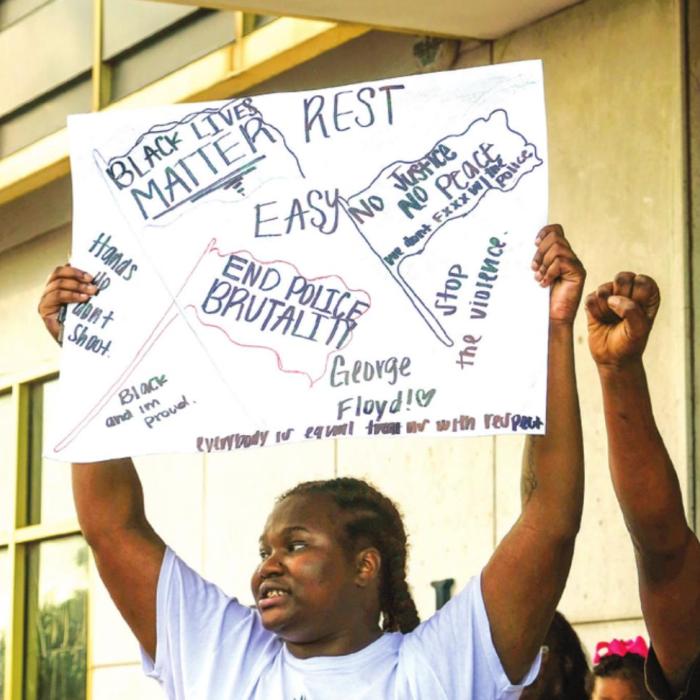
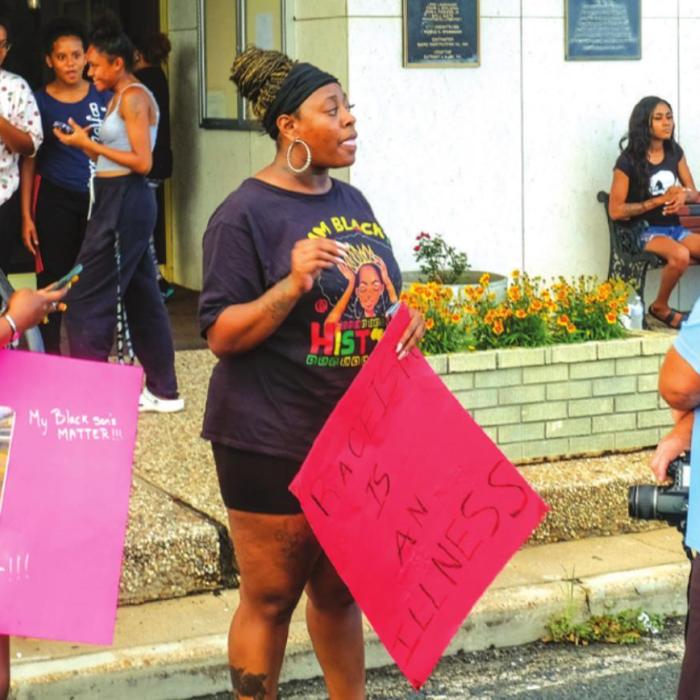
The protest movement that swept across the nation in recent weeks following the death of George Floyd in Minneapolis came to Fayette County last week.
A group of residents from Schulenburg, Weimar and the surrounding area held a demonstration on the steps of Schulenburg City Hall last Wednesday, June 3. Another was scheduled to take place Sunday evening, June 7.
“Just like your grandfathers fought in the wars, our grandfathers fought in the wars,” said one of the protesters, Charity Williams of Weimar. “Just like your grandparents struggled and had to pick cotton, our grandparents struggled and picked cotton.”
Williams said Floyd’s death, which came after Minneapolis Police Officer Derek Chauvin knelt on his neck for nearly nine minutes, has galvanized the black community into action, not just in the big cities, but in small towns as well.
“We see the racism and it hurts us. We’re tired of being hurt. We’re here for equal justice in the law system,” she said.
About 25 to 30 people participated in the protest on Wednesday. Most of them were local people from the African-American community. A few whites and Hispanics joined the group. The crowd was predominantly female. They began arriving after 5 p.m. Many of the signs they held had messages like “My black sons matter!” The crowd dispersed around 7:30 p.m.
Myles Thomas, a recent graduate of Schulenburg High School, was among the protesters. He spoke about the prejudice that young black people in Schulenburg commonly face.
“A lot of white people put on an act like they’re not racist,” Thomas said. “They might talk to you after the football game. But then when you see them in town they act like they don’t know you. They look at you and think you must be a criminal. They look at hispanics and think they must be illegal.”
“We bleed the same way. we put our pants on the same way,” said Diamond Houston, who lives in Houston, although she said she has many relatives in Schulenburg.
Schulenburg Police Chief Troy Brenek described the protest on Wednesday as “entirely peaceful.” Brenek said he and other officers spoke with some of the protesters when they first arrived at City Hall and quickly determined it was a peaceful assembly. There was no police presence downtown when the Record arrived around 6:30 p.m. that day. Williams said one of the officers even offered the protesters bottles of water.
Brenek said he believes the protest remained peaceful because of the relationship between his department and the local black community.
“We don’t do what the big cities do,” Brenek said. “We’re on a personal level here. Treat others as you want to be treated.”
Brenek said he recognizes there is a “subculture” of bad cops within some law enforcement agencies. Speaking of Derek Chauvin and the death of George Floyd in Minneapolis, Brenek said, “This guy (Chauvin) had 17 complaints, and because of arbitration and whatever other reasons, they didn’t mess with him. He got away with it.”
Brenek said he would like to see more people of color become police officers. The law enforcement profession can forge bonds of brotherhood between white and black officers, and more black officers could improve trust in law enforcement in black communities.
“Then you can change the culture on both ends,” Brenek said.
While the protest remained free of violence, the affair was not all sunshine and rainbows. Most of the signs the protesters held displayed messages like “Racism is an illness” and “Being black should not be a death sentence.” Others held signs with more provocative messages, like “F*** 12,” the number 12 being a reference to police.
As Williams indicated, the relationship between the local black community and local law enforcement isn’t exactly cozy. She spoke about her brother who spent a year in jail for a crime which she says he didn’t commit.
“He was falsely accused, right here in Schulenburg, Texas,” she said. “He did a year in jail. My brother, a minority, didn’t have money to hire an attorney.”
“It’s something that I’ve seen, but I never had a voice to speak for me,” Williams said. “Now that the world has woken up, I’ve come out here to speak for my brother. A lot of black people are scared to come out here like us, because they think the law is going to harass us. But we shouldn’t feel that way. We’re exercising our first amendment. Why shouldn’t we?
“I want people to know, just because you’re going in front of city hall, you’re not going to jail,” she said. “I want everyone to know, black people, white people, hispanic people, that they need to exercise all their rights: their first, second, third, fourth, fifth and sixth amendment rights.”
A study by the Pew Research Center released last month found that the incarceration among black Americans fell by a third since 2006, however, wide gaps still remain. Blacks make up just 12 percent of the U.S. adult population yet they amount to 33 percent of the prison population. Whites on the other hand amount to 60 percent of the U.S. adult population yet comprise just 30 percent of the prison population. Meanwhile hispanics make up about 16 percent of the U.S. adult population and 23 percent of the prison population.
Williams also criticized the way police treat white and black suspects differently. Williams said she believes police use tasers on black people more often than whites, and that officers tend to detain and handcuff black people more often, even if they are ultimately released.
“We’ve had people come up to us and say, ‘We hear you, we support you,’” she said. “But we also had a man who said he thought we shouldn’t have been out here because he fought in a war for our freedom. Everyone has a right to their own opinion.”