


La Grange Police Chief Talks Policy Changes, Challenges
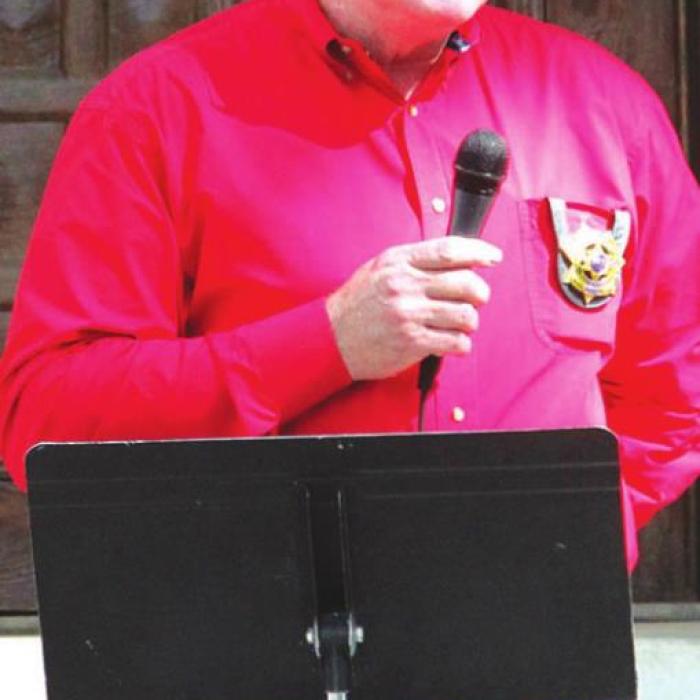
Demonstrations about race and police misconduct are starting conversations between law enforcement and communities around the nation, and La Grange is no exception.
Last Saturday a group of local young people organized a “Unity Gathering” at White Rock Park in La Grange where citizens and police came together to discuss race relations and the local police. La Grange Police Chief David Gilbreath sat down with the Record on Tuesday, June 23, to discuss those conversations.
Gilbreath said his department started implementing reforms three years ago.
“We got ahead of the curve in 2017,” Gilbreath said.
That year, shortly after he took over as police chief, Gilbreath updated several official policies regarding the use of force, racial profiling and police misconduct. Before that, La Grange’s police policy handbook stipulated when and how officers should use firearms and less--lethal weapons like tasers and police batons. However, the old policy did not regulate methods of physical restraint like choke holds.
At that time, Gilbreath said, he made the changes partly in response to the killing of Eric Garner by New York City Police in 2014.
“You could see it coming,” Gilbreath said, referring to the questions about police use of force that followed Garner’s death.
A
On July 17, 2014, New York City officers attempted to arrest Garner for the relatively minor crime of selling cigarettes on a street corner without a tax stamp. Video footage captured the encounter. Garner pulled his hands away from the officers. One of the policemen, Daniel Pantaleo, placed Garner in a choke hold. In the video, Garner can be heard saying “I can’t breath” eleven times while lying face down on the sidewalk. He later died at a hospital. Garner’s autopsy stated that his death was due to the police choke hold.
When Gilbreath took over as La Grange Police Chief in late 2016, he decided to adopt policies based on the best practices recommended by the Texas Police Chiefs Association. Those policies include a prohibition on choke holds and other methods of physically restraining suspects.
Gilbreath said the recent conversations about police misconduct spurred him to make another change to the policy as well.
The policy adopted in 2017 requires officers to report fellow officers for misconduct. However, it does not appear to include any requirement for officers to intervene if another officer abuses their power.
“Let’s say we’ve got a suspect under control, and an officer is still on top of him or kicking him or whatever, then another officer needs to intervene,” Gilbreath said.
Gilbreath said he does not believe any of his officers would abuse their power in such a way, but he said the department’s policy book needs to include a duty to intervene.
“I’m going through and checking the policy, and I’m going to add that to it if needed,” Gilbreath said.
Gilbreath said he was planning a meeting with all officers on Thursday, June 25, to discuss his expectations regarding police conduct and the duty to intervene.
“We’ve got to start policing ourselves,” Gilbreath said.
Small agencies like the La Grange Police Department may be in a better position to address police misconduct than large metro departments with heavily unionized police forces. Many police unions have gotten departments to implement complex arbitration processes for officers accused of misconduct. Gilbreath said those arbitration agreements often favor officers accused of misdeeds.
In the case of Derek Chauvin, the Minneapolis officer who kneeled on the neck of George Floyd for nearly nine minutes before Floyd died, citizens had made 18 complaints about Chauvin’s conduct before the Floyd incident, yet Chauvin remained on the streets.
La Grange Police officers are not unionized. The City and the Police Chief have much more leeway to dismiss officers for misconduct.
“Here, we know in the first year whether you’re made for police work or not,” Gilbreath said.
Gilbreath pushed back against the movement to dismantle and defund police agencies.
“How is that supposed to work?” he asked.
Gilbreath pointed to the situation in downtown Seattle, Washington, where police abandoned a precinct station in a so-called “occupied” protest zone. Seattle Mayor Jenny Durkan conceded to demands by protesters to cut the city’s police department budget and implement alternative forms of dispute resolution. But after days of nighttime violence in the protest zone, including gunfire and at least one shooting death, Durkan told protesters on June 23 that police will reclaim their precinct station in order to respond to 911 calls. She encouraged protesters to peacefully leave the zone. But some groups are vowing to stay. “I don’t see how they’re go
“I don’t see how they’re going to resolve that peacefully,” Gilbreath said.
He also spoke about the challenges young police officers face amidst the current turmoil surrounding law enforcement.
“It scares them,” Gilbreath said. “They’re asking themselves, ‘What have I gotten myself into?’ I tell them to do the job the best you can and leave the emotions out of it. This too shall pass, but we’re going to have to make some big changes.”