

Corn And Survival
Part I
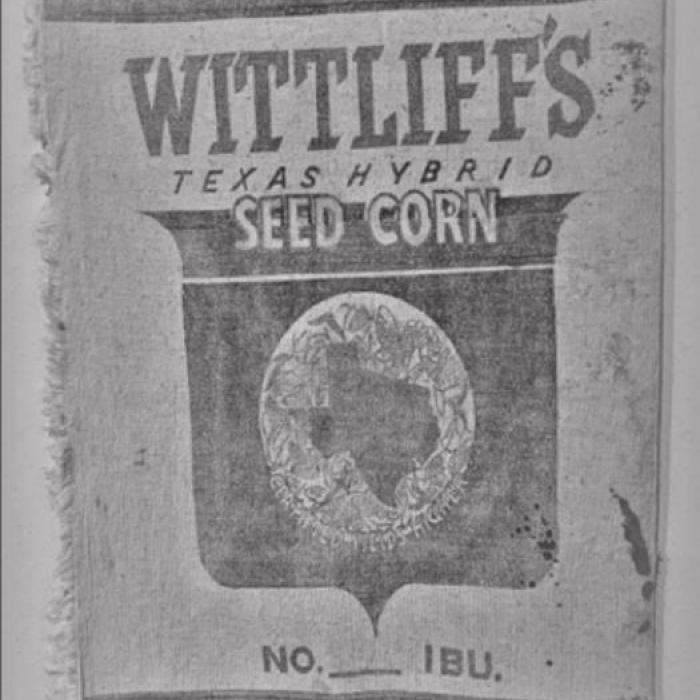
Going through my late husband’s things, I came across a neatly-kept seed corn sack. That was a reminder about how corn meant survival at one time in Fayette County and throughout Texas. Corn not only fed humans, but also animals. Wheat flour was not available in the early days, so cornmeal became the basic ingredient for cornbread, Johnny cakes and cornmeal mush, which was frequently prepared with meat renderings as food for dogs and cats. Dogs were essential as guard dogs and to help with hunting and cats were utilized as “mousers” to keep down the rodent population, especially in the corn crib.
There are many stories that have been documented about the importance of corn in the lives of the early settlers of Fayette County, as well as the lives of others outside of the county, who were the recipients of corn that was grown here. Had it not been for the shipments of wagon loads of corn grown on the Nassau Plantation east of Round Top sent to settlers in the Hill Country during the Adelsverein German emigration effort in the 1840s, many would have died of starvation. Corn is still an essential ingredient in many products consumed by animals and humans, as well as products like ethanol.
In 1824, William Rabb, one of Austin’s original 300, was awarded five sitios of land, equivalent to approximately 22, 239.6 acres, in an agreement to build a grist mill to help feed the colony. Part of his grant was located in present-day Fayette County along the Colorado River in what is now known as Rabb’s Prairie. Rabb imported two millstones, each weighing one ton, from Scotland. They were used as ballast on a sailing ship, and from the mouth of the Colorado River at Matagorda he transported them 100 miles inland by attaching an axle and a tongue and using them as wheels. The mill was in operation by 1831 with the controlled flow of the river water providing the power used to grind corn that was then dried for six to eight months. Unfortunately, the mill was destroyed by a flood in 1833. The millstones are now in a pocket park called Founders’ Park on the north side of the square in La Grange.
In a “Footprints of Fayette” story written by Katie Kulhanek, she related how Jesse Burnam, an early settler, killed two deer. His family then had meat to eat, but no bread, so he traded one of his horses for twenty bushels of corn.
In 1882, the Cernosek family settled in the Bluff area and suffered many hardships, but never hunger. At times they ate just cornbread and molasses. This was a fairly good diet, because corn is rich in Vitamin B12, folic acid and iron. Molasses is a good source of iron, selenium and copper, all of which help maintain healthy bones.
In 1911, the Bauer family in the Swiss Alp area raised corn, cotton, cattle, chickens and hogs and grew a vegetable garden. They belonged to the community beef club. They traveled to Swiss Alp to sell their eggs and buy groceries. In 1925, during a severe drought, the vines that were growing on the corn stalks were pulled off to feed the cows and hogs before the corn was ready to be harvested. Nothing was wasted.
More stories about the importance of corn will be related in the sequel.
(to be continued….)