


Boarding School, Breeches and Buzz Bombs
Longtime Fayette County Resident Richard Dixon Recalls his Youth in England During World War II

When the thin, nine-year-old boy reached up to give his mother a quick peck on the cheek, she hugged him tightly. Although she knew she must, she was reluctant to let her baby go. Richard Dixon then turned and shook his father’s hand. Hovering close by, his sister, Lizanne, offered an encouraging smile.
“Ready?” asked his older brother, James.
Richard nodded. The boys climbed onto the steam train from the platform at the small railway station at Exmouth, Devon, in southwest England. Weighted down with bulky suitcases and sandwiches for their lunch, they took seats in the third class compartment for the long trip.
Until that day, Richard had rarely traveled on a train or spent a night away from home. He had been a student at Exmouth Grammar School, along with Lizanne. Although she had proved herself scholastically superior to her younger brothers, no other educational options were available to her.
However, Richard had been granted a place in Christ’s Hospital, a boarding school near Horsham, Sussex, 200 miles away. James, who was returning for his sixth year, accompanied him that day. The boys’ uncle and two cousins also had attended the same school.
Hundreds of Years of History
Christ Hospital dates back to 1552 when young King Edward VI established the boarding school to help address the needs of London’s poor children. Over the centuries, admissions at the famous educational facility had broadened from that of a strictly charitable facility. It accepted boys whose fathers had influence or connections but were not wealthy.
Leaning upon his naval associates, Richard’s father had secured both his sons highly coveted places at Christ’s Hospital to give them each a chance at a better life. The quality of education offered there compared favorably to highly prestigious schools such as Eton, Harrow or Stowe.
“At age nine, though, you don’t want to leave your mother’s skirts,” Richard says. “But my father was very happy and that’s what counted really.”
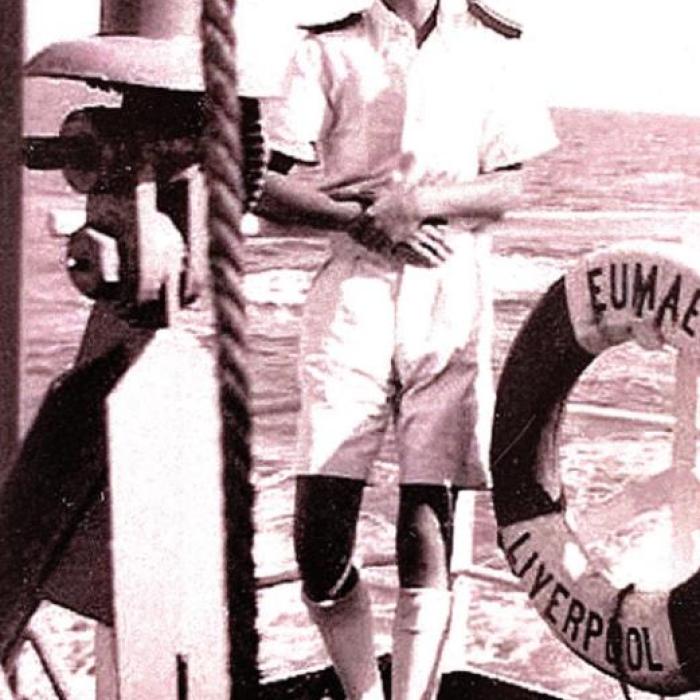
Richard’s father, Alan Dixon, was a retired naval officer. His mother, Muriel, had been born in Egypt, the daughter of the British Consul and Honorary American Consul in Suez. They had married in Egypt when Richard’s father was returning from the Far East during World War I as the captain of a ship.
War all around
In 1941, when Richard was going off to boarding school, Great Britain had been at war with Germany for two long, dreadful years. Hitler’s unrelenting and carefully targeted aerial attacks of English cities such as London, Bristol, Liverpool and Plymouth had left thousands dead and injured. Property destruction and damage was extensive.
Bombs had even fallen in the Devon county town of Exeter, 10 miles from the Dixon’s home. Where the next assault would be or whose lives would be lost was anyone’s guess. Food and clothing were rationed. Would the Germans invade England? What the future held, no one knew.
Because of his naval experience, Richard’s father was in charge of local civil defense efforts in Exmouth. The label on his steel helmet read “Air Raid Precautions.” The family didn’t have a vehicle, so Captain Dixon walked around his area.
His responsibility was to train local citizens on how to respond to bombings and assist them in the aftermath of actual occurrences. Everyone, including small children and babies, had been issued gas masks and he demonstrated their use.
“Just as you wouldn’t think of going out without your cell phone today, you would not leave home without your respirator gas mask in those days. They came in a small, ugly brown carton with a bit of string that hung around your neck. They were the most awkward things and in the end, we never used them,” Richard recalls.
“It didn’t take long,” he adds, “before the ladies were decorating their gas masks to make them more presentable, just as people have done with their face masks in the current COVID-19 situation.”
Captain Dixon also provided instruction on how to put out a fire from a German incendiary bomb. He demonstrated a stirrup pump resembling those used to put air in bicycle tires. Richard’s father also regularly inspected the buckets of sand hanging in public places to ensure they were full. In the event an enemy bomb fell nearby, they would be used to put out any resulting fires.
“When the German bombers were being chased out of the country by the RAF (Royal Air Force), they would often drop their bombs all in a line, one after the next,” Richard recalls.
“I can remember hearing one drop some distance away. The next one was closer and the one after that was even closer. We held onto each other until the sound of the planes diminished. That meant the raid was over and the Germans had gone home.”
In the town where the Dixons lived, a house was hit by a bomb that never detonated. However, the resident died from its sheer weight. As a child, Richard thought how terrible it was to be killed by a bomb that hadn’t gone off.
Off to school
Before the war, the most direct route from the Dixon’s town to Christ’s Hospital involved changing trains in London. However, the Germans’ aggressive assault on the capitol city made Captain Dixon uneasy. After carefully studying the Southern Railway routes, he re routed his sons’ travel. Over five hours, they caught trains from Exmouth to Exeter Central and from Woking to Guildford and finally to Christ’s Hospital.
Surprisingly, the school had its very own two-story station built when the educational institution relocated from London in 1902. The stationmaster’s home was upstairs, while the ground floor accommodated passengers and cargo. Since so many Christ’s Hospital pupils lived in London, a special train was hired to transport the boys at the beginning and the end of the semesters. It was dubbed the “Housey Special.” (Housey was the boys’ slang name for their school.)
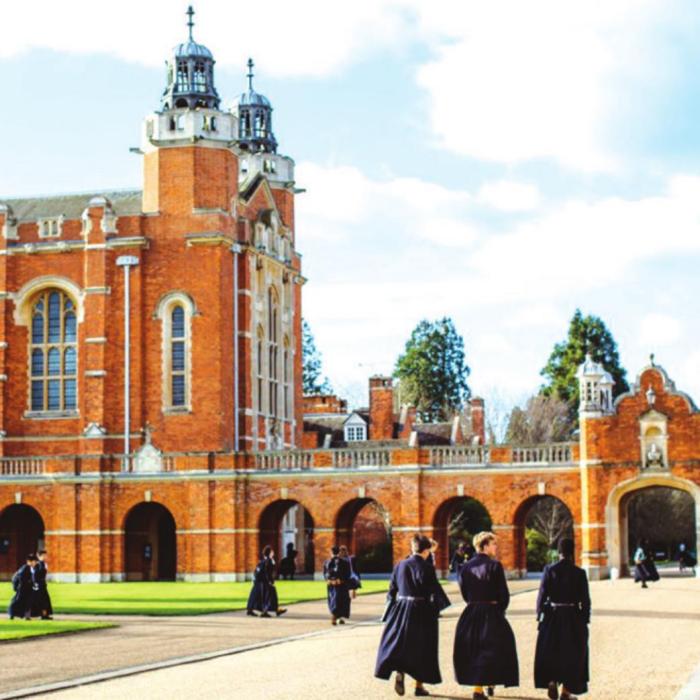
When Richard arrived at Christ’s Hospital in September 1941, he joined a group of 50 new pupils in Middleton B House. The 800 pupils lived in 16 houses in eight buildings built in the shape of the letter H. Each house’s housemaster and an assistant housemaster had accommodation in the crossbar of the H. Before bedtime each night, a matron inspected the junior boys to ensure they were clean and healthy.
“It was not unusual to hear crying during the night. These boys had just left home and age nine is pretty young,” Richard recalls.
The school also had a small hospital called an infirmary that was staffed with a resident doctor.
“If you had an injury or a bad cold you were sent there because any infection could spread easily, as you can well imagine.”
Tradition, tradition, tradition
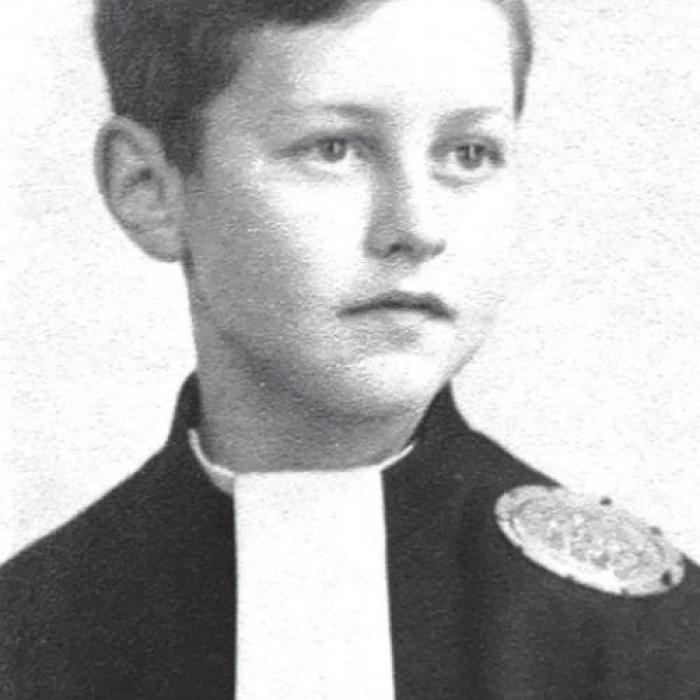
The students’ uniforms were not vastly different from the original design in the 1500s.
“We wore a loose leather belt at the waist of a long dark blue coat that had a yellow lining and six buttons down the front. Our breeches had three buttons on the side of each leg and went to below our knees. Our stockings were yellow. Supposedly, back in the Middle Ages, that kept the rats away. Our shoes were black.”
Although a few American exchange students were at first incredulous, the Christ Hospital boys were very proud of their attire.
One tradition that continued through Richard’s years at Christ’s Hospital had its origin from when the school was still in London. Because the drinking water was far from clean, the boys received a daily issue of ale, something close to beer.
“The senior boys were still getting a bonus, a very meager amount known as beer money, when I left. Not only did they have the option of choosing their own brand, they were given the money to buy it. The junior boys had to make do with the ale, however.”
Daily at lunchtime, the students marched in for their meal, house by house, while the school band played in the quadrangle.
“In our houses, we each had little lockers where we kept the contents of the parcels sent from home. If you wished, you could carry your jar of strawberry jam, for example, with you to meals,” he says.
Although Christ’s Hospital provided clothing and books, the pupils bought their own sneakers and rugby (football) boots. Most houses had a pool or snooker table that had been received as gifts. Richard remembers taking his toboggan (a long, narrow sled) to school.
For two months in the summer and a month at Easter and Christmas, the students went home.
Wartime worries
The boys in Richard’s house stayed glued to the wireless (radio) for war news. With access to the daily newspapers and updates from the staff, they understood what was going on despite their youth.
“I believe 216 graduates from Christ’s Hospital, called Old Blues, were killed during World War II. An awful lot of those boys had been called up immediately after they left school.”
For the junior boys, the loss of their popular teacher, Royal Air Force Volunteer Reserve Pilot Officer Claud McComas, was a staggering blow. After leaving the school and training in Canada, he had returned to Christ’s Hospital on leave and slept in a spare bed in the boys’ dormitory until returning to active duty. He left his Canadian cowboy hat and revolver the pilot on the windowsill, planning to return for them later. Tragically, Pilot Officer McComas lost his life when his aircraft was shot down in July 1942. He is buried in Boulogne, France.
Another tragedy involved a graduate of Christ’s Hospital who visited his friends one weekend. On the return trip, he died when his train was peppered by German machine gun fire.
“During chapel on Sunday evenings, the headmaster would announce the names of the boys who had been killed that week. It was a somber thought to realize someone whom you had played rugby with had died in the Burma jungle. I’ve never forgotten that,” Richard says.
On another occasion, a flying bomb hit the teachers’ garage where their vehicles, many of them Daimlers, were smashed to pieces.
Several mornings, the pupils awoke to find the playing fields littered with thousands of short strips of aluminum foil called ‘window.’ British planes had dropped it overnight to confuse the enemy’s radar. Although the material created a temporary mess, it soon was lost in the undergrowth.
Richard’s brother, James, told the story of a Polish pilot landing his British Spitfire on the school grounds when it ran out of fuel. A talented pianist, the pilot treated the pupils to an impromptu concert that evening.
“Toward the end of the war, I remember coming out of the school at dusk one day and seeing the sky filled with American airplanes. At least 50 were flying east toward Germany, probably from the nearby British airbase at Dunsfold.
“Early the next morning, we were awakened by the sound of the airplanes returning. They’d been to Germany, dropped their bombs and, those that were safe and sound, were coming home. It made a great impression on me.”
Hitler unleashed buzz bombs, which he called his secret weapon, on London toward the end of the war. When these unmanned planes filled with explosives ran out of fuel, they plummeted to earth causing widespread death and destruction. If British anti-aircraft guns or fighter planes intercepted the planes, the buzz bombs sometimes exploded before reaching London. Although Christ’s Hospital was vulnerable because of its proximity to the city, it never received a devastating direct hit.
“Although I probably heard no more than a dozen, their engines made such a foul noise that we knew what they were. If we heard the engines stop, we dived in a ditch. That happened one Sunday to James and me when we were out for a walk,” Richard says.
Rationing in England was stringent during wartime, yet the school managed to feed its 800 students three meals a day with careful management.
“There was a ‘”tuck shop” on the grounds where we could buy our ration of candy or entertain parents or visitors at tea. I remember many boys bought half loaves of fresh bread and ate them on the spot or as they walked away.
“Supposedly, one boy found a horse’s molar tooth in his bowl of stew once, but I didn’t actually see it,” Richard adds.
Each of the houses at Christ’s Hospital had its own football field. To thwart the possible smooth landing of a German glider or airplane, the goal posts were pulled up and placed on the open area.
Because of so much bombing nearby, another safety precaution involved moving the sleeping quarters of the senior boys. They relocated from the second floor of their respective houses to ground level. That meant the junior boys had to relocate to the underground tube that connected the 16 houses. They slept there amid the water and electric mains with sandbags piled between the different houses.
“It was pretty miserable, I have to tell you,” Richard says.
What a birthday gift!
Victory in Europe Day, May 8, 1945, was Richard’s 13th birthday.
“We were doing our homework in the evening when someone came in to tell us the war was over. All excited, we said, ‘to hell with the homework.’ An unidentified student ran out and rang a very old bell like the devil and it broke!
“No one would admit to having done it, so the physical training sergeant had all 800 of us boys run up and down for 45 minutes. I thought it was awfully unfair punishment.”
Post-war adventures
“I wasn’t a very good student and unsuitable to go on to university, so I finished up at Christ’s Hospital at the age of 16.
“I wanted to go to sea like my father and his father before him. Father put in a lot of legwork and subsequently, I went for an interview with a major shipping company.”
Richard’s wish was granted. He left school in December 1948 to start a four-year apprenticeship as a midshipman in January 1949. He was paid six pounds five shillings a month, the equivalent of approximately $10 U.S.
“I was actually an indentured servant, tantamount to being a slave, although I didn’t regard my tenure as such at the time,” he says.
That post was the bottom rung of a ladder that Richard steadily climbed during his halfcentury in the maritime industry. He spent 18 years seafaring. Richard is a qualified Master Ship’s Captain and a Nautical Institute Fellow.
An attractive management opportunity brought him and his family to the U.S. more than 50 years ago.
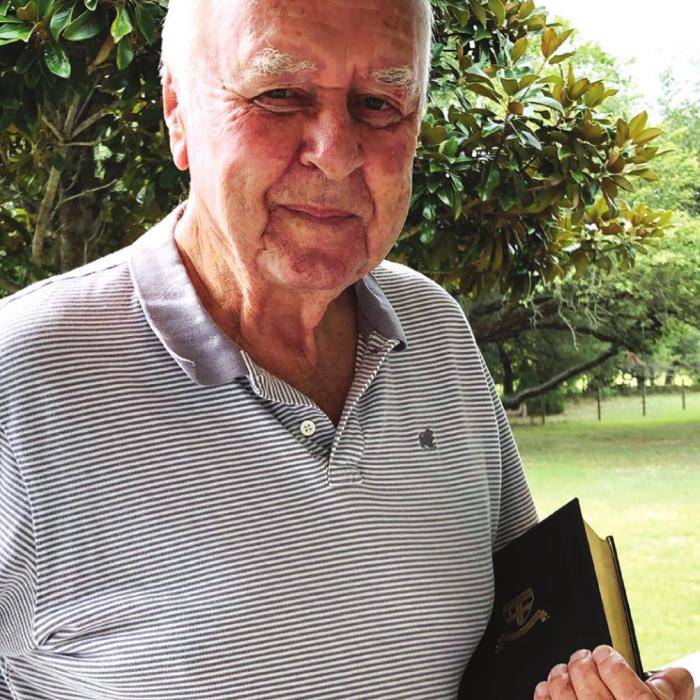
He spent more than 20 years as a marine cargo/ship surveyor in Texas. Upon his retirement, Richard and his wife, Ann, moved to La Grange.
A U.S. citizen for decades, Richard is perfectly content with life at Rutersville, Texas, but he will always be an Old Blue from Christ’s Hospital School in England.
If you’d like to read more of Elaine’s stories, visit www.elainethomaswriter.com/blog/ and sign up to receive new posts twice a month. You can also call Elaine at 979-263-5031.