


The Arrival of Women’s Suffrage in Fayette County
One hundred years ago, on August 26, 1920, U.S. Secretary of State Bainbridge Colby signed a proclamation certifying the Nineteenth Amendment to our Constitution. This amendment extended suffrage, the right to vote, to women all across the United States and ended a long struggle begun several generations earlier.
Congress had passed the amendment the previous year, on June 4, 1919. However, three-fourths of the states were required to ratify it. Surprisingly, Texas had been the ninth state, and the first state in the South, to ratify the 19th Amendment. However, this was not without controversy.
Led by Wyoming and most of the West, some states had already extended voting rights to women when Texas Governor James E. Ferguson, a staunch opponent of women’s suffrage, was impeached during the summer of 1917. He was replaced with the lieutenant governor, William P. Hobby. Texas suffragists (suffragettes was a derogatory term) promised Hobby they would support him in the next election if he would support the passage of a law permitting women to vote in state primary elections, which required only a simple majority in both houses of the Texas Legislature. A special session was called and Governor Hobby signed that law on March 26, 1918.
With women now able to vote in primaries, Annie Webb Blanton, who attended high school in La Grange, became the first woman to hold public office in Texas. As State Superintendent of Public Instruction, she instituted a system of free textbooks, revised teacher salaries and certification standards, improved rural education, and worked for equality for women teachers.
When Hobby recommended that the Texas Constitution be amended to offer full voting rights to women, things did not go so smoothly. That statewide referendum was set for May 24, 1919. Most of the ensuing comments in our local newspapers were from groups or individuals in opposition. However, the April 10th La Grange Journal reported that a mass meeting of Fayette County African Americans had adopted a resolution supporting the amendment.
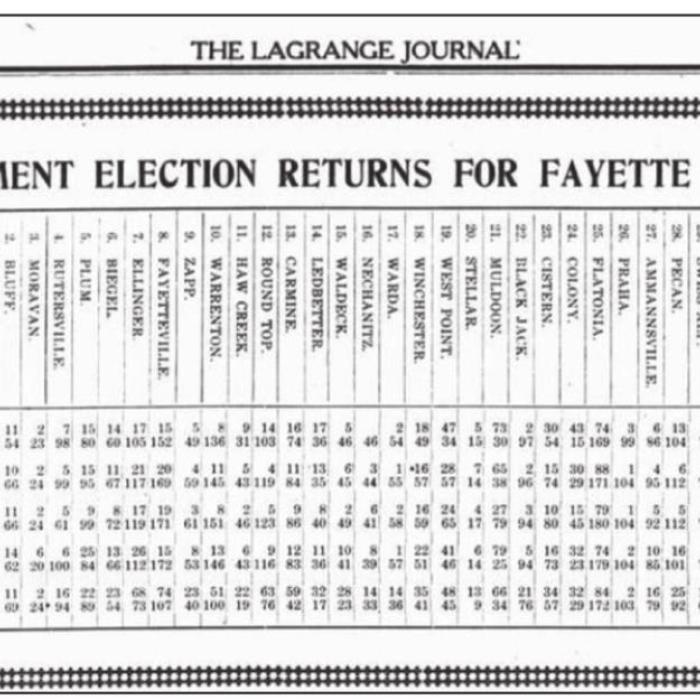
In the end, the referendum to amend the Texas Constitution failed statewide by 25,000 votes. The men of Fayette County, 86% of them, voted overwhelmingly against giving women full voting rights. The only two election boxes in the county to approve were Muldoon and Colony. The boxes with highest rates of rejection tended to be the rural areas that had been populated by German and Czech immigrants.
At this point, it should be mentioned that the same statewide election included a referendum for an amendment to the state constitution prohibiting the manufacture and sale of intoxicating liquors. This amendment passed statewide, but was also soundly defeated in Fayette County—although not by quite as large a margin as women’s suffrage. (In case you’re wondering, the men of West Point, Muldoon, and Colony were the only boxes to approve Prohibition.) Among other worries when considering women’s suffrage, the local men may have been justifiably concerned about how their wives would vote in future referendums on Prohibition.
This setback for women’s suffrage in Texas did not last long. On June 4th, the U. S. Senate passed the women’s suffrage amendment and submitted it to the states. Less than three weeks later, the Texas Legislature convened in special session and, within days, both the Texas House and Senate had voted to ratify the amendment. Newspapers’ editorials across Texas swiftly berated the Legislature for ignoring the will of Texans, as demonstrated in the state referendum only weeks earlier. Benno Harigel, editor of The La Grange Journal, wrote the following: “My vote at the recent amendment election was cast for the suffrage amendment, but I am a majority man, and believe that the majority vote should have been supreme.” However, he recognized the Legislature’s move as payback for earlier wrangling over Prohibition.
It took fourteen more months to get three-fourths of the states to ratify the Nineteen Amendment and, at times, the ratification process appeared ready to fail. However, with a narrow victory in its state legislature on August 18, 1920, Tennessee became the 36th and final state necessary to ratify the amendment. That November, one hundred years ago, women proudly exercised their right to vote in the 1920 presidential election.
Sources:
Handbook of Texas Online, Debbie Mauldin Cottrell, “BLANTON, ANNIE WEBB,” accessed August 16, 2020, http://www.tshaonline.org/handbook/online/articles/fbl16.
Handbook of Texas Online, A. Elizabeth Taylor, rev. by Jessica Brannon-Wranosky, “WOMAN SUFFRAGE,” accessed August 16, 2020, http://www.tshaonline.org/handbook/online/articles/viw01.
La Grange Journal. Vol. 40, No. 23, Thursday, June 5, 1919
La Grange Journal. Vol. 40, No. 28, Thursday, July 10, 1919
Footprints Of Fayette
Fayette County is one of the most historic counties in Texas. In this weekly feature from the County Historical Commission, a rotating group of writers look back at local history.