

Tomato Penance

I don’t grow tomatoes to feed my family. That’s what potatoes, beans and squash are for. Sure, we eat some tomatoes, but the reason I grow them has more to do with penance or self-punishment, I think.
What I’m trying to say is that tomatoes are difficult to grow. Besides that, everyone you talk to will tell you a different way to grow them, often with the claim “This is the only way that works.” I think the opposite is probably closer to the truth – there are lots of ways that work. Let me try to explain what I’m doing this year.
First, I’m not using any chemical herbicides. The only chemical fertilizer that I used this year was a light broadcast of 10-10-10 conventional fertilizer that I sprinkled throughout the garden back in January. I planted a few of my tomatoes at the end of February. At the time, I thought I would just replace them if it froze. Lucky for me, my place didn’t experienced any hard frost since then, so those plants are doing great. We’ve been eating their fruits for about a week now.
There are two kinds of tomatoes - determinate and indeterminate. Determinate tomatoes grow to some “determined” size and produce all of their fruit at one time. Inderterminate tomatoes keep growing and producing fruit until the first frost kills them (as long as you keep them alive during the summer).
This spring I’m only growing indeterminate varieties.
Some indeterminate varieties can reach 10 or 12 feet tall, so they need support. I’ve built a cage out of wood that surrounds my tomato bed. I simply loop twine around a sturdy part of the tomato stalk and then tie it high on my cage. I keep supporting the tomato plants in this way as they grow up through the cage.
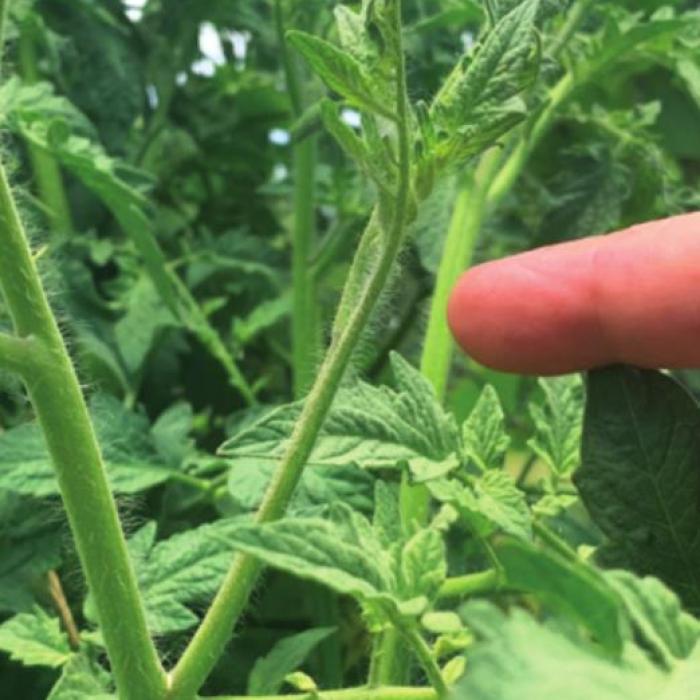
I’ve also been trying to clip most of the suckers off my plants. Suckers are new stems that grow at a roughly 45 degree angle from the pocket between the main stem and a leaf stalk (see image on C1). You can pinch the small suckers off with your fingers. Bigger ones require a pair of scissors or a knife.
Picking off the suckers helps your plant concentrate its energy and nutrients to the main stem (or stems). I usually let one or two suckers develop into secondary or tertiary stems. I wouldn’t let indeterminate tomatoes form more than three stems, however, because the plants become too unwieldy. Once your tomato plant gets to the top of your cage or support, cut off the tip of the stems. That will make the plant stop growing in height. There’s no use in growing tomatoes that you can’t easily reach.
Did you know you can clone your tomato plants from the suckers? Simply dip the bottom of the suckers in some rooting hormone and stick them in some potting soil. I’ve also stuck them straight into the garden soil and watched them grow. I currently have five cherry tomato plants in my garden that I cloned in this way.
If you’re growing determinate tomatoes, you don’t need to do anything. Just water and fertilize.
As I mentioned earlier, I started out with a little 10-10-10 fertilizer in the soil initially. Once the plants were in the ground, I foliar sprayed them with fish emulsion, seaweed extract and liquid molasses at a rate of 2 oz. of each per gallon of water. Once the tomatoes started to set fruit, I stopped applying fish emulsion, which has more nitrogen than the others. If you give your tomatoes too much nitrogen, they will grow beautiful foliage. But we don’t eat the leaves, so its not really necessary.
Seaweed extract and molasses are full of micro-nutrients that benefit the soil and plants. They also raise the carbohydrate levels in the plants, which makes the fruit taste better and less susceptible to insect damage.
The varieties I’m growing are “Early Girl,” a large slicing tomato, “Super 100” cherry tomatoes, “San Marzano,” an Italian heirloom used for canning, “Stripped German,” “Brandywine” and “Black Krim.”
If you are planting today, it might be a little too late for the larger tomatoes like “Brandywine” and “Stripped German.” But it’s never too late to plant some cherry tomatoes. If you haven’t grown tomatoes before, grow cherries. They are the easiest to grow. They will produce as long as you keep them watered. I want to try the “Currant” variety of cherry tomatoes. They are supposed to be the hardy, tasty and close in relation to the wild tomatoes of South America. If you find some of these plants for sale, please let me know where.
You may have heard of “blossom end rot,” a dreaded condition that results in half-rotten tomatoes on the vine. It’s usually caused by irregular watering or a calcium deficiency. There are some organic calcium products that can help plants recover from blossom end rot. Usually the problem is caused by irregular watering. I use the old knuckle test to determine when I need to water. Stick your finger in the dirt knuckle deep. If it’s dry at the bottom, you need to water.