

One Nation, Indivisible, or is it? – An Impossible Timeline
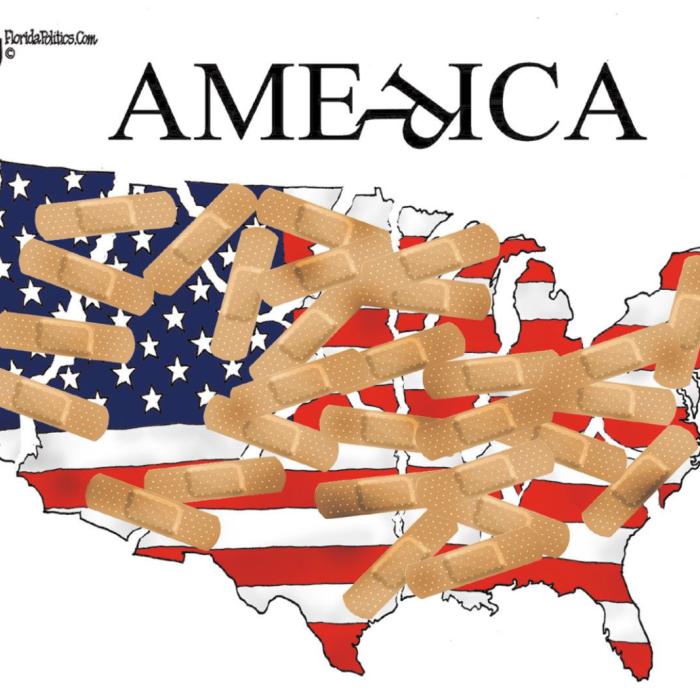
The past 10 months saw flurries of letters to the editor, passionately arguing pro and con Trump, BLM protests, election fraud, Capitol riots, suppression of free speech, and of course COVID policies. More than anything, the letters have served to illustrate the many ways in which the personal becomes political. Or rather, the ways in which the political can become intensely personal, deepening rather than bridging the divides.
We have also all watched the divides become progressively exacerbated over time on the national level, first as Bush was elected, then Obama, then Trump, and now Biden. The vitriol directed at Obama from some conservative quarters has come full circle to be more than matched by the toxic fury directed against Trump. Now, the worm has turned to make 2020 a replay of 2016 in reverse, but with the shrill amplified and turned ever more hostile. Specious accusations of election interference by Russia in 2016 to help explain that unexpected loss, have come full circle, as the questions raised about the integrity of the 2020 elections will likely continue to fester, whether permitted on social media or not.
The sight of such seemingly irreparable fault-lines running through states, regions, communities, and even families, have mostly served to fuel a serious and uncomfortable suspicion by growing parts of the voting population, that these, once every 4 years elections, are not the sacrosanct ritual of democracy-in-action we once believed them to be.
However, even as people across the land look upon the allegations of wide-spread fraud with attitudes that run the gamut between indignation, dismay and even despair, I wanted to bring up an aspect that should have been addressed all along, one that should have but wasn’t taken up substantively at any outlet, despite being in plain sight. That aspect having to do with the obvious fact that the timeline of America’s elections, as mandated by the constitution and settled traditions, is so tight that it does not, in truth, allow for any serious, large scale audit of the votes, should these ever be called into dispute by any party.
A scant two month period separates the first Tuesday in November, when elections are held, through certification of state electors in December, to official counting of the electors vote by Congress in early January. No matter how credible any objections raised may be, a true audit, possibly of tens of millions of votes, across one or more states, with all the litigation and cross-litigation this would entail, is simply not compatible with such a pressing timeline. All the more so in 2020, when votes involved huge numbers of mail-in ballots, a majority cast in states that did not have enough time to set sufficient safeguards and procedures in place to guard the provenance of votes so received, including verifying signatures, and resolving any conflicts. That, in my opinion, was likely the true reason legal challenges by the Trump team were not taken up by the courts of the land, up to and including the Supreme Court, no matter what legal reasons were or were not provided.
It is worth noting that while there were past election challenges, be it say, Florida in 2000 or Ohio in 2004, these were always limited enough in scope to make recounts potentially feasible, at least in principle. Yet even in those cases, the recounts could not be completed, partly due, at least IMO, to that extremely pressing schedule which would have made proper recounts difficult at best, questionable at worst. This is what generates enormous pressure on the aggrieved party to concede, no matter how serious and substantial the grievance was. Such pressures got all the more intense in 2020 where the doubts about both the manner and practice of counts were deep and widespread. Numerous irregularities and challenges could, and were expected, be it due to a plethora of privately owned voting machines, bedeviled by nontransparent algorithms, and/or a large number of mail-ins in states that did not have the time, or perhaps the will to implement sufficiently strict safeguards - all spread across at least six battleground state.
Such challenges, documented and presented to various courts, albeit with varying levels of confidence, naturally met a chorus of derisive reactions from the officially winning side, and no small amount of disillusionment and fury from the other side when the courts declined to as much as weigh whatever evidence was presented. Nonetheless, it is surely obvious to even the most casual observer, that implementing a large scale recount would have been a laborious and thankless exercise that would have likely taken months, not weeks or days. Since such an undertaking is incompatible with the mandated, cast-in-stone timeline, there never really was a chance of a do-over. Not without miring the election results in turmoil while a caretaker government is all but paralyzed for many months.
It seems that neither the founders, nor long past electoral administrations anticipated the possibility of deeply disputed elections, conducted through privatized vote counting machines with hidden algorithms that can never be fully trusted. Thus, mechanisms for adjudicating voting disputes that are both fair and practical were never devised, at least not in ways that deeply conflicting political sides would find acceptable.
The result is what we now see – one party declaring victory with no further questions allowed (settled matter!), while over 74 million voters of the losing party are left feeling disenfranchised (and far from settled!). No matter what we hear in the coming days, and no matter that the Republican party establishment has caved in to the inevitable, unforgiving timeline, its voters will not mollified as easily as their leadership. One which is, after all, motivated to let “bygones be bygones’ while salvaging what they can of remaining power.
Consequently, even as a new administration is set to take power, the whiff of illegitimacy will accompany its operations every step of the way. Under such unfortunate circumstances, prohibiting the airing of grievances by members of the injured party, will only serve to further erode trust in democratic foundations that are the glue that held the country together, at least up to now. With the two sides increasingly acting as combatants, locked in never-ending disputes with no resolution or reconciliation in sight, calls by the winning side for “healing”, while excoriating the other side, even for the mere exercise of free speech, will be interpreted as a thinly disguised demand for unconditional surrender.
My own fear is that we may indeed be about to come face to face with the collapse of the belief system that sustained social and political stability of these united states, across a highly diverse and spread-out population. Is there some positive to be gleamed in the face of such a dire prognostication? As it happens, I do have some ideas for moving forward, but will save those for another day.
To be continued ...
Hoffman lives in Fayetteville.