

Gardening Advice from a Desert Father

An elder said: “In the same way that no plant whatsoever can come up on a welltrodden highway, not even if you throw seed on it, because the surface is trodden down, so it is with us. Retire quietly from all (worldly) business and you will see things growing that you did not know were in you, for you were walking on them.”
-an anonymous saying of the early Christian desert fathers. The ancient ascetic who first uttered those sentences spoke wisdom, I think, both for our daily lives and our work in the garden.
I try not to disturb the soil. I know it sounds simple. But I think it’s something really important.
As the desert father points out, nothing grows on a well-trodden path. So it is in our garden.
If we walk across our rows or growing beds, we disturb the soil. Think of the soil like a city. A city has a road network, a system of pipes to transport water, a system of wires to transport energy, communication networks, etc., and a whole lot of people who live and work there. These people, for the most part, use a system of voluntary exchange to acquire the things they want.
It takes time to build a city from scratch. A well-functioning city grows over time. The Allen Brothers planted a little town on the bank of Buffalo Bayou in 1836. It’s taken nearly two centuries for Houston to grow into the world-class metropolis it is today.
Now let’s imagine a hypothetical small town. If we wanted to grow our small town and make it more productive, would it be a good idea to raze it to the ground, plow up all the water pipes and tear down all the electric lines and telephone cables, rebuild, and then repeat that process year after year?
I think that’s a bad idea. That’s what happens if we till our gardens year after year. But how do you manage a garden to avoid tilling?
I used to grow vegetables in a bunch of raised beds. I had a big problem with weeds, especially Bermuda grass. It was a constant battle to keep Bermuda out of my raised beds.
Plus, the soil in the beds would always settle. Then I had to refill the empty space with new soil. I didn’t want to introduce weeds into my beds, so I filled them with soil and amendments that I usually had to purchase.
About three years ago I began preparing a new in-ground garden space. I started with a dump truck load of sandy loam topsoil that I mixed with the native sandy soil on the property. I amended it with a bunch of MicroLife Humates Plus, compost, molasses, whole ground corn meal, and rock minerals. I laid out four rows spaced three feet apart. Then I covered the walk spaces with cardboard and wood chip mulch from the Fayette County Recycling Center. The cardboard and mulch help to retain moisture between the rows during drought. It also cools the soil on hot days.
When I need to plant seeds, I use stirrup hoe to weed the rows, which are only about two feet wide between the cardboard and mulch. I then use a handheld garden fork to break up the top inch or so of the soil. Then I plant my seeds. When I need to stick transplants in the ground, I might weed a little with my stirrup hoe, but then I use a spade to make a small hole just big enough for the transplant. I stir up the soil very little when transplanting vegetables.
That’s just what I do, but there are all sorts of different methods to grow a garden while keeping soil disturbance to a minimum. Raised beds work for many people. Some people use woven ground cover material in place of cardboard and mulch. Other folks pick weeds until they’re blue in the face.
The desert father mentioned something else: “Retire quietly from all [worldly] business and you will see things growing that you did not know were in you, for you were walking on them.”
If you stop disturbing the soil, you will begin to notice all sorts of beneficial life growing in it.
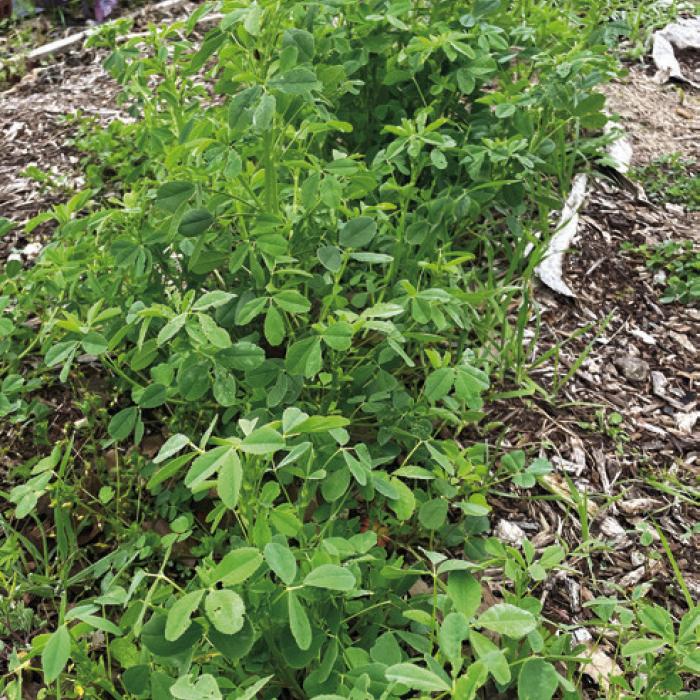
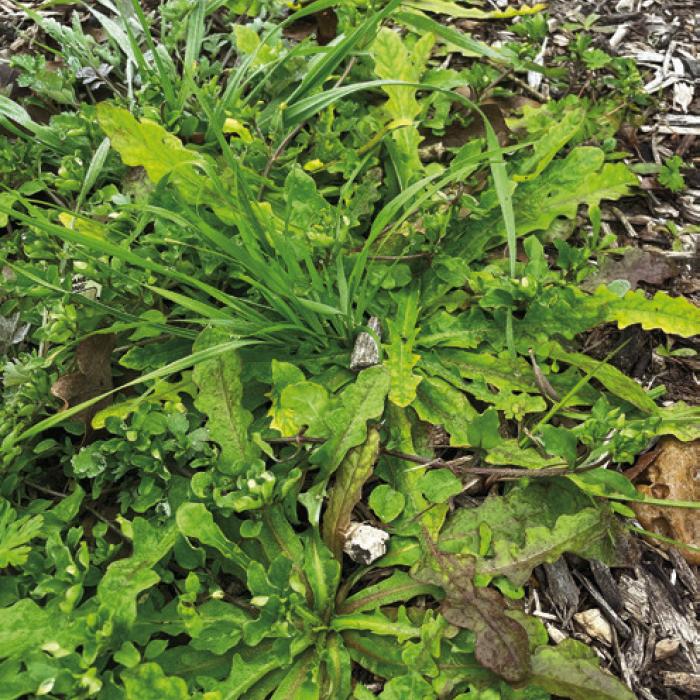
The two inside rows of my garden are not growing any vegetables at the moment. But they are very much alive. They’re covered mostly in wild yellow clover, also known as sweet clover, and lots of false dandelion, also known as cat’s-ear. I don’t really think of these plants as weeds.
The cat’s-ear’s long tap root breaks up soil deep into the ground. When it’s almost time to plant something in the row, I kill the cat’s-ear by spraying it with vinegar on a sunny day. Its long taproot will eventually rot in the ground, creating nutrients and a channel for water to penetrate deep into the soil. Sometimes I leave them to grow as a living mulch, especially this time of year, when their leaves spread out to cover the soil.
Nitrogen is one of the most important plant nutrients. Nitrogen makes up nearly 80 percent of the air we breathe. Many legume like yellow clover possess the amazing ability to take atmospheric nitrogen and deposit it in nodules attached to their roots via a symbiotic relationship with certain soil bacteria. You can see these nodules if you pull up the roots of a mature yellow clover plant. This species, Melilotus officinalis, also known as sweet clover, gets the name from the sweetness you can smell from cutting or crushing the leaves.
I tend to leave the clover growing in the garden. When I need to remove it, I do not pull them up by the roots. Instead, cut the plant off at the soil level, leaving the roots and nodules in the ground. The nitrogen in the nodules feeds other nearby plants.
I did not plant the cat’s-ear or clover. They grew naturally from seed brought in with the soil or the wind. They are the kind of weeds I want.