

Fabric Of Many Colors
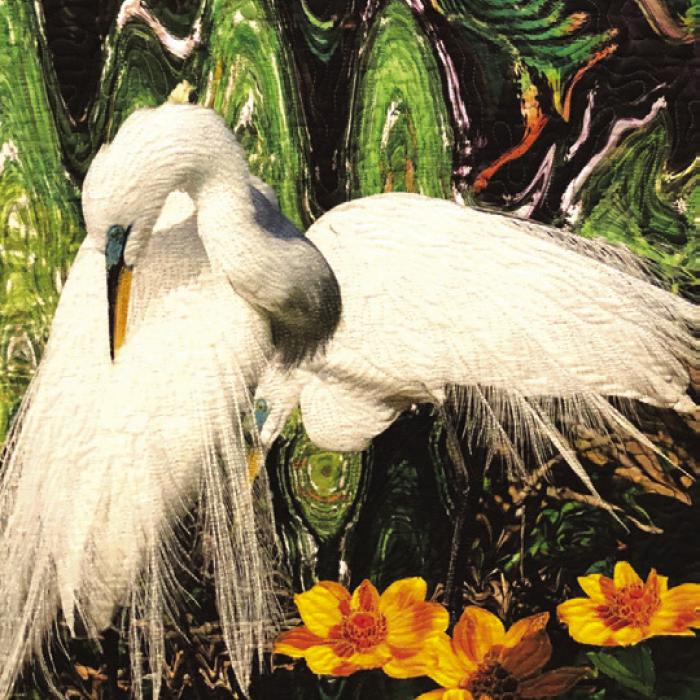
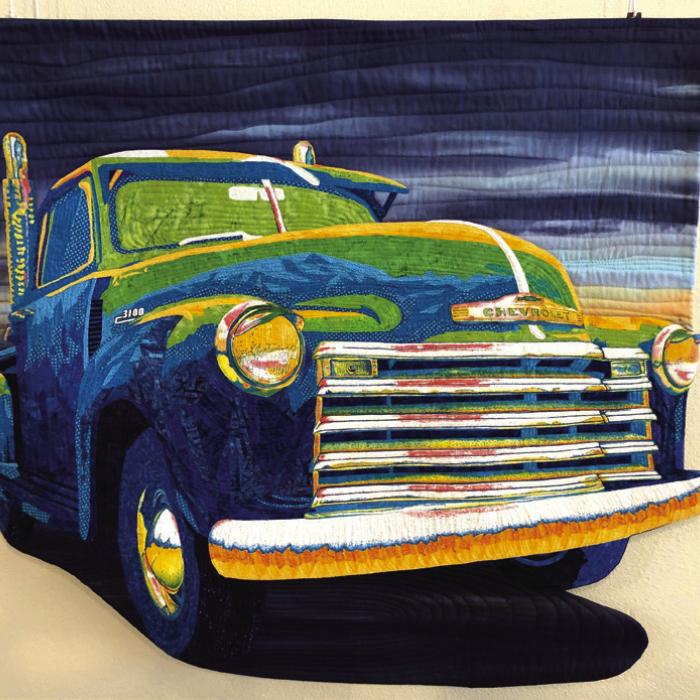
Since my friend and neighbor was the newly named director of the Texas Quilt Museum on the La Grange square, I decided to visit the place. The plan was to check out the new juried exhibition, Seeing in Color and to give the whole space a quick perusal and then approach the individual quilts with scrutiny. What’s this quilt business all about anyway?
But when I breezed into the second-of-three exhibit spaces, I noticed a painting on display––a very familiar painting. In fact, it resembled the intricate Japanese style technique of a successful Japanese artist friend, Masami Yamada whose pieces hang in Tokyo government buildings. He uses rock pigments on Japanese paper that contains cloth. The colors, the framing, the perspective of this one quilt, were all just like Masami’s Papua New Guinea work. His images created there reflect the beautiful birds and other elements of nature on that Melanesian Island.
What was a painting doing here among these quilts?
Of course, it wasn’t a painting at all. It was a quilt. That’s when I realized my narrow concept of “quilt” comprised a limited perception of what a quilt is. I hadn’t imagined that art of––of, not on–– cloth could radiate such vibrancy, realism, and beauty. Same as Masami’s works.
I am speaking of a quilt entitled Two Egrets as One; it is in the north wall of the rear-most exhibit hall in the museum. Its fabricator––its artist–– is the Floridian Dariel Dodge-Diestelkamp who is an accomplished fabric artist whose aim, in the artist’s words, is to “explore the wonder and beauty of life” through various art forms including quilt art and photography. Exploring further, I discovered more quilts that couldn’t possibly be quilts. There was Tonya Littmann’s Dad’s Blue Truck immortalizing the vehicle Dad drove her in to the Mr. Frosty drivein circa 1950. And, from Eugene, Oregon, a swirling avant-garde work by Niraja Lorenz of “celestial forms” that “tell stories of political discord, environmental destruction, and human potential.” In a quilt? Yes, in a quilt. Now, I shouldn’t have been surprised by the amazing art I discovered in our Texas Quilt Museum. After all, I’d been tangentially involved in an astounding quilt-art exhibition from the Gullah people of the Sea Islands in the ‘90s. That exhibition was at the Museum of Fine Arts Houston as I recall. But folks, they tell me the quality of the works in our own quilt museum is on a par. (This may be understandable since our museum is offspring of the large and prestigious annual International Quilt Festival/Houston.) Though I had learned the medium of quilts as a platform for art was no less valid than other substructures––canvas, marble, keys on a piano, the human voice––I had somehow forgotten that lesson.
Some of the images these quilt artists have created evoke wonder at how one could do THAT with patches of cloth. But, more than that, according to the genre’s critics these artists also create an aesthetic experience no different from that of viewing art in the finest museums.
Still need help getting over the “nice blanket” connotation as I did? Try this: A piece known as the Reconciliation Quilt once sold for $264,000 at Sotheby’s in 1991. And there is a quilt in North Dakota whose expanse is 11,395 square feet and weighs 800 pounds.
So, dear reader, when you have big-city visitors to our bucolic, small-town environment, by all means take them to pet the baby goats at the Jersey Barn Yard. That’s just great; it’s what I do. But then, also be sure to take ‘em to the Texas Quilt Museum on the square where they’ll experience world-class, mind-blowing art.
You just might want to tell ‘em, “we’re going to an art exhibition” and let ‘em find out it is all quilt art once they’re there.
Seeing in Color, curated by Vicki Mangum and sponsored by the Lucille Gaebler Klein Fund will be on view until Dec. 17 at the Texas Quilt Museum, 140 West Colorado Street, (979) 968-3104. Museum hours: 10 a.m. to 4 p.m., Thursday, Friday, and Saturday. The International Quilt Festival/Houston will be Nov. 3-6 in the George R. Brown Convention Center. Preview night is Nov. 2.