

Cuban Oregano Wins This Year’s Garden Resiliency Award
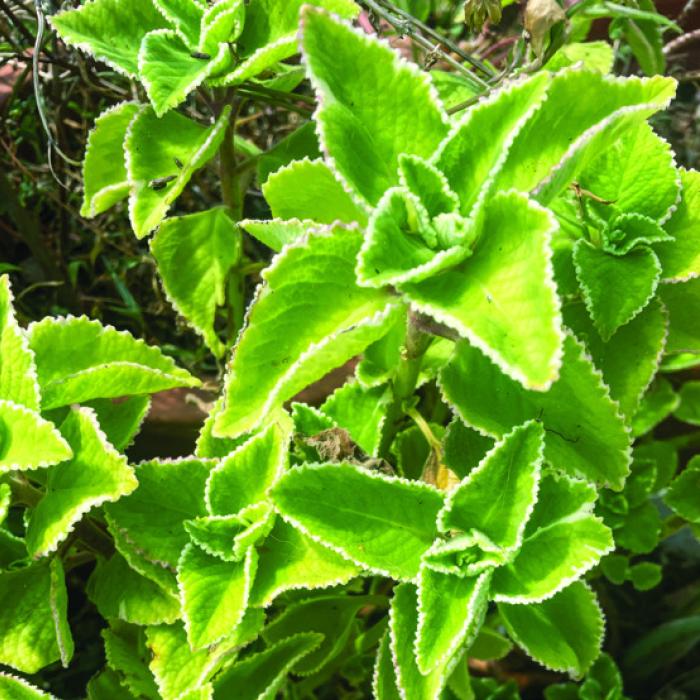

When we get into an extended drought in the early fall like this, I like to survey my plants to see which ones are the most resilient. This year, the award goes to Cuban oregano.
We’ve grown this plant at our house for many years. We used to grow it in the ground, where it thrives in the summer. It grows into a large succulent bush. But the slightest freeze kills it. So this year we have grown it in pots.
It doesn’t get as big in a pot. But it’s still a very beautiful and useful plant.
The scientific name is Coleus amboinicus (also known by the synonym Plectranthus amboinicus). As the first name implies, it is a member of the highly ornamental coleus genus. The various coleus species are all part of the mint family, Lamiaceae. Most of the ornamental coleus don’t really have a smell or taste. But this one, most commonly called Cuban oregano, is quite fragrant. It doesn’t really smell like mint. Rather, the aroma is more similar to oregano.
I use it just like oregano in the kitchen. It’s a very popular herb in Caribbean cuisine, often paired with strongflavored proteins like goat or fish.
The succulent leaves are much more substantial and “fleshy” than common oregano. For that reason, I like to finely chop it. It can take quite a bit of cooking, unlike other herbs that tend to lose their flavor if you cook them too long.
The plant has some powerful medicinal properties as well. This is what researchers had to say about the herb in a study published by the scientific journal Pharmeceuticals that came out in May of this year:
“ P. amboinicus extracts and essential oils exhibit significant antimicrobial activity against both Gram-positive and Gram-negative bacteria, and notable antifungal properties, particularly against dermatophytes. Additionally, the species demonstrates remarkable mosquito repellent and anti-parasitic effects, comparable to DEET, and potent anti-inflammatory properties by inhibiting pro-inflammatory cytokines. The plant’s rich polyphenolic content contributes to its significant antioxidant properties, preventing conditions like hyperpigmentation and premature aging. P. amboinicus also exhibits cytotoxic activity against various cancer cell lines and promotes wound healing through its analgesic, anti-inflammatory, and antioxidant abilities.”
Cuban oregano is not winter hardy in this part of Texas. Most sources say it’s cold hardy to USDAzone 10 – regions like far South Texas, South Florida and Southern California. So don’t even think about overwintering it outside.
If you grow it in the ground, it’s quite easy to propagate it from cuttings. Just snip off a branch and stick it in a pot with some soil. Keep it watered on a window sill over the winter. After the threat of frost has passed in the spring, plant it back into the ground.