

Big Time Culture in a Little City

When I was a wee tot, I subscribed to the single-ladder theory. Everything was in sync. If you were the smartest person in the land, you’d also be the richest. The most attractive. Probably the president. According to the theory, everything is tied together that way.
There was a single ladder for city life, too. The bigger and more prominent the city, the more important and successful the life experience. Big city … big culture. Little city … little culture.
Example: Want to witness Emanuel Ax-level piano concert? Fine, Go to Carnegie Hall or Kennedy Center. Never gonna get that level in a small town. Right?
I am no longer a wee tot. And I now know how fallacious the single-ladder syllogism is.
Take the piano concert I attended this past Saturday at the Presbyterian Church. The two young pianists––Christie Pollard and Miles Gillette––were young, talented artists from Brenham and Fayetteville respectively. One could be forgiven for thinking, this concert has “small town” written all over it; just how good could it be? The answer: WORLD CLASS. That’s as good as it gets. Both Pollard and Gillette share the Baylor School of Music in common. She is a graduate pursuing a master’s degree and he is an undergraduate student there in piano performance.
Laura Gillette, the church’s music director, introduced Pollard, the first soloist who took the stage in a stunning black gown and blazing red pumps, poised and gleaming. She played beautifully pieces by Schubert and Liszt from the Classical and Romantic eras as well as a forceful composition by the Modernist Prokofiev. (Prokofiev was known for composing difficult works and for being friends with Stravinsky, at least until they went their separate ways. Prokofiev did not care for Igor’s later works.) Pollard’s artistry was precise, yet sensitive. Her interpretations were indicative of her vast experience as a performer, a teacher and a judge of competitions.
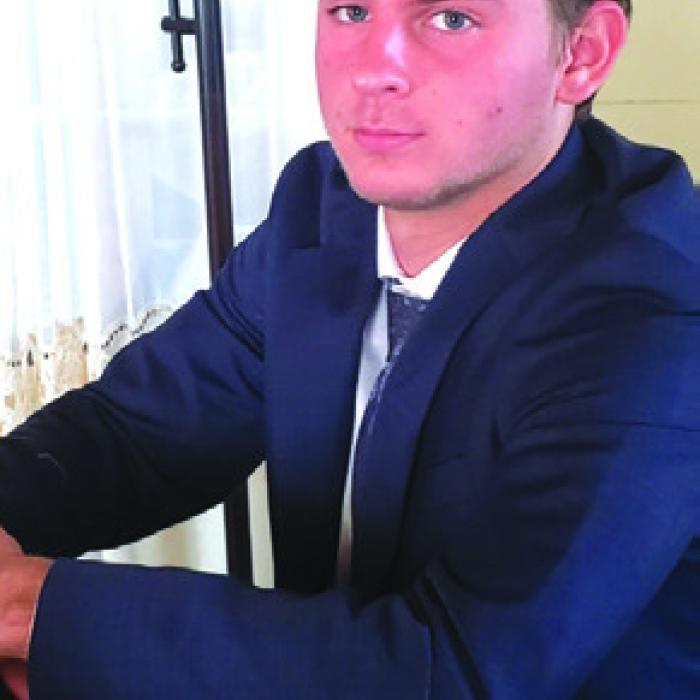
Miles Gillette––whose name alone tells me he is bound for stardom––also played pieces from the Romantic and Modern periods. Miles was the winner of the prestigious Baylor University Concerto competition in 2021. So, I was eagerly awaiting his performance.
He played with fierce concentration. He was under a spell; and he cast a spell with a trifecta of nocturnes. The first, Nocturne in A Flat Major by Chopin, seemed familiar. Gillette played with dramatic expression. The other two by Impressionistic composers Debussy and Respighi were equally as spellbinding.
His final solo was a showpiece by Franz Liszt (Ballade No. 2 in B Minor). At times, using only his left hand, Miles seemed to evoke Paul Wittgenstein, the one-armed pianist and brother of renowned philosopher, Ludwig Wittgenstein. It brought down the house.
(You might get to hear him play: He’ll spend the summer at Festival Hill this year.)
They both started lessons at about the same age, she at five, he at six. She loved the piano from the start, he not so much. But he quickly fell in love with playing. You don’t learn to play like that without being completely smitten with the instrument.
When asked each one who his or her most inspirational artist was––I anticipated names like Gould, Horowitz, Eschenbach––their replies were similar. They both named their well-loved teachers: John Dujka for Miles, Cheryl Amelang for Christie.
As for the piano, it was a Weinbach grand piano, which sounded particularly bright and pellucid to this layman. Paul McCartney, Ray Charles, and Count Basie all played Weinbachs. They are made and assembled by the Petrof company.
Perhaps fittingly for our region of Texas, Petrof is a Czech company.