

Adventures in Farming With Old Equipment
I’ve been wanting to plant a winter cover crop in my pasture for a couple of reasons.
First, started feeding hay to my cows in July after the drought scorched my pasture. A good stand of oats or ryegrass would cut down on my hay use. Second, the soil in the front part of our place is pretty poor. The root system of a crop like ryegrass can break up compacted soil, making nutrients available to plants. The fibrous roots add organic matter to the soil.
Cover crops in the brassica family, such as turnips, release chemicals called glucosinolates that can suppress weeds. Turnips also work very well at breaking up compact soil. Plus, cows love to graze on them.
I should have planted these seeds weeks ago. On the farm, though, sometimes a simple job takes a few weeks to complete.
Before I could plant anything, I needed a grain drill. My dad has an old Massey Ferguson grain drill, which I assume was built in the 1960s. He said I could borrow it if I got it running. It has sat unused at my parent’s farm for about 15 years. A bunch of small cedar elm trees were growing up through it. The tires were dryrotted. All of the tubes that carry seed from the hopper to the soil were either broken or missing.
I spent all of last Saturday morning cutting away the brush and greasing the moving parts. I filled up the tires, and to my amazement, they held air. I slowly drove it home from my parents’ place north of Ammannsville. Services must have just ended at the Bethlehem AME Church as I passed by on FM 3233. I caused a slight traffic jam in downtown Cozy Corner. I was about to turn into my driveway when I realized that the 10-foot-wide grain drill might not fit through the cattle guard. There was a line of traffic behind me on FM 155, and I wasn’t about to stop and measure it. I gave myself a sign of the cross and turned in.
The wheels just barely squeezed through the pipe rails on the sides of the cattle guard. I’ll make sure to rub a little grease on them when I bring the drill back to my parents’ place.
I bought my seed from Donnie Dippel at CHB Market and Ranch on FM 155. Dippel possesses a library of knowledge about the various cover crops that grow in our area, their effects on livestock nutrition, and more importantly, their benefits to the soil.
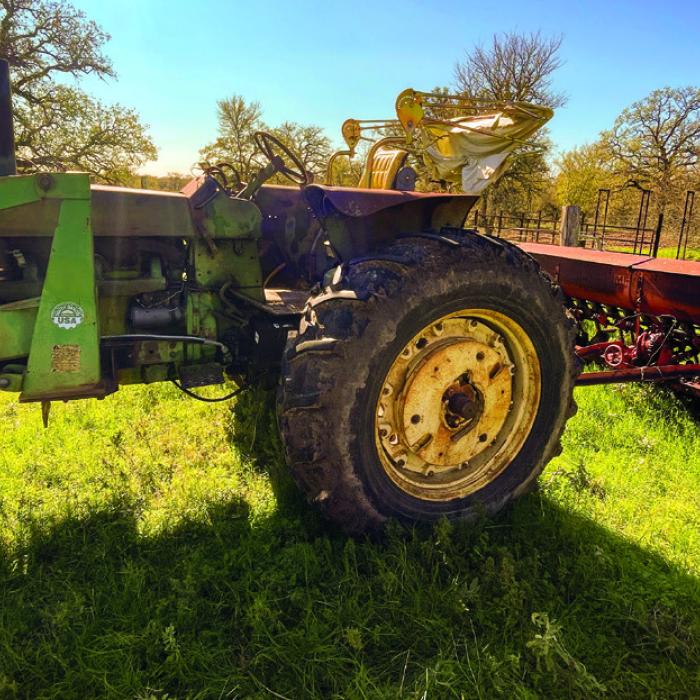
He gave me some great advice on what to plant and application rates. I settled on a mix of ryegrass and turnip seed. I got back home and fired up my John Deere that’s older than me. I put it in gear and it wouldn’t budge. The hydraulics had been acting up on it. They chattered a lot when I raised and lowered the front bucket. The tractor’s transmission had occasionally given me some trouble, too. Once in a while, it would take a long time to start moving after I shifted it into a gear. I thought it was a linkage problem, because a jiggle of the gear shifter would usually set it into motion. But now it wouldn’t move at all, no matter which gear I put it in, forward or reverse, or how hard I jiggled it. I bought this tractor a couple of years ago from a fellow near Ellinger. I’ve never changed the hydraulic filters on it, so I thought I would give that a try. I did some research and learned that my tractor has a metal screen tube before the filters that you can take out and clean.
I located the screen, took it out, and discovered it was clogged so full of sludge that the tube was crushed from the pressure of the oil trying to flow through the clogged screen. That was Sunday night. I couldn’t get any hydraulic oil or filters until the next day, but I had to work.
It was supposed to rain again on Monday. If I didn’t get these seeds planted I would probably have to wait another week before it dried up. Thankfully, my employer allowed me to take off Monday afternoon so I could fix my tractor and plant.
I spent Sunday night and Monday morning worrying that I had a severe transmission problem. It took about three cans of brake cleaner to remove all the sludge from the screen. I found no signs of metal flakes in the oil. That gave me a little relief. I cleaned all the sludge I could from the housings for the filters and screens. I installed new filters and filled it back up with hydraulic filters.
I started the tractor and let it warm up. I put it in gear. Praise the Lord! My tractor was back up and running.And it only took two days, some brake cleaner, filters and $200 worth of oil.
I could see the rain clouds in the sky. The field was still a little wet from the two inches of rain we got on Saturday. I hooked up to the grain drill, filled it with seed and drove into the pasture.
My dad’s half-century-old grain drill worked like a charm. I added a 40 lbs. sack of Micro-Life Multipurpose organic fertilizer with the seed. The pellets of fertilizer are about the size of a pea, so they flow through the drill. People say you shouldn’t run fertilizer through the seed hopper on a grain drill. That only applies to salt-based chemical fertilizers, which will rust the metal. Organic fertilizer is not so corrosive.
Since most of the seed tubes on the drill were busted, so it didn’t really “drill” the seed into the soil. It just dropped it on the surface. I lightly disked the field a week before. I don’t like to till soil because it harms beneficial life like soil bacteria and earthworms. But this field was in poor shape and I figured the disc harrow wouldn’t make it any worse. Plus, it would help the seed get better contact with the soil since I was basically broadcasting. Ryegrass doesn’t need to be planted very deeply. The chains attached to the back of the drill helped to press the seed into the soil. It started raining just as I emptied the drill. Perfect timing. After I planted the pasture, I told my dad about this adventure.
“Since you got the drill running, maybe I’ll plant some ryegrass, too,” he said.
My kids need to hurry up and grow up. I’ve got some broken stuff they need to fix, too.
He offered to help me replace the seed tubes. Maybe in spring, I’ll use it to plant a big field of cowpeas, which both the cows and I like to eat, unlike turnips.