


Long-Ago Memories of the Old La Grange Hospital
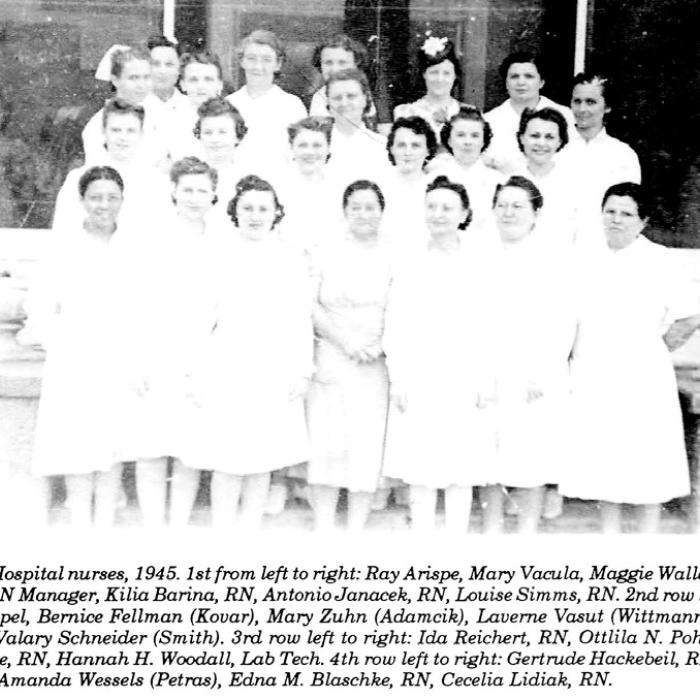
As one grows older, memories of the past seem to become more prevalent, nostalgic recollections of experiences become topics of conversations, and longings for simpler times occupy the gray matter of the brain like comfort food in the stomach.
The old La Grange Hospital that was founded in 1920 by Dr. Frank J. Guenther of Moulton, Texas, is the source of some stories and memories that come to mind from the perspective of having been a patient, as well as being the daughter of parents who were hospitalized, and as an employee before college. I’ll save my recollections from the time that I worked as a nurse’s aide during the summer of 1962 for a future story.
Although this is not a recollection, it is a story related to me about my entrance into the world in the old hospital. My birth in 1944 apparently made an impression on two nurses, Elizabeth Tilton, R.N. and Otillia Pohl, R.N., who still remembered my birth eighteen years later. I was born with dark hair that was long enough to almost reach my eyes. They told my nineteen-year-old mother that they were going to have to trim my hair to make bangs. Being somewhat naïve, she didn’t realize that they were teasing, so she was distraught at the thought, suggesting that a ribbon could be used to tie my hair up. She was quite relieved when I went home with all my hair intact.
My youngest recollection of the hospital is from age four. I had severely infected tonsils, resulting in nausea, vomiting, and malnutrition. Our physician, Dr. L.D. Boelsche, felt that I was too young to withstand ether, the anesthetic used at that time. So, he prescribed a viscous yellow tonic with vitamins to supplement my lack of nutrition. I couldn’t keep that down either; however, the plants at the backdoor that were fertilized with my regurgitations, grew quite well. Eventually, Dr. Boelsche relented to my mother’s urgings and agreed to remove my tonsils in June 1948.
Upon arriving at the hospital, I was placed in an iron baby bed, which made me quite indignant at age four. I felt that I was a big girl who shouldn’t be in a baby bed. Cecilia Lidiak, the floor nurse, who came to take me to the operating room, was a rather imposing, stern lady, who frightened me, so I refused to cooperate. An orderly was walking by the room, so I pointed to him instead, declaring that he could take me. So, he obliged – I can still remember the walk down the hall being held by a strange man. I was more curious than afraid.
As I was lying on the operating table, I looked around to see Ida Reichert, R.N., the head nurse, arranging the surgical instruments, and Mrs. Tilton, the circulating nurse, and Mrs. Pohl, the nurse anesthetist, doing something at a counter nearby. Now, being a nurse, I know that they were preparing the ether cone to anaesthetize me. The reason I can remember who they were is that they were all still nurses at the hospital in 1962 when I returned to work there.
Little did they know that my maternal grandmother, who lived with us, had been diligently teaching me the alphabet and how to count. So, when one of the nurses said, “Well, little girl, I bet you can’t count backwards from 100!” I immediately replied, “I bet I can….100, 99, 98”, and then my lights went out as the ether cone was placed over my nose and mouth.
After the surgery, being a rather outspoken child, I kept asking for ice cream instead of Jello. Of course, I was repeatedly told that ice cream wouldn’t be good for my throat. Not wanting to hear “No”, I finally learned my lesson when the ice cream caused excruciating pain when swallowing, and the phlegm in my throat almost choked me. The hospital staff was probably happy when I was discharged.
Unfortunately, my mother had multiple health issues, so she was frequently hospitalized. When I was quite young, I remember wanting to use the hand cranks at the end of her bed to raise and lower her head or feet, much to her dismay, especially after a surgical procedure. She always wore a bed jacket over her nightgown, which was allowed back then. Now, open-backed hospital gowns that are two sizes too large have replaced personal attire. Bed jackets were part of a lingerie ensemble to provide more modest coverage.
When I was in high school, my father, a mechanic at Brasher Motor Company, had an accident in the shop, resulting in both bones in a lower leg being fractured. In those days, heavy casting and traction with the leg being elevated with straps and pulleys were the standard treatment. Repositioning in bed was done by using one’s arms and an overhead triangle. The entire bed looked like a medieval torture device. The idea of day surgery or getting out of bed within a day of surgery for almost any procedure to maintain muscle tone and bone strength was never even considered.
The most traumatic event for me though was when my mother, who needed surgery for GI ulcers, decided that as a sophomore in nursing school, I should be allowed in the operating room to witness the surgical removal of the ulcerous areas. Why Dr. James Makinson and an associate even allowed that to happen is unbelievable. While observing the lengthy procedure, it became evident that the anesthesia was no longer adequate when Mom moaned and cried out in pain, causing me to wince with sympathy pains. It was awful.
Thinking back, that experience certainly prepared me for the many medical crises that I would encounter during my 41 years as a nurse. If I could withstand those sights and sounds, I could do anything.
Footprints Of Fayette
Fayette County is one of the most historic counties in Texas. In this weekly feature from the County Historical Commission, a rotating group of writers looks back at local history.