


Recalling Frau Tiedt’s Elementary School German Classes
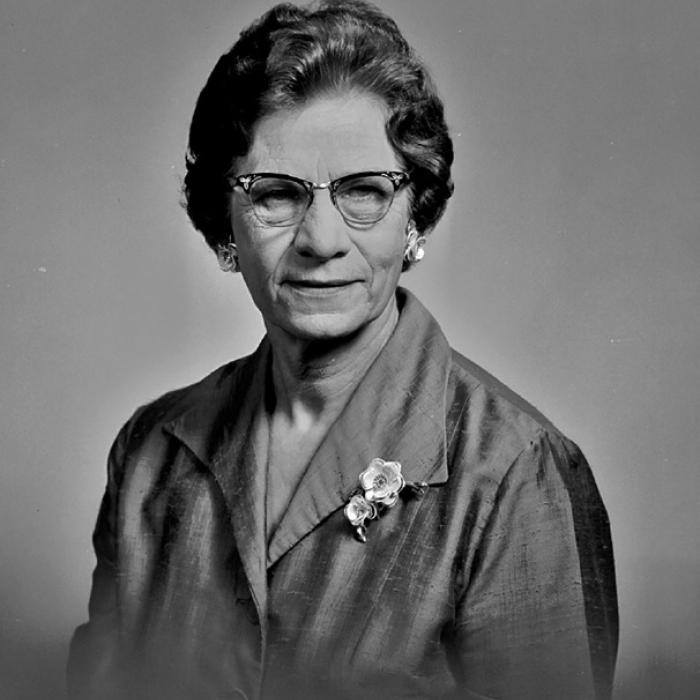
Sixty years later, some of my clearest memories of Hermes Elementary School in La Grange involve German lessons from Frau Tiedt.
German-speaking citizens have been in our area since at least 1831, when Friedrich Grasmeyer was granted a quarter league of land along the Colorado River at the current Fayette-Bastrop County Line. In the 1840s, ‘50s and later, large waves of German immigrants poured into Fayette and surrounding counties, with the result that many local school children, including me, had German surnames or at least some German lineage. However, by the 1960s, very few of us were learning German at home.
Leola (Kiel) Tiedt already had many years of teaching and acting as a school principal under her belt when she managed to convince Superintendent C. A. Lemmons that local children needed to begin learning German in elementary school. The plan was initially announced by the school board in January 1962, but did not take effect until Fall 1963.
I was in the third grade when Frau Tiedt first arrived in my classroom with her rolling cart holding whatever props she needed for that day’s 15-minute lesson. The props I remember best were her metal dollhouse, the paper mache and fabric puppets, and the reel-to-reel tape player. Occasionally, there was a slide projector. All day long she pushed that cart from the first-grade classrooms to the sixth-grade classrooms, teaching German language and culture all along the way.
We probably began by learning to count in German with the help of a little rhyming chant: Eins, zwei, Polizei. Drei, vier, Offizier. Fünf, sechs, alte Hex. Sieben, acht, gute Nacht. Neun, zehn, auf wiedersehen!
That was followed by learning the ABCs and the Alphabet Song in German to the same tune used in the English version. Learning the sounds each letter made was a lot easier than in English, although pursing your lips just right for umlauts was a bit of a challenge.
That 1960s metal dollhouse was used to teach us the rooms in a house: das Wohnzimmer, das Schlafzimmer, die Küche, das Badezimmer. We also learned pieces of furniture: der Tisch, der Stuhl, das Bett, u. s. w.; and family members: der Vater, die Mutter, der Bruder, die Schwester.
We learned all kinds of silly little poems. “Ich heisse Fritz. Mein Hund heisst Spitz. Meine Mutter heisst Mama. Mein Vater heisst Papa. Meine Schwester heist Ottilie und das ist meine ganze Familie.”
Frau Tiedt used the puppets in various ways, but my favorites were the well-known fairy tales with German dialogues. The two lines I remember to this day were between Little Red Riding Hood and her grandmother. “Rotkäpchen, Rotkäpchen, wo bist du?” “Hier bin ich!” There were other translated fairy tales, but none so memorable as Rotkäpchen. Many years later while antique shopping, I saw a complete set of Little Red Riding Hood puppets, complete with wolf, identical to the ones Frau Tiedt used. My attachment to that recollection remains so strong, that I’m still mad at myself for not buying them.
The other memory that remains strong involves the songs we learned to sing in German. By the mid-1960s Frau Tiedt was nearing sixty years of age, but she was not a shy, retiring, grandmotherly sort of woman. She had a very loud, authoritative voice, and her singing was loud and a bit jarring. I don’t remember any handouts with lyrics. The reels for her tape player were filled with German songs that we learned phonetically.
All these years later, I don’t remember all the lyrics, but I can still sing the chorus to the Christopher Columbus song she taught. A lot of lessons were based around the seasons of the year, and we learned a lot of German traditions and folklore. At Christmas time, we learned about St. Nikolaus and that our decorated Christmas trees originated in Germany. Christmas carols sung in German still have a special place in my heart.
I really don’t know how much Frau Tiedt’s lesson plans changed from first graders to sixth graders, but I do remember that many of the songs and chants became very familiar as we got older which is probably why they remain in my memory today.
That elementary school experience was followed by two years of Junior High School German Classes taught by Mr. Emil Kern (finally with a textbook), Freshman year German with Miss Margie Schriber (ironically, later she also became Frau Tiedt), and a year of college German. Despite all that exposure, I’m going to admit that I still cannot speak German. Maybe things would have been different if my German-speaking grandparents had been around longer. Maybe I just don’t have a gift for languages.
Nevertheless, I am extremely grateful for this early introduction to the German language and culture. It has brought me an appreciation of the stories of my German immigrant ancestors, who arrived in Texas unable to write or speak the English language. I’ve loved learning how they were drawn to Fayette and surrounding communities where they could share their culture with other German immigrants through German newspapers, German church services and organizations like the Sons of Hermann and Schützen Vereins. I treasure the elaborate baptism, confirmation, marriage and even death certificates printed in German and issued by their pastors.
Even with my limited vocabulary, being able to read printed German text and knowing the pronunciation rules for German surnames and places now comes in handy every day in my second career at the Fayette Heritage Museum and Archives. I may not have appreciated its importance at the time, but those early German classes from Frau Tiedt have enriched my life in many ways.
Footprints Of Fayette
Fayette County is one of the most historic counties in Texas. In this weekly feature from the County Historical Commission, a rotating group of writers looks back at local history.