


Heimsath
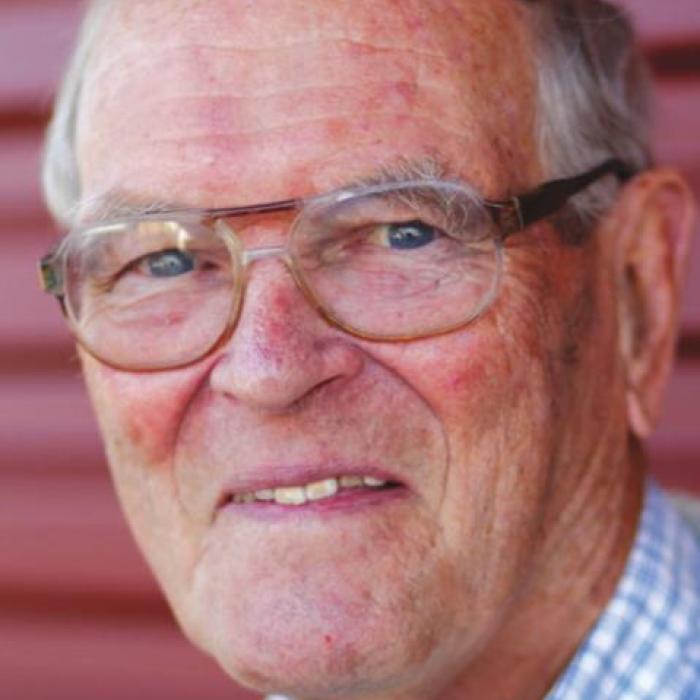
Clovis Benton Heimsath, FAIA, architect, artist, and community visionary, died on Oct. 10, 2021, at the age of 90.
Clovis was born on Oct. 25, 1930, in New Haven, Conn., where his parents were pursuing graduate studies at Yale; his mother, Star Macdaniel Heimsath, in Philosophy, and his father, Charles Herman Heimsath III, in Divinity. Clovis attended the Peddie School, class of 1948, and went on to Yale College, where he earned a B.A. in architecture in 1952. Clovis attended the University of Texas School of Architecture from 1952-1953. He participated in ROTC and served as a petty officer in the U.S. Navy, serving in the Caribbean during the Korean War.
Returning to New Haven to continue his graduate studies in architecture, Clovis met Maryann Holmes, then a graduate student at Yale in Microbiology. They were married on June 5, 1956 in Plandome, New York. Clovis graduated with a Master of Architecture from Yale University in 1957.
Clovis was awarded a Fulbright Scholarship and studied in Rome in 1958. Maryann and the first two of their five children traveled with him to Rome and the young family was featured in a profile in Mademoiselle Magazine that same year. Clovis’ time in Italy coincided with the earliest phase of Vatican II, and it was an exciting time for the young Catholic family to live in Rome, especially as Clovis described himself as “a Catholic with a Protestant mind.”
Clovis had a distinguished career as an architect. Prior to his tenure at the University of Texas, Clovis worked briefly for O’Neill Ford in San Antonio. After returning from his Fulbright Scholarship, Clovis continued his professional career at Voorhees, Walker, Smith, Smith and Haines (later Haines, Lundberg & Waehler) in New York City. In 1962, Clovis and Maryann moved their family to Houston, Texas, where he founded his eponymous practice.
Clovis was interested in architecture not simply as a form, but as a reflection of human expression and behavior. Of his many award-winning and celebrated designs, Clovis felt his greatest contributions were those that elevated the human element and captured the ways in which people use space. Notable projects in Texas included the Episcopal Church of the Epiphany (1974) in Houston, Cypress Creek Christian Church and Community Center (1976) in Cypress Creek, the Fayette County Heritage Museum and Library (1978) in La Grange, the Kagan-Rudy Chapel (1985) in Houston, and the restoration of St. Mary’s Catholic Church (2005) in Ellinger.
Clovis was a member of the American Institute of Architects (AIA) and the Texas Society of Architects, and, in 1979, he was elected into the AIA College of Fellows for his contributions to research in the practice of architecture. He was a contributing editor to Texas Architect magazine and a co-chair and founding member of the City of Austin Design Commission. Over the course of his career, Clovis influenced many students of architecture as a teacher and mentor. He was an Assistant Professor at the Rice School of Architecture from 1961-1964 and a visiting professor at the University of Texas at Austin and at Texas A&M University. In addition, Clovis wrote several well-received books, including Pioneer Texas Buildings. A Geometry Lesson (UT Press 1968); Behavioral Architecture (McGraw Hill 1976); and Geometry in Architecture: Texas Buildings Yesterday and Today (UT Press 2002).
Clovis had an immense love of the people and spirit of rural Texas. In the 1970s, Clovis divided his time as architect, painter, carpenter and historic preservationist, and part-time restaurateur. In 1974, Clovis and his wife, Maryann, previously weekenders, moved full time with their family to their farm in Fayetteville and moved his architectural firm into the historic Zapp Building, a nineteenthcentury brick mercantile building, on the square.
As there was extra space in the building, Clovis and Maryann, with no restaurant experience between them, decided to open a country restaurant, with Maryann as chef, Clovis as the maître d’, and the Heimsath children in the kitchen washing dishes. The restaurant soon blossomed into a regular business with patrons driving from Houston, Austin, and San Antonio, and led to the establishment of a hotel in the rooms on the second floor. The Country Place Restaurant was open on Friday and Saturday nights and served a set menu for $7.00. The rustic rooms at the Country Place Hotel, with shared bathrooms, were $15/night.
Clovis understood life through the visual. As an adjunct, or perhaps a counterpoise, to his architectural practice, for over 50 years Clovis explored the world around him through painting. What began as a playful pastime during family vacations developed into a deep exploration and searching for an understanding of his community and his world. Clovis always strove to connect with people, to develop and broaden his concept community and his place within it. When he was painting, whether on the square in Fayetteville, in front of a church in San Patricio, Mexico, or within the walled gardens of Gargonza, Italy, his generosity and authenticity drew people to him. How many times strangers looked over his shoulder while he painted. Not strangers, though; friends every one.
Clovis enjoyed small-town life, attending school basketball games, joining the Lions Club, participating in the annual Lickskillet Day parade, and welcoming the cyclists, antique shoppers, and weekend tourists who stopped by to chat as he sat outside on the square painting or sketching the scene around him. On the farm, Clovis loved to sit in his studio upstairs in the barn and paint the people and places of Fayetteville.
In the 1980s, Clovis moved the firm to Austin, which, as Heimsath Architects, remains a vibrant team with expertise in design, preservation, and adaptive reuse, of religious, community, residential, and school buildings as well as master planning, under the leadership of Clovis’ oldest son, Ben Heimsath, along with his associates. By the 1990s, Clovis and Maryann had semi-retired back to Fayetteville, and were running a newly renovated Country Place Hotel, in the same mercantile building. Clovis also established a studio and gallery in the building next door, where he created many of the most iconic paintings of his career and also provided a space for other painters to work with him. Clovis and Maryann ran the hotel until 2017. In 2015, they moved from their farm of 40 plus years to a house and studio right on the square in Fayetteville.
In recent years, Clovis and Maryann remained deeply involved in community and civic life, while also enjoying opportunities to travel and visit extended family and friends in New England, Mexico, India, Italy, Spain and Norway. Always painting, Clovis created a visual narration of these full and beautiful experiences.
Clovis had a feeling for the human spirit and human dignity, and he readily gave his time and energy to others. He began a project to create and distribute watercolors to residents of several local nursing homes. Clovis would paint a small watercolor each week, which Maryann copied on notecards. Every Friday they visited the nursing home to present the cards and spend time with the residents. In all, Clovis painted over 600 of these watercolors, which provided joy to many hundreds of people.
Clovis is survived by his wife of 65 years, Maryann, their five children, Mary Elizabeth Hollman of Brownsville; Catherine Waldron of Haverhill, Mass.; Ben Heimsath of Austin; John Heimsath of Fayetteville; and Virginia Carliner of Washington, DC, twelve grandchildren, and seven great grandchildren.
A private funeral was held at St. Mary’s Catholic Church in Ellinger, and a Celebration of Life will be scheduled for a later date in Fayetteville.
In lieu of flowers the family suggests memorial donations to the Haitian Health Foundation.
Funeral arrangements were entrusted to Koenig-Belvill Funeral Home & Cremations in La Grange.