


Year Ends on Up Note For Sales Tax in LG
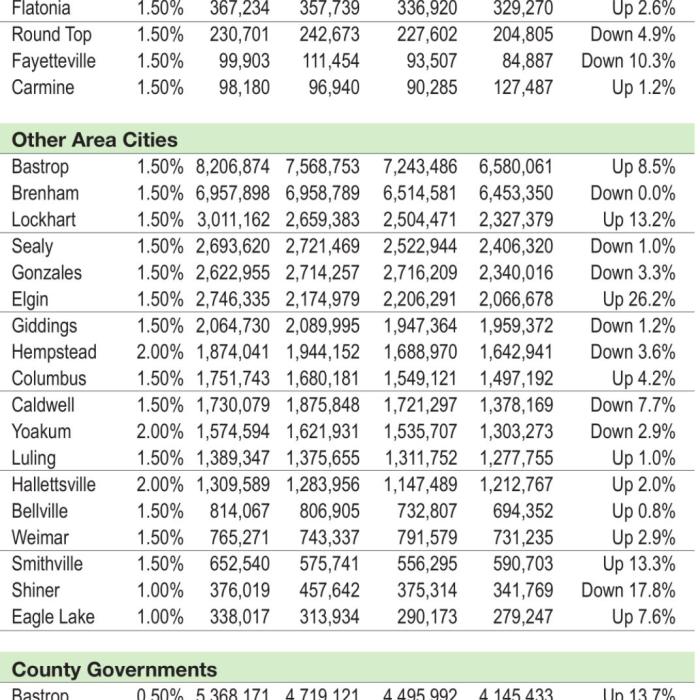
There was no Christmas Miracle for the treasuries of area cities, but La Grange did at least hit the $2 million mark for sales tax revenue from the state as the year of Covid-19 ended.
In November, it looked like it might not. But a $178,233.24 check from State Comptroller Glenn Hegar in December was nearly 18 percent larger than last year’s December check. That pushed total revenue for 2020 to $2,012,442.43.
It wasn’t enough of a gain to make up for all the earlier deficiencies this year. The city’s sales tax income was down 6.2%, or more than $130,000, from 2019.
It was much the same story for many other area towns.
With the final checks for the year, three of Fayette County’s six towns saw gains for 2020. Schulenburg was up more than 10%, Flatonia was up 2.6% and Carmine was up just over 1%.
Of the 24 area towns tracked by the Record, 11 were down this year.
For a bit of perspective, though, only three of the 24 got less in 2020 than two years ago and only one less than in 2017, indicating strong retail growth until the pandemic hit early in 2020.
The checks for December reflected sales made in October and reported to the state in November. The Christmas sales of December won’t actually be known until rebates go out in February to towns, counties and other entities levying the optional local sales tax.
Fayette County got $2.12 million in 2020, down 2.3% from its $2.17 million in 2019.
Of the nine area counties that the Record tracks, five are down for the year. The counties charge a tax of one-half of one percent on applicable retail sales in the county. Cities, on the other hand, tax only the sales made inside their city limits, so sales in rural areas are taxed by the county but not by a city.
Based on their various tax rates and revenue received this indicates taxable sales for the year in Fayette County amounted to over $424 million. Of this, over $134 million was in La Grange, taxable sales in the other five towns combined amounted to over $113 million, and sales in areas outside of cities totaled $176 million.
By comparison, taxable sales in neighboring Colorado County were $427 million, about the same as Fayette’s, while Bastrop County’s were nearly $1.1 billion.
Hegar, whose Comptroller’s office oversees tax collections in Texas, earlier this month said the outlook has improved considerably in recent months.
"In short, despite continuing to show year-over-year declines most months, revenue collections have exceeded our July expectations," he said.
For the state as a whole, "The biggest bright spot … so far, has [been] sales tax collections, by far our largest source of tax revenue. Sales tax revenues are outpacing expectations. It's something we've seen in most other states as well. Consumer spending has helped keep sales tax collections from dropping even more than they have," Hegar said.
Hegar also noted that Texas even had "one positive month during the downturn," July, when sales taxes were up relative to the same month in 2019. Hegar said that uptick could be largely attributed to government assistance around that time such as stimulus checks, enhanced unemployment benefits and the Paycheck Protection Program, as well as things like Texans taking staycations instead of vacations in the month of June and therefore spending more on home improvement projects.
In years past, the state and cities seldom got taxes from sales made online. A Supreme Court ruling and changes in tax law during the last Legislative session have helped close that loophole more recently.
With 12 months of collection from “remote sellers and marketplace providers,” the state has "received nearly $1.25 billion in state sales taxes from them," Hegar said. That amount is ahead of the original estimates from those sources.
Online marketplaces like Amazon, eBay and Etsy now must collect sales tax on sales made on their platforms. These then get rebated to local taxing entities, which has benefited towns like La Grange that previously had to rely only on “bricks-and-mortar” stores for sales tax revenue.