


Stall Honored for His Key Role in Space Center Houston’s Creation
-
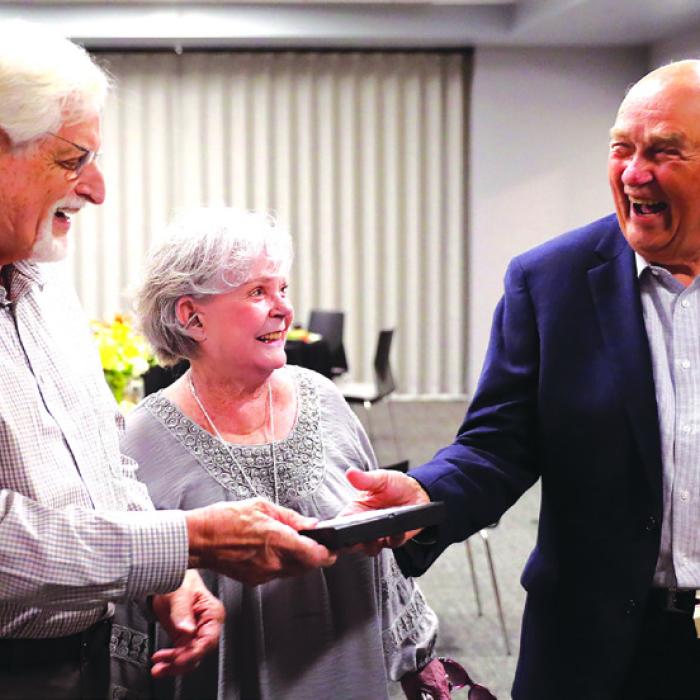 Harold “Hal” Stall, Dorothy Stall, and Harvey Hartman an original foundation member with a VHS video tape that Stall used to pitch fundraising for Space Center Houston. Photos by David Stall
 -
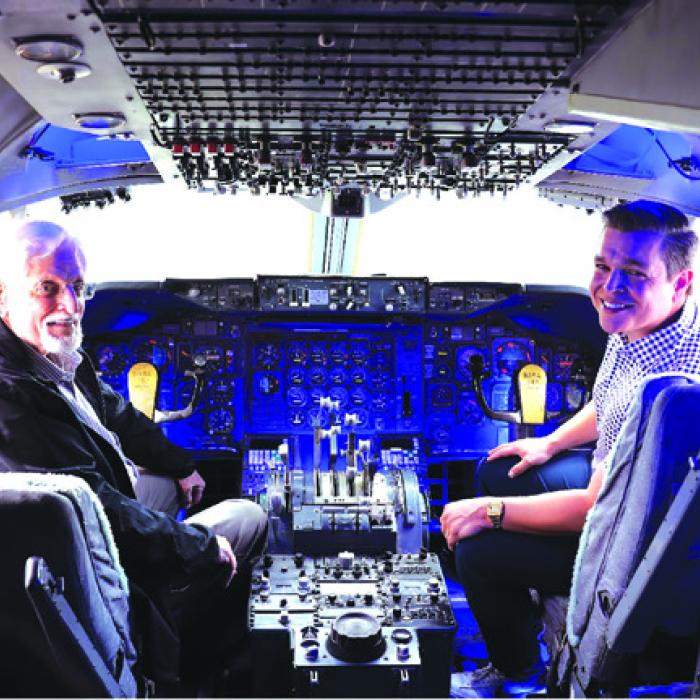 Harold “Hal” Stall and his grandson Micah Manzano at the controls of NASA’s Shuttle Carrier Aircraft (Boeing 747) on static display at Space Center Houston, NASA Johnson Space Center, Houston, Texas.
 -
 Harold “Hal” Stall and Johnson Space Center NASA Director Vanessa Wyche.
Harold “Hal” Stall prefers to spend his time in Fayette County, a place where he and his wife Dorothy have lived full-time since 1996. But last week, he went to Houston where he was treated to a special 86th birthday lunch with family at NASA’s Johnson Space Center (JSC).
The small private gathering was held at Space Center Houston, NASA’s official visitors’ center and included a visit from the JSC NASA Director Vanessa Wyche. It was indeed a very special occasion and somewhat of a homecoming for Stall. Some of his Fayette County neighbors, who themselves have visited Space Center Houston, might be surprised to discover that the $70-million, 250,000 square-foot, visitor and education facility was conceived by Hal 40 ago.
Stall brought his family to Texas in 1975 when he became Director of Public Affairs for NASA’s Johnson Space Center, a position he held for the next twenty years. His arrival came after the glory days of Apollo and before the era of the Space Shuttle.
He loved his work and the NASA culture of excellence, exploration, and advancement of science. It was something that he was proud of and wanted to share with the world.
During the 1980’s however, he became increasingly disappointed with the visitor experience he was able to present at the very place where astronauts worked and trained: the home of Mission Control, or as astronauts in space simply called it, “Houston.”
If you visited the Johnson Space Center in the 1980’s as a tourist, you would have seen priceless space artifacts in ordinary cabinets with modest typed labels. These national treasures were displayed in a surprisingly ordinary way, in simple wood framed cases against the walls in the employee auditorium. No one was more surprised than Stall. He likened it to “keeping the Hope Diamond in a cardboard box.” Stall felt very strongly that the amazing treasures of America’s space program deserved more. He believed they could do a much better job, but said at the time, “The money is just not there to build a facility to accommodate public visitors.” Stall did not even consider asking for additional funds to build a visitors’ center. “The federal government is running a huge deficit,” he explained.
So, Stall developed a unique plan to finance the new visitors’ center without tax dollars. And accordingly, The Manned Space Flight Education Foundation, Inc. was created in 1986 as a Texas nonprofit corporation specifically to build and operate Space Center Houston. This new foundation was funded by private contributions and tax-exempt bonds.
Members of the organization were community leaders and individuals from the Johnson Space Center. The goal was to create a place where the amazing accomplishments of the US space program could be featured through exhibits and artifacts. Visitors would have a greater understanding of the space program and the possibilities of space travel. Children visiting the Space Center would be inspired to study math and science and dream of going to the moon, or in this day-and-age, to Mars. Fundraising was necessary and more challenging since neither the property nor the artifacts were owned by the foundation, and no tax dollars would be spent. As Stall says, “it’s hard to sell bonds for a project built on land they don’t own, featuring artifacts they won’t ever own!” But they did.
Next, they hired creative people from Disney Imagineering to design exhibits which would transport the visitor to new worlds. Wonderful equipment and technology used to orbit the earth and go to the moon were displayed in a beautiful setting for the public to enjoy. Programs for school children filled the center with young voices with new goals.
It all sounds easy, but there were many hurdles and challenges to overcome. It was six years before design and finances were in place and construction was completed.
Space Center Houston opened its doors to the public in October 1992. Since then, the center has welcomed more than 22 million visitors and annually generates $118.7 million in economic impact. In 2014 it was designated a Smithsonian Affiliate Museum. Today it displays over 400 space artifacts, including Mercury 9, Gemini 5, and Apollo 17 space capsules.
Last week, Stall was welcomed back to Space Center Houston, his dream come true. Hal and Dorothy, along with their children, grandchildren, and spouses, were honored to attend the special birthday lunch held in honor of Hal’s 86th birthday. They were joined by JSC senior staff, the JSC NASA Director Vanessa Wyche, and old friends from the original Manned Spaceflight Foundation board. The family enjoyed a lovely lunch and great stories of days gone by. Hal and original board member Harvey Hartman amused everyone when each pulled out their Gold Lifetime Membership cards to the Space Center issued in 1992!
After lunch the group was treated to a VIP tour of Space Center Houston to see all the changes and updates. The highlight of the tour for Stall was getting to sit in the pilot’s seat of the first and last 747 aircraft used to test and carry space shuttles across the country. This original 747 aircraft was flown to Ellington disassembled, “walked” to JSC, and reassembled where it stands proudly outside the center.
While he is no longer the president of the foundation he created, and nearly 20 years have passed since he retired from NASA, he is still and forever the father of one of the finest space visitor centers in the world. And a very happy 86-year-old resident of Fayette County.