


A Rattlesnake Tale
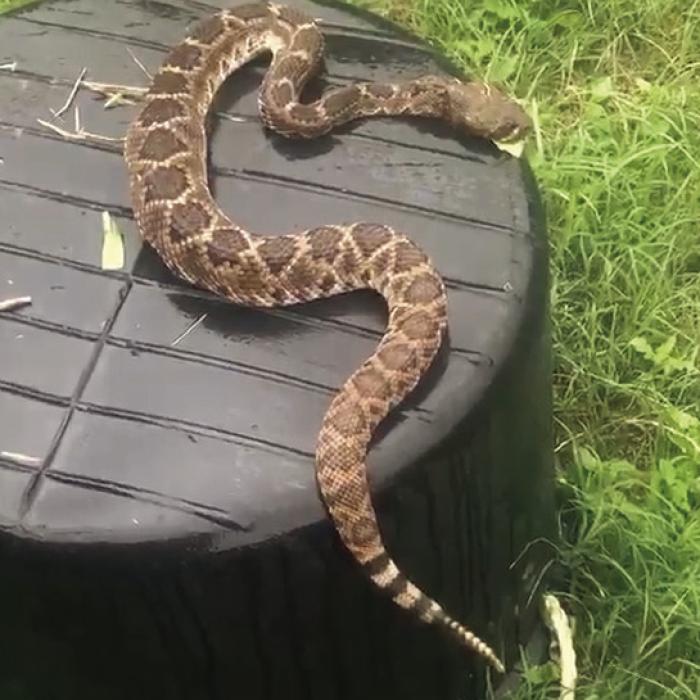
Erwin Sladek of La Grange was rummaging through his shed a few weeks ago when he made a startling discovery.
“I was in my garden shed, and it was kind of dark, but then I saw it,” Sladek said.
In the corner of the shed he spied a three-and-a-half foot long eastern diamondback rattlesnake. The snake was coiled up in the corner.
“I think he just finished eating a rabbit, because I saw another rabbit in the shed,” Sladek said.
Unsure what kind of snake it was at first, Sladek probed it with a shovel.
“I saw its mouth open up and those fangs come out,” he said. “I leave most of the snakes alone unless they’re (venomous).”
He dispatched it and took it outside into the light. Then he saw the rattles on its tail.
Sladek called Texas Game Warden Shaun Bayless to inquire about his discovery. Bayless examined the snake and identified it as an eastern diamondback. Bayless said eastern diamondbacks do not normally show up in this area. Their native range lies far east of here.
“East Texas has them,” Bayless said. “The farther you go east – Louisiana, Alabama, Mississippi, Georgia – the southern coastal states have them. They get pretty big and are fairly aggressive snakes.”
While rattlesnakes in general are somewhat rare in Fayette County, folks in this area are more likely to come across timber rattlesnakes, a species that prefers brushy areas. Western diamondbacks are more commonly found in the Hill Country and South Texas, Bayless said.
“To have an eastern diamondback is pretty neat because you don’t see them around here too often,” Bayless said. “There’s no telling where that snake came from.”
Sladek’s property is located along the Colorado River east of La Grange. Bayless said it possibly came here by traveling along the river.
“People can bring them in on shipments, oilfield stuff, things like that,” he said. “I’ve even seen them come in on shipments of cord wood. There’s no telling where it came from.”