


Packed House for Charged Meeting About Local Battery Storage Facility
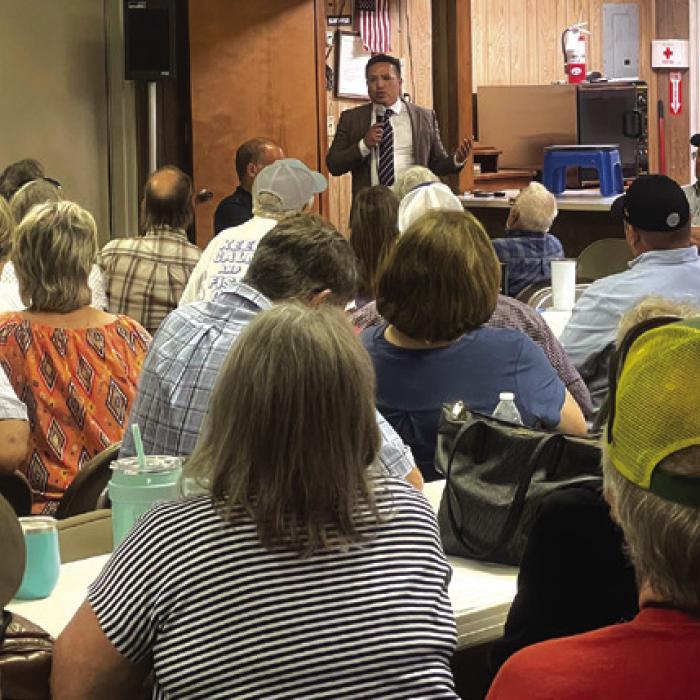
A standing-room-only crowd packed the hall at the Warda Picnic Grounds Thursday for a meeting over a proposed battery storage facility.
Most of the speakers at the meeting were strongly opposed to the battery storage facility, and especially any tax abatement for it. Staccato Storage LLC, the company developing the project, announced last October their intention to apply for a property tax abatement with Fayette County. The Fayette County Commissioners Court will hold a public hearing on the tax abatement this Thursday, Aug. 22, at 9 a.m. at the Fayette County Ag Building.
Warda resident Scott Bradley welcomed the crowd to the meeting last Thursday and spoke first. Bradley said he moved to Warda four years ago following a career in the field of aerospace engineering.
“If you do a green energy project correctly, they have some potential to bring some good things to the neighborhood,” Bradley said. “But I think we all agree these things need to be based on common sense. They should be financially efficient, self sufficient, no government handouts should be needed to make these things work. Our tax dollars should not be subsidizing these facilities.”
Bradley said battery storage facilities should not be “an eyesore or public nuisance” to those living around them.
“But most of all, I think we all agree, those places need to be safe,” he said.
He asked who would be responsible for damages and cleanup in the case of a fire or explosion.
Bradley spoke about the risk of thermal runaway in the lithium ion batteries used in battery storage systems. In rare cases, these batteries can malfunction of become damaged in a way that leads to explosion or fire.
“These fires are very difficult to put out,” Bradley said. “Thermal runaway fires need huge amounts of water to cool the batteries and stop the chain reaction. Traditional fire extinguishers don’t work.”
Bradley questioned where the water would come from to fight such a fire, and where the toxic water runoff would go.
He noted that the Texas Department of Transportation recommends a onethird mile evacuation zone around lithium ion battery fires. Holy Cross Church in Warda and Faith Lutheran School lie on the edge of or just within that area.
“Neither Fayette nor Lee County has the trained personnel or (personal protection equipment) to deal with these fires,” Bradley said.
“It’s true that disaster may never happen here,” Bradley added. “But the impact is not negligible.”
The proposed battery storage facility would be located on 15 acres within a 90 acre tract owned by Pct. 1 Commissioner Jason McBroom and his family. The property lies next to an electric substation, making it an ideal site for projects that require a connection to the State’s electric grid. McBroom has recused himself from all Commissioners Court discussions and votes on the project due to his conflict of interest. McBroom did not attend the meeting in Warda.
Battery storage facilities take power off the grid, storing it during off-peak times, and then return power to the grid when it is needed. An article in the Texas Tribune last summer described how battery storage facilities help to alleviate pressure on the state’s electric grid, especially as the grid relies more and more on solar and wind resources.
The article quoted Joshua Rhodes, a research scientist at the University of Texas at Austin: “If you really wanted to push the needle further (transitioning away from fossil fuels), you’re going to need batteries to be there for the times when the wind does stop blowing and the sun is setting.”
McBroom told the Record last week that he his family separately leased a portion of the property to a cryptocurrency mining business. The business operates banks of computers inside a building on the property.
“Bitcoin mining facilities are literally the opposite of green energy,” Bradley said. “They consume massive amounts of electricity.”
In addition, Bradley said, bitcoin mines are noisy. He spoke about a bitcoin mine in Granbury, where formerly lived, that made headlines for noise complaints from neighbors.
Concerning the bitcoin operation on the McBroom property, Bradley said: “We’ve sat on our back porch, and we could hear it running, I believe, in the early morning hours. It sounds like traffic noise out on the highway.”
“These bitcoin operations provide basically zero benefit to the community,” he said. “All they do is draw down the grid and they only make money for the owners. They don’t do much for anyone else. Maybe it’s just good luck over there that the owners are going to have a battery farm right next door to it to help with power when demands are high. Or maybe that was the plan all along. We don’t know.”
Kelley Stalder, Deputy Chief of Inspection and Engineering for the State FIre Marshal’s Office, spoke about his agency’s limited authority to regulate or inspect battery facilities.
“We can only look at complaints of issues related to fire and life safety,” Stalder said.
Stalder said his agency also offers fire investigation services to local officials. But the State Fire Marshal has no permitting authority over battery storage facilities, he said.
Winchester Volunteer Fire Department serves the Warda area. Winchester Fire Chief Eddie Schneider said Fayette County does not have a hazardous material response team. The nearest such teams are in San Marcos and College Station, he said. Schneider said hazmat training is very specialized and time consuming. Local volunteer firefighters cannot dedicate the time required to become certified in responding to hazmat emergencies, he said.
“If there is a fire at this facility, there is not enough water in this area to cool it down and put it out,” Schneider said.
Schneider said the facility should be required to have a fire suppression system capable of handling a battery fire. Furthermore, he said the State of Texas should require these types of facilities to take out a bond to cover cleanup in the case of a disaster.
“That’s about all the advice I can give you,” Schneider said. “You can’t stop progress.”
Danny Salazar, a staffer for U.S. Congressman Michael McCaul, said Rep. McCaul will write letters of support to help local fire departments get the funding and equipment they need.
“Furthermore, we’ll make sure the plant complies with any federal safety regulations,” Salazar said.
Salazar also said Rep. Mc-Caul has helped provide funding to Texas A&M University for research into fighting battery fires.
“We’re trying to make sure the counties and local fire departments have the funding to contain and fight these fires,” Salazar said. “And we’re trying to increase regulation to make sure the companies that build these batteries build them in a safe way.”
Local activist T.J. Mc-Cleney, leader of FayCoSaysNo, spoke about her organization’s fight against wind turbines in Fayette County.
“About three days after I made the Facebook page for the anti-turbine group, somebody reached out to me from (Warda),” she said.
The group has since incorporated as a nonprofit. Its mission statement on the Fay-CoSaysNo website states the following: “Our mission is to educate the community on the impacts of solar, wind, hydrogen, battery storage facilities and other green energy projects. To do this, we host informational public meetings, maintain an educational website, and support a community legal defense fund aimed at helping neighbors who are negatively impacted by local green energy projects.”
“We kind of got labeled as an anti-green energy group,” McCleney told the crowd in Warda. “That’s not what we’re about. Any new technology, we’re all for. But you’ve got to do some things to prove to us, for one, that’s it’s safe. Two, make sure it benefits us. Everything that I see regarding solar, wind, all that kind of stuff, where does it go? If they’re going to put 600-foot turbines up in our view and devastate our property values, and collect that wind energy to put in a battery storage facility to ship off to Austin, who is suffering here? Not the people in Austin. That’s us. If they build this battery storage facility to store all this or supply the bitcoin thing … just make sure, one, it’s safe, and two, it benefits us. The third thing is, for a lot of us who recently bought property here … and paid a fortune, how is it fair to us to bring turbines in and dump them in our front yard and decimate our property value.”
Evan Horn, a tax consultant working for Staccato Storage, previously told the Record that the proposed battery project in Warda is not connected to the wind farm under development in Fayette County. Documents filed with the Electric Reliability Council of Texas (ERCOT), the state’s grid operator, describe Staccato Storage as a “stand alone” facility and not one connected to a specific solar or wind project.
“This thing got dumped in my lap because it is related to the fight we’re fighting down south in the Schulenburg area,” McCleney said. “Honestly, I think the battery storage thing is worse.”
Like the earlier speakers, she raised concerns about fire suppression.
“I’m not anti-battery storage,” she said. “I don’t understand it all. But what I do understand being a police officer for 32 years, I understand safety.”
McCleney also spoke about the bitcoin operation.
“I’m not saying someone doesn’t have the right to do what they want to do on their own property,” she said. “I am a 100 percent property rights advocate. That’s what makes America great. That’s what makes Texas great. But when you chose to do something on your property that negatively impacts your neighbors, where are your property rights at? That’s what all this is about. Let’s face it, he’s not bringing in a tulip farm here.”
McCleney went on to speak about the legal defense fund that FayCoSaysNo launched. The fund was set up to assist property owners in filing nuisance lawsuits to stop wind turbines or battery projects. She introduced Flatonia attorney Alex Hernandez, who has agreed to represent landowners in these lawsuits Hernandez said he is already in talks with potential clients in Warda who live near the McBroom property.
“When they took me around their property it was clear to me I was talking with people who actually had a legal claim,” Hernandez said.
Hernandez said the lawsuits are not about winning large monetary settlements. Instead, he said, they will be aimed at stopping harmful developments.
“Let’s say a church was in proximity to a battery storage facility, and that church also had a high school, and that church feared there was going to be a disruption in their activities caused by that battery storage facility,” Hernandez said. “That church could then sue the battery storage facility and try to get them to be enjoined, meaning stopped, halted, and not able to be pursued.”
Hernandez described himself as a “fighter attorney.” He said he was offering his services free of charge.
Rev. Dustin Beck, pastor at Holy Cross Lutheran Church in Warda, was in attendance at the meeting. The Record asked him for his thoughts about the battery storage project.
“I can’t really comment on anything,” Rev. Beck said. “We have concerns just like everyone else. It’s in our back yard.”