


The Murder of Stephen Townsend
Footprints Of Fayette
Fayette County is one of the most historic counties in Texas. In this weekly feature from the County Historical Commission, a rotating group of writers looks back at local history.
On October 29, 1850, a man named John Haywood Vaughn rode into Round Top and was invited to a card game at Stephen Townsend’s home. The following morning, sometime between seven and ten o’clock, Townsend, Vaughn, and several other men gathered at a local grocery store near one of the blacksmith shops in town, likely purchasing supplies and possibly sharing breakfast.
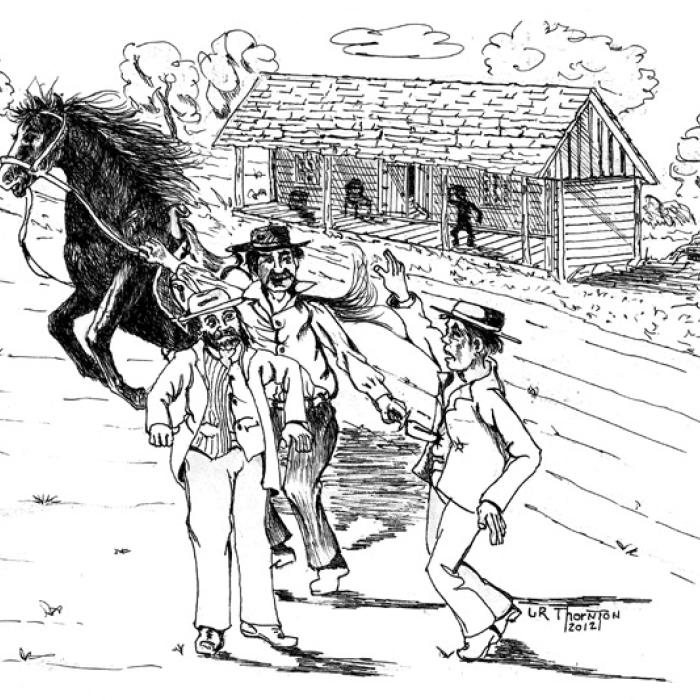
Townsend was speaking with Edward Henkel in the street when an argument suddenly erupted between Vaughn and another man, reportedly involving a dispute over a horse race. During the heated exchange, a man named Jones shouted that Vaughn should be hanged, and swung at him, and kicked Vaughn’s horse. Townsend then struck Vaughn across the shoulder and face with an open hand to intervene. The context of the horse race is lost to history. However, it is noted that Vaughn lost his last three dollars playing cards the night before.
The situation escalated quickly. Vaughn moved to the far side of his horse after the altercation became physical, then rushed toward Townsend and plunged a knife roughly six inches into Townsend’s abdomen. After committing the attack, Vaughn fled toward a nearby group of Comanche Indians with whom he apparently had some prior relationship, seeking protection before eventually escaping toward Arkansas. Stephen Townsend survived for approximately thirty hours after receiving the fatal wound before finally succumbing to his injuries.
One of Stephen’s sons pursued Vaughn to Arkansas and several years later successfully brought him back to Texas to face justice in Fayette County. When Vaughn was brought back, there was a group who wanted him to be hanged immediately, requiring him to be under twenty-four-hour guard while in custody before and during his trial. However, due to concerns that an impartial jury could not be seated locally, the presiding judge approved a change of venue. The trial was moved to Austin County and was held in the town of Bellville.
The trial itself drew little public attention in Bellville. Only a few witnesses testified, and their accounts were largely consistent aside from minor disagreements regarding the exact time of day the attack occurred. The lack of real detail other than the brief description presented here leaves more questions than answers.
Little is known about John Haywood Vaughn prior to his arrival in Round Top, and no earlier records of him appear in Fayette County. Because of this mystery, some have speculated that Vaughn may have been an assassin sent with the specific intent of killing Townsend. Given Stephen’s long career in law enforcement and his efforts against criminal gangs, he certainly had enemies who might have wished him harm.
Stephen was associated with an organization known as the Fayette Association. This group worked in support of law enforcement to bring criminals to justice in the growing but often lawless frontier communities. Few records survive regarding the association, but notices printed in newspapers in Brenham and Houston indicate that it included several prominent citizens of Fayette County, many of whom were also Freemasons.
Though he was not a leader within the Fayette Association, Stephen and others were instrumental in bringing members of criminal gangs to justice, including those associated with the notorious Short Brothers gang of rustlers. These criminals were known for stealing cattle, hogs, horses, chickens, and virtually anything of value that could be taken. One captured gang member became the first inmate delivered to the newly established state penitentiary in Huntsville. The Fayette County sheriff was accompanied by five local men on that escort, and it is widely believed the Fayette Association played a significant role in the effort.
In 1850 Stephen filed a lawsuit in Fayette County against Hugh White, who had allegedly failed to pay a bond owed to Isaac Hill, Hamilton Ledbetter, and Otto von Roeder. The bond had been entered into by Melvina White for the purchase of an enslaved pregnant woman and a boy, illustrating the harsh realities of the era’s economic and social systems. Issac Hill, a Mason, had passed away and there were several who were looking after his family’s affairs.
Hugh White may have had reason to wish Townsend dead to avoid the pending lawsuit. Members of the Short Brothers gang could also have sought revenge against the man who had helped pursue them. A third possible motive involved the Banton brothers and their expulsion from Lafayette Masonic Lodge. The Banton Brothers were expelled from Masonry for questionable morality and not paying their debts. Their property was held by the Sheriff until it was sold at auction and almost immediately after their expulsion they left the area permanently.
In the absence of clear evidence, the truth may never be fully known. However, many historians believe that the Short Brothers gang had the strongest motive and likely played some role in the crime. Vaughn’s mysterious arrival and his attempt to hide among local Indians lend weight to that theory, as the Short Brothers were known to associate with the local Indian population.
Whatever the true cause, the murder shocked the community. Stephen Townsend had been a soldier, lawman, Mason, civic leader, and pioneer who helped shape the early development of Fayette County. While I have read many newspaper articles, Lodge minutes and other items, Stephen was never called out as being memorialized in any way. Today he is buried in Florida Chapel Cemetery, marked by a simple pink granite flat stone with the Texas Ranger symbol as well as a square and compass accompanied by a red iron cross and a small Texas and American flag.