


More Recollections of the Old La Grange Hospital
Footprints Of Fayette
Fayette County is one of the most historic counties in Texas. In this weekly feature from the County Historical Commission, a rotating group of writers looks back at local history.
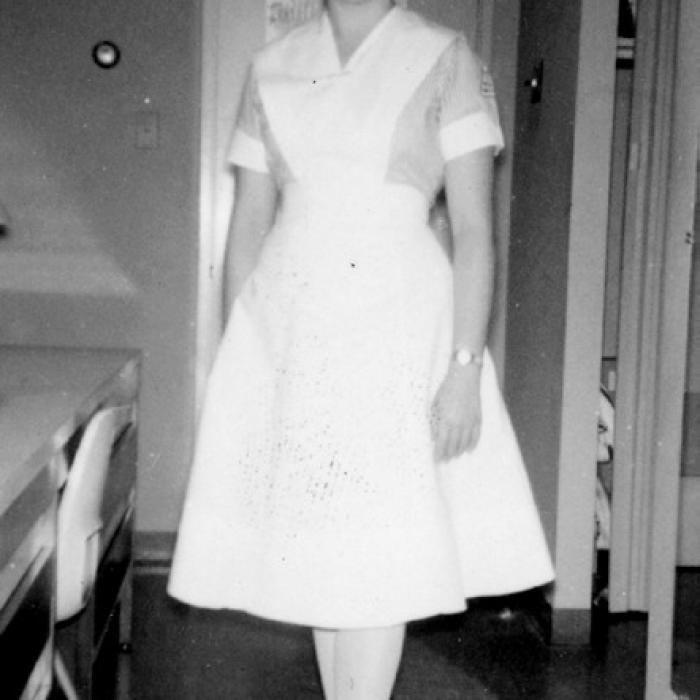
This mental journey goes back in time to the summer of 1962 after I had just graduated from La Grange High School. As a senior, I made the decision to pursue a career in nursing. My application to Texas Woman’s University College of Nursing was approved, and plans were in motion for my move to Denton, Texas. However, my mother insisted that I work as a nurse’s aide in the old La Grange Hospital during the summer to ensure that I had made the right decision. Those experiences left lasting impressions that are still vivid in my mind. Before starting my 49 cents an hour job, my mother took me to the New York Store to buy two nurse’s uniforms, a pair of ill-fitting white shoes, and two pairs of white stockings. I was now ready for my job - a greenhorn with no experience, but a willingness to learn. Interestingly, four nurses, Ida Reichert, R.N., Otillia Pohl, R.N., Elizabeth Tilton, R.N., and Cecilia Lidiak, R.N., were all still working in the hospital from the time when I had my tonsillectomy at age four.
The hospital, founded in 1920, was still antiquated over 40 years later. I doubt that anything had been updated. Two larger rooms located in the front of the hospital on both floors in the right wing had private bathrooms. Those rooms, which cost $12 per day, were part of the original house owned by Mrs. Delphine Byrnes prior to its purchase by Dr. Frank J. Guenther. Two added wings included patient rooms, an emergency room, operating room, sterilization area, nursery, dining room and kitchen, workrooms and storage closets, along with lobbies in the center. There was no air conditioning, so windows with screens were the source of any circulating air. However, the more expensive rooms up front had large doors that opened to screened porches providing better ventilation. Sometimes, when the hospital was filled, some patients had to stay on the porches. The patient rooms in the wings that had no private bathrooms were $9 per day. Ambulatory patients had to share common bathrooms located along the hallway. Otherwise, potty chairs and bedpans were the only other options. The staff had to walk down the halls carrying bed pans covered with heavy cloths to a hopper room where a foot pedal opened and closed a lid on a machine that washed and steam cleaned the bedpans. Water pitchers, emesis basins, wash basins, urinals and bedpans were all metal. IV bottles and syringes were made of glass, and needles were sharpened with a whetstone and reused. Everything was wrapped and sterilized in a steam autoclave. Wheelchairs were large and unwieldly with woven cane seats and backs, and large green oxygen tanks were wheeled into rooms with a dolly.
Needle sharpening and wrapping instruments were two of my jobs that summer, along with transporting clean laundry from the wash house behind the hospital. The laundresses, who worked in an open shed, piled the folded laundry on a gurney that I had to push across a gravel driveway, through the ER, to linen storage closets. To get upstairs, I used a large freight elevator that operated with ropes and pulleys.
Since this was before integration, there was an outside building on the left side for black patients; it was divided into wards for males and females.
One of my favorite patients that summer was Theo Kroll, an elderly gentleman who was hospitalized for weeks with a fractured pelvis. I was so enamored with the colorful stories of his life that I’d forget that I had other duties to tend to. Mr. Kroll, who grew up in Biegel, Texas, helped his father in his store and pickle factory when he was young. His favorite tales, however, were recaps of his experiences as a captain in the 1st Texas Infantry in Cuba in the Spanish American War. After the war, he returned to La Grange in 1899, married Rose Lenert in 1908, and began his career for 40 plus years, first in the wholesale grocery business and then as a consignee for Gulf Oil. Through the years, friends always called him Captain. He died three years later at age 91.
On Thursday afternoons if we were able to look out front, we were privy to seeing the “ladies of the night” from the brothel outside of town arrive in their large car, probably a Cadillac, for their weekly scheduled checkups with the physician across the street. They were always recognizable with their bouffant hairstyles, tight pencil skirts, gaudy jewelry and high heels. For a naïve 18-year-old, that was a memorable spectacle!
My most traumatic experience, however, was being attacked by a very angry alcoholic, who was hospitalized with DTs (delirium tremens), the withdrawal symptoms from being denied alcohol while incarcerated. He had been admitted from the county jail into an isolated room at the rear of the hospital away from everyone else. When delivering his lunch tray, I was unaware that he had escaped his arm restraints and was waiting with his arms hidden under the sheet. When I entered the room, he grabbed a metal pitcher and threw it at me full force while yelling Polish expletives. The food tray went flying, I moved slightly, and the pitcher hit the wall, leaving a large hole in the sheet rock. That would have been my head had I not moved quickly enough. My screaming for help brought half the staff to my rescue. He was soon handcuffed and transported by a sheriff’s deputy to another facility. That was a close call.
That summer was the beginning of a 41year career in nursing with enough stories to fill an entire book. It definitely made me grow up fast.
Sources: Ancestry.com.; military and marriage records Fayette County Record; Obituary for Theo H. Kroll; Vol. 45, No. 84, August 20, 1965; The Portal to Texas History, accessed August 29, 2026