


How Safe Are Our School Buses?
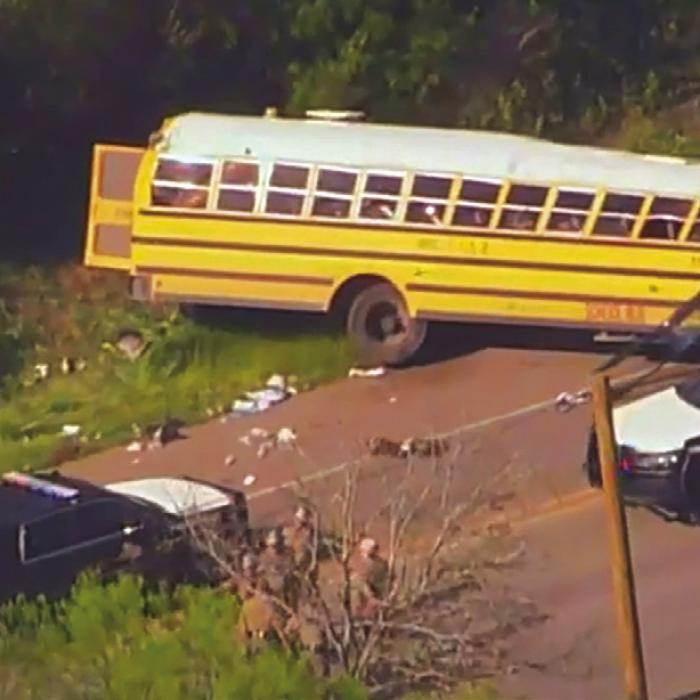
In the aftermath of the tragic school bus crash in Bastrop County last week, lots of folks are wondering whether a seat belt could have saved Ulises Rodriguez Montoya, the five-year-old who died in the wreck.
The crash happened around 2 p.m. on a narrow section of Hwy. 21 west of Bastrop, according to a report from the Texas Department of Public Safety (DPS). Montoya and his pre-k class from Tom Green Elementary School were riding in a Hays Consolidated ISD school bus when it collided with a cement truck. Montoya died in the crash and more than a dozen others were injured. A Dodge Charger crashed into the rear of the bus, killing its driver.
Hays Consolidated said DPS is conducting an investigation to determine whether a seatbelt would have made a difference.
Texas law requires all school buses purchased after 2017 to be equipped with three-point seatbelts for every passenger. The bus involved in the accident on Hwy. 21 last Friday was a 2011 model and thus exempt from the law.
For local school leaders, the tragedy hits close to home.
“This was the thing I worried about the most when I was superintendent,” said retired La Grange Superintendent Erwin Sladek.
This week the Record contacted each of the public schools in Fayette County to inquire about their bus fleets. We learned that most school buses here are not equipped with seatbelts. La Grange ISD has 12 buses equipped with seatbelts out of a fleet of 27.
Schulenburg ISD has 13 buses in total. Five of them have seatbelts throughout the entire bus, and one bus has four seats equipped with seat-belts for smaller kids. Seven buses have no seatbelts.
Flatonia ISD has five regular buses newer than 2018 that have seatbelts along with two Special Education buses that also have seatbelts. Flatonia ISD reported six buses in their regular fleet without school seatbelts, ages 2009 to 2016. Flatonia’s fleet also includes two back-up buses without seat belts. The district’s two white “marshmallow” buses (which accommodate less than 14 passengers) all have seatbelts.
Round Top-Carmine ISD has ten buses, and five of them have seatbelts.
La Grange, Schulenburg, Flatonia and Round Top-Carmine ISDs each reported that they try to use only seatbeltequipped buses for out-oftown travel for field trips or extracurricular activities.
Fayetteville ISD does not have any buses equipped with seat belts.
Older school buses can be retrofitted with seatbelts, but at substantial cost. According to the National Association of Pupil Transportation, outfitting school buses with seat belts ranges between $7,000 to $11,000 per vehicle. None of the school districts in Fayette County reported interest in retrofitting older buses. The La Grange, Schulenburg, Flatonia and RT-C superintendents said their districts will eventually phase out all of the older buses without seatbelts as they purchase new buses.
“I think we need to look at the big picture,” said La Grange Superintendent Andy McHazlett. “That was a cement truck that hit a school bus, and a lot of kids survived. You tend to forget that because of the death, and it was horrific. But it could have been worse. What if they were traveling in a van or some other vehicle?”
According to figures from the Texas Department of Transportation, there were 2,305 crashes involving a Texas school bus in 2022. Of those, there were seven fatalities, amounting to a fatality rate of about three percent. Overall, there were more than a half million crashes on Texas roads in 2022 with over 4,400 fatalities – a fatality rate of nearly eight percent.
Sladek, who continues to serve on the Texas Region 13 Education Service Center board of directors, trained school bus drivers throughout the region for more than 25 years. He spoke about their safety record.
“School buses are designed for what we call compartmentalization,” Sladek said. “You’ve got high back seats. The seats are padded, and the back of the seats are padded. If you are in a collision, the youngster goes forward into the padded seat. They’re all compartmentalized. You might have some injuries, but the kids survive. That’s why there wasn’t a requirement for seat belts before.”
Sladek said the seatbelt law for school buses was somewhat controversial when first proposed. He said seatbelts can complicate rescue efforts when a bus rolls into a body of water or catches on fire, especially with young children who might need help unbuckling the belt.
Regardless, Sladek said school buses – even those without seatbelts – provide the safest way to transport children.
“We don’t have very many fatalities on school buses,” Sladek said. “We have way more fatalities with the loading and unloading process, when other vehicles are running over the kids. That’s where most of the fatalities occur. It doesn’t usually happen in school bus accidents unless you flip one over.”
That’s what happened last week in Bastrop County. The bus rolled after the concrete truck hit it.
When fatal bus crashes do occur, Sladek said, the deaths tend to be concentrated around the point of impact. Other times, he said, the students killed were standing up or walking in the bus when the crash occurred. He said students seated in a school bus are much more likely to survive a crash than students traveling in a van or car.
“School buses are the safest vehicles out there on the road,” Sladek said. “They’re designed that way, they’re built that way. They’re reinforced.”
Round Top-Carmine Superintendent Brandon Schovajsa agreed with that assessment.
“When it comes to school buses, you have a safety factor with the weight alone,” he said. “I’m certified to drive a bus, and the training you have to go through really harps on how the impact in accidents, even from a head-on collision, the bus absorbs the shock. Our school board is very adamant – they want our kids on a school bus because of the safety aspect.”
Flatonia Superintendent Chris Sodek said students in his district attend a bus safety training session shortly after the start of every school year.
“We show them how to properly evacuate the bus if there’s an accident or if it’s on fire,” Sodek said. “We teach them to help each other. We’ve taken the proper steps to train our kids so that if we do get in an emergency, we’d have some idea how to function in that situation.”
Local Paramedic
Was Incident
Commander at
Bus Accident
An off-duty Fayette County paramedic served as the incident commander for the Bastrop County school bus wreck last Friday.
Fayette County EMS Director Josh Vandever said one of his department’s paramedics, Preston McGraw, also serves as a Bastrop County First Responder.
McGraw was off duty for Fayette County at the time. Vandever said McGraw responded to the scene for Bastrop County and served as the incident commander.
McGraw coordinated the medical response to the wreck, which involved a concrete truck and a Hays CISD school bus with 44 Pre-K students and 11 adults who were on a field trip. One of the children died in the wreck, along with the driver of a Dodge Charger that crashed into the back of the bus. More than a dozen people were injured, including four who were flown by helicopter from the scene.
“Since the incident, multiple agencies have reached out to show their appreciation for our team member’s performance on the call,” Vandever said.
Vandever said Fayette County EMS sent an ambulance to Bastrop County last Friday to assist with the call.
“Fayette County EMS was notified of the accident by regional EMS authorities and dispatched an ambulance to the scene,” said Fayette County EMS Director Josh Vandever.
He said the ambulance was about five minutes away from the scene when Bastrop County authorities got the situation under control and canceled their call for assistance.
“It was truly a heartbreaking incident and everyone affected remains in our prayers,” Vandever said.