


How a Beloved Christmas Custom Forever Captured a Fayette County Woman’s Heart
For Margaret Roscher, it isn’t Christmas until she can indulge in “The Nutcracker”
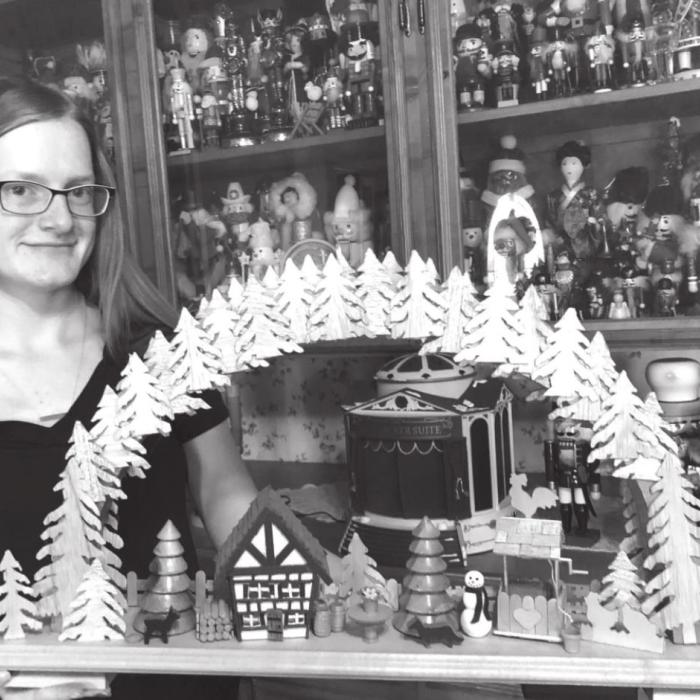
Margaret Roscher’s joyfilled Christmas addiction dates back to the late-1970s. That’s when her mother, Audrey Huenefeld of La Grange, took Margaret to see Ballet Austin perform “The Nutcracker” at Bass Concert Hall in the capital city.
Audrey had no clue how the most frequently performed of all ballets would affect her young teenage daughter. In fact, Audrey recalls that Margaret and her two brothers, John and Robert, weren’t keen on the idea of even going.
“There was a lot of grumbling, but I told them, hey, you only have to do this once. If you don’t like it, I’ll never ask you to go again,” recalls Audrey, who loves classical music. She then wrote and ordered their tickets through the mail.
A La Grange music teacher at the time, Audrey had become familiar with Tchaikovsky’s famous ballet when she studied music years before at Southwest Texas University (now Texas State) in San Marcos, Texas.
“The Nutcracker” is the story of a little girl named Clara who receives a wooden nutcracker as a Christmas gift. On Christmas Eve, it comes alive and, after waging a battle against the Evil Mouse King, turns into a handsome prince.
“I’d never seen “The Nutcracker” performed professionally, so I’d always promised myself that one Christmas when our kids were old enough I would take them,” Audrey says.
Much to Audrey’s delight, all three of the Huenefeld children were smitten by the live event, but it made the most dramatic impact on Margaret. That enchantment has stayed with her.
“I came out of the hall with stars in my eyes and I have never lost that sense of awe,” Margaret says.
“The music, the costumes, the story, I love it all. For me, that ballet represents the magic of Christmas. Other ballets don’t appeal to me.”
Margaret’s introduction to “The Nutcracker” inspired her to collect the symbol of the ballet, the brightly painted wooden folk art figurines that resemble soldiers.
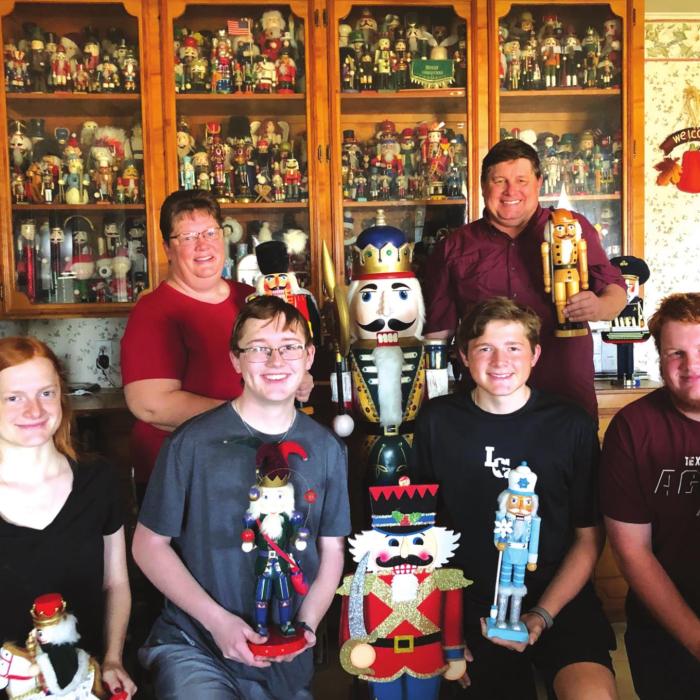
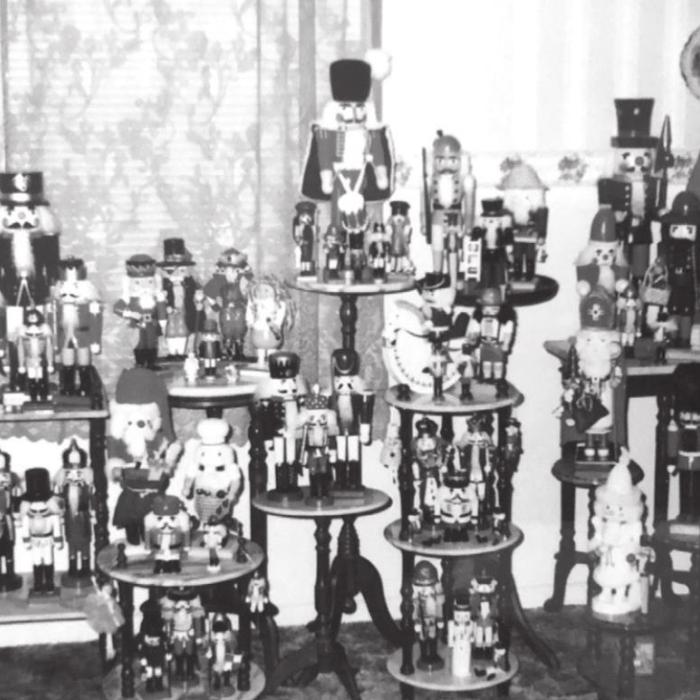
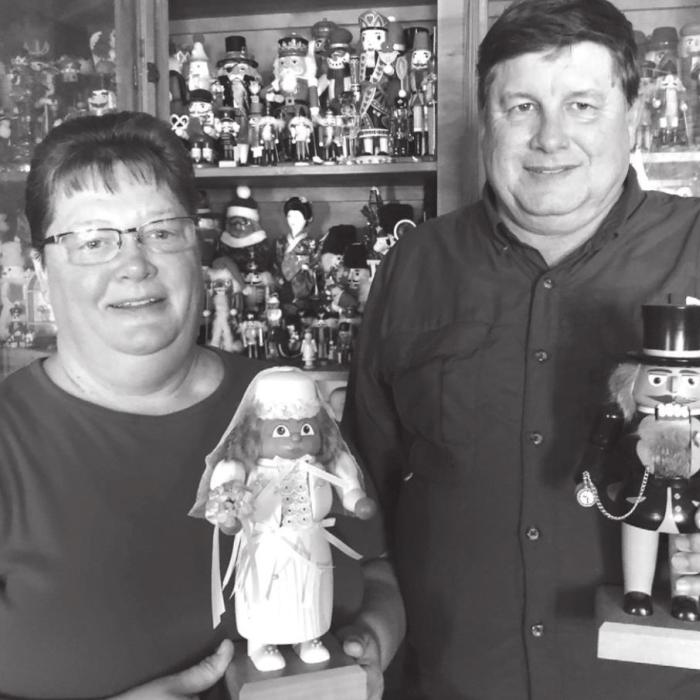
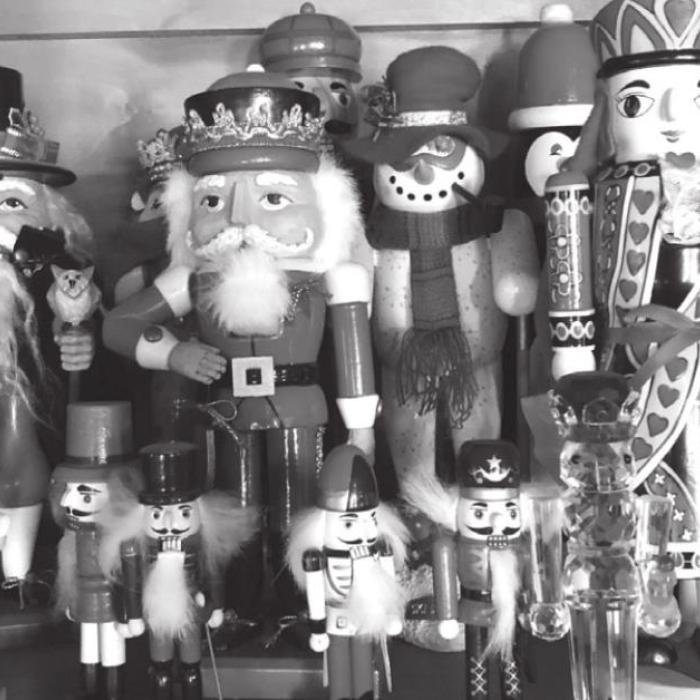
She and her husband, Glen, and their four children share their Hostyn farm home with a carefully curated collection of 275 to 300 nutcrackers that is on display year-round.
“Christmas is my favorite holiday and favorite time of year, so leaving my nutcrackers up is an uplifting reminder of the joys of the season,” Margaret explains.
Nutcrackers fill to overflowing a specially constructed living room cabinet and stand at attention on either side of it. They range in size from two inches to life-size, although the average size is 10 to 12 inches tall.
Glen lends support
Glen was introduced to “The Nutcracker” while growing up on the Hostyn area farm where the family lives today.
“Rev. Arlyn Hausmann, the pastor at the Swiss Alp Church, took some of us kids to a production of the ballet at Bass Concert Hall in Austin as a Christmas treat.
“I’d never seen anything like that,” he remembers. “I couldn’t follow the ballet intricacies, but I liked the story.”
Little did he know what good education that experience would be for the day he started dating his future wife, nutcracker enthusiast Margaret Huenefeld.
Possibilities abound
Traditionally, nutcrackers have been carved from birch and beech trees in Germany, but there’s no end of alternatives available to avid collectors like Margaret. Choices now include the popular figures fashioned in glass, candlewax, fabric and crystal. Beyond the traditional form, nutcrackers are now available dressed in professional sports teams’ uniforms and colors. You can even find those that celebrate different professions and hobbies.
Famous German makers, such as Steinbach and Christian Ulbricht still handcraft high-end market nutcrackers that cost several hundreds of dollars each. For the less expensive, massproduced versions readily available in big box stores and online, especially during the Christmas season, the quality varies with the prices.
Margaret’s collection includes some of each, as well as sentimental favorites.
There’s the tall, handsome nutcracker that Margaret’s brother, John, cut out of wood for her when she was 16 years old. She painted that nutcracker with such care and skill that it won a grand champion ribbon at the Fayette County Fair. Two other cherished nutcrackers are the bride and groom that graced the entry table at the wedding reception after Glen Roscher and Margaret were married.
Her sister-in-law, Linda Anders, who frequents garage sales and thrift shops, keeps an eye out for an unusual nutcracker that’s not duplicated in Margaret’s collection
Glen and Margaret’s children Josh, Abigail, Colton and Tyson keep a discerning eye out for additions to the collection. Glen was thrilled one year when he rounded the corner in a department store’s Christmas shop and found a four-foot nutcracker waiting for him.
“I’m out of room, so I have to be pickier, but I always find a place for a special new nutcracker, as well,” Margaret says.
She pauses and, with a gleam in her eye, adds, “I could probably fill this entire house!”
Visiting the makers
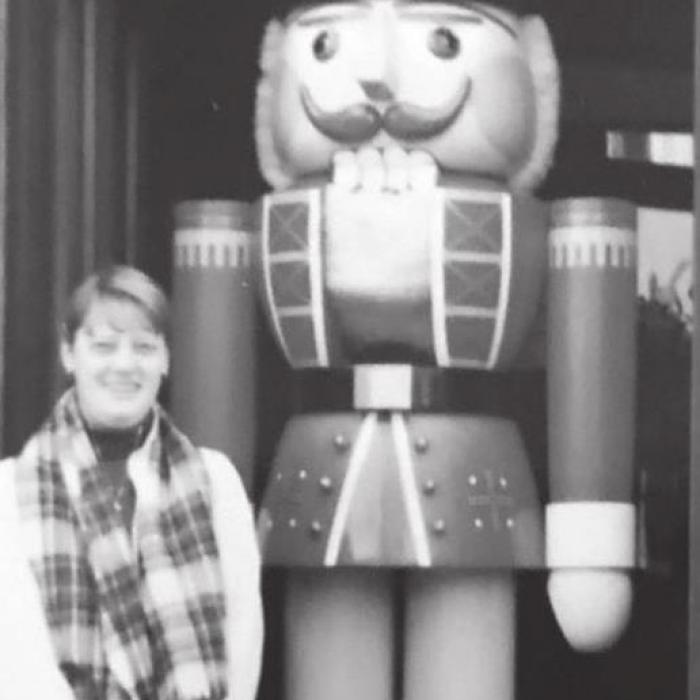
Margaret certainly felt that urge in 1995, when she and her mother accompanied Fayette County German war bride Renate Meiners, who served as their tour guide, on a trip to Ger many. Before the Huenefelds left Texas, Audrey got in touch with distant relatives in Seiffen, a village in the Erzgebirge region of Saxony.
That just happens to be the mecca for nutcracker makers and their devoted and diehard fans. Legend has it that local woodcraftsmen began making nutcrackers to earn a living after the local mines played out more than a century ago.
“When our relatives came to welcome us, they invited us to go back to their home. I just couldn’t! I wanted to spend my limited time in the village of Seiffen visiting the back rooms of the different shops to watch nutcrackers being created. Mom understood, so she went with our relatives while I dashed in and out of stores all afternoon with a shopping bag in my hand. I loved it,” Margaret recalls.
Circumstances soon reversed for the mother-daughter collectors when the Fayette County tour stopped in Lauscha, Germany, the mecca for delicate hand-blown glass Christmas ornaments. Margaret appreciated watching her mother indulge her passion for collecting the exquisite baubles.
It was by no means the only time that the mother-daughter team indulged their zeal to shop for additions to their respective Christmas collections.
“After the first time Mom took us to “The Nutcracker,” we went again and again. We made it a point to stop at Highland Mall in Austin, which was “the” place to shop at the time. One of the major department stores always set up a nutcracker village with new additions each year. I was in hog heaven,” Margaret recalls.
How the craft and ballet clicked
Although called nutcrackers, the purpose of these figurines was never to crack nuts!
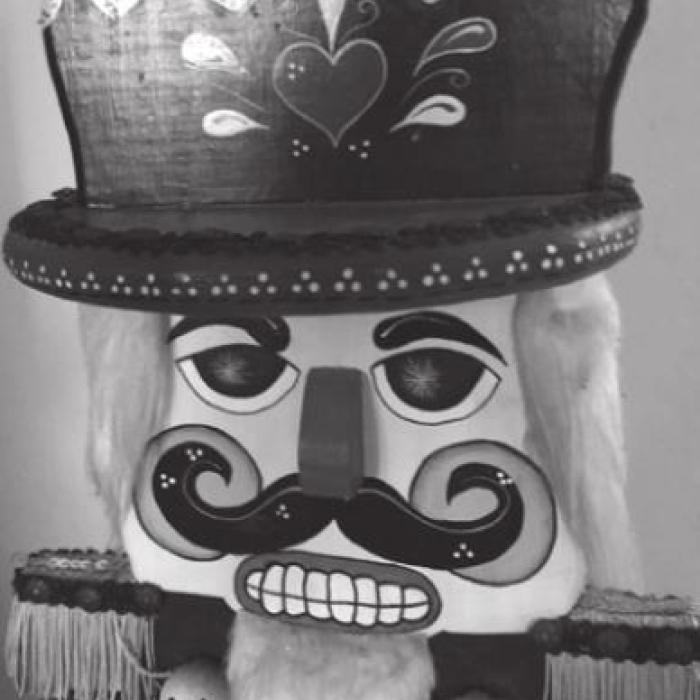
According to German folklore, nutcrackers were given as keepsakes to bring good luck and goodwill to families and to protect their homes by keeping away evil spirits and danger. During the early 1600s, nutcrackers began as ugly hand-carved figures. Considered fierce protectors, that’s why nutcrackers traditionally show their teeth.
As the centuries passed, nutcracker art evolved and so did their role. It is said their purpose developed as a way to poke fun at the reigning aristocracy, much like what our modern-day political cartoons do.
After Peter Tchaikovsky of Russia composed “The Nutcracker Suite” in 1892, the popularity of nutcrackers spread well beyond Germany. This ballet was performed in the U.S. in 1940 for the first and, since the opening scene is a Christmas party, it soon became a holiday season favorite.
American soldiers serving in the European Theater during World War II are credited with introducing nutcrackers to the folks back home when they sent them as Christmas gifts.
“But I’ve yet to find a nutcracker in an antique store,” Margaret says. “That tells me they weren’t readily collected or perhaps they still were so rare and precious that they were handed down in families.”
Nutcrackers are cherished by the Roschers as is the firmly entrenched family ritual of attending the ballet.
“My brothers and I have kept the tradition alive by taking our children. We hope in the future our children will take their children,” Margaret adds.
Merry Christmas to all!
*Due to COVID safety concerns, Margaret and her family won’t have an opportunity to see a live performance of “The Nutcracker” this year. However, she already has the DVD out and has plans to watch it more than once!
If you’d like to read more of Elaine’s stories, visit www. elainethomaswriter.com/blog/ and sign up to receive new posts twice a month. You can also call Elaine at 979-263-5031.