


Garden Blues of the Good Kind: Colorful Corn
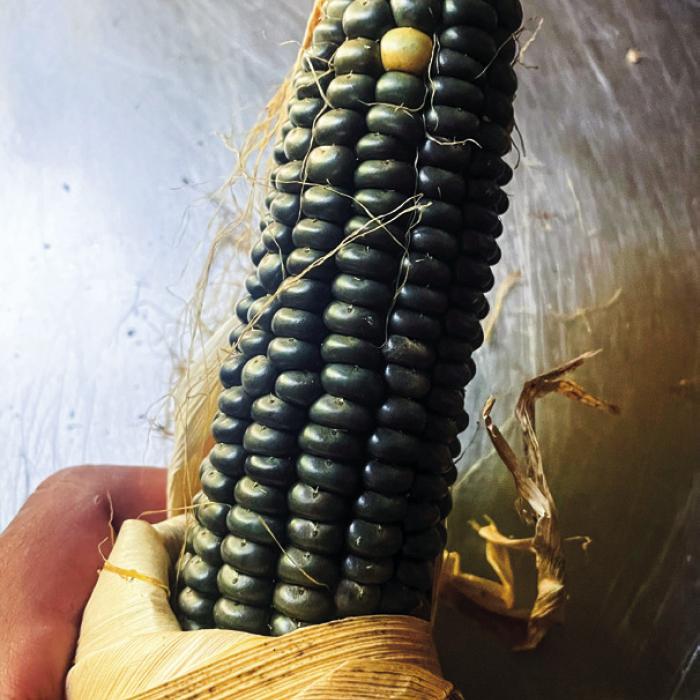

Last week I harvested my patch of Hopi Indian blue corn.
A fellow Fayette County gardener, Larry Ripper, gave me the seed last year. I reckon the seed he gave me amounted to about one and a half ears. I think it produced about 25 lbs. of corn, although I haven’t shelled it yet.
The corn grew quite tall, about seven feet, some plants even taller. And most of the plants produced two ears – one big one and one smaller one. I lost a little bit of it to deer pressure. I guess that’s something I should expect.
I tried spacing the blue corn away from a patch of sweet corn I grew. That wasn’t far enough. The plants closest to the sweet corn had a little cross-pollination. After harvesting, I noticed that some of the kernels were yellow and wrinkly like dry sweet corn. I’ll probably feed those ears to my chickens.
But most of the ears appear true-to-type. It’s quite beautiful – dark, inky blue. The kernels are plump and round – it’s definitely not a dent corn.
I’ve been wondering, would it be economical to grow open-pollinated corn like farmers did years ago? They’d feed most of it to the animals and keep some for grinding into cornmeal for the kitchen. But they’d always save enough seed to plant the next year.
These days, corn farmers plant hybrid varieties for bigger yields and better resistance to insect and weed pressure. But you can’t really save the seed for replanting. Seed from a hybrid crop usually grow into less vigorous plants with wide variation in characteristics.
Over the years, corn farmers have accepted this trade off. They can harvest bigger yields. Modern genetically engineered varieties allow farmers to spray herbicides without harming their crops.
These technological breakthroughs mean fewer farmers can feed an evergrowing world population. But they have to buy seed every year.
The ag industry treats corn as a standard, uniform comodity. But not all corn is the same. Research shows that open pollinated varieties contain more crude protein, digestible protein, sugars and minerals than hybrid varieties. Other studies have shown that livestock, when given the option, prefer open pollinated corn to hybrid corn.
A few plant breeders are experimenting with new open pollinated varieties with higher yields. But I doubt corn farmers will switch any time soon. It’s too risky.
I’m not too worried about risk on my small acreage with a few cows and chickens.
So what am I going to do with my blue corn? I’m not sure. I’ll definitely save a bunch of seed to plant a larger patch next year.
A long time ago, my dad and I bought an old four-row John Deere planter and cultivator at a farm auction. I’ve long fantasized about using this equipment top plant a big patch of heirloom corn to feed my livestock. Maybe one day.
I plan to grind some of my blue corn into cornmeal. I’m going to try and make some masa and hominy as well. The ancient Aztecs and Mayans invented the process to make these products. It’s called nixtamalization.
The process involves boiling the kernels in a solution of water and slaked lime (calcium hydroxide). The chemical reaction removes the outer coating of the kernel, known as the pericarp, and it softens the kernel.
The whole kernels of nixtamalized corn are known as hominy. Masa is made by grinding fresh, soft hominy. It forms a dough that can then be made into corn tortillas, tamales, gorditas, empanadas and all sorts of other Mexican specialties.
I’ve never made masa or hominy from scratch before. If any of you have tips or suggestions, please let me know. Email me at andy@fayettecountyrecord. com.