


Fire Marshal’s Report Reveals New Details About Hostyn Church Explosion

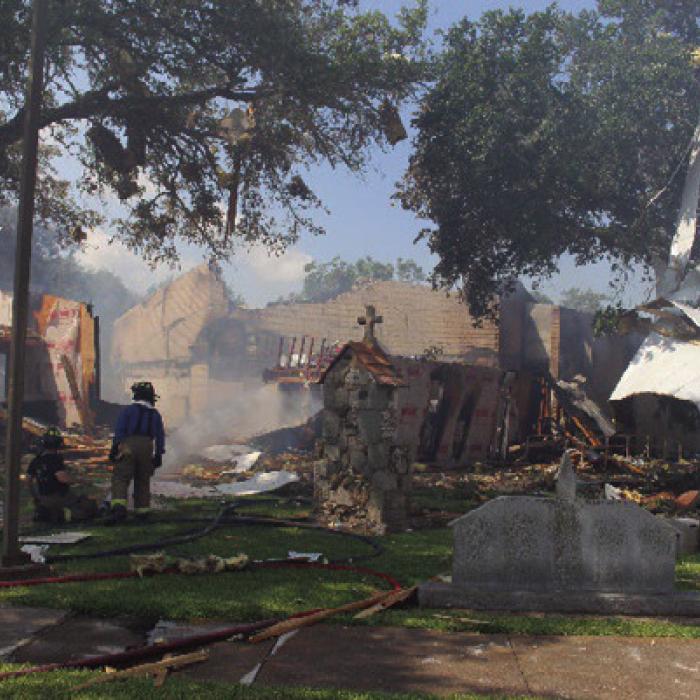
The State Fire Marshal’s Office released the investigation report into the 2022 Hostyn Church explosion. The Record obtained the report through an open records request filed earlier this month.
The report confirms that natural gas fueled the explosion that destroyed the Queen of the Holy Rosary Church in Hostyn. The blast happened just before the 7 a.m. mass on June 9, 2022. A 75-year-old parishioner, Verlene Kuntschik, was inside the church during the explosion. She died from injuries 11 days later.
The investigator, Deputy State Fire Marshal Jackson Durbin, stated that the cause of the fire was classified as “undetermined.” Investigators concluded, however, that the explosion was fueled by “natural gas vapors from an unidentified source.”
Durbin and a team of four other investigators and a fire investigation canine arrived at the scene on the day of the explosion while local firefighters were still putting out the blaze.
“Natural gas was supplied to the structure via two separate connections on the east side of the building,” the report said. “Gas supply was turned off by the gas company prior to my arrival. Structural members throughout the building were extensively consumed and exterior masonry walls were examined for potential collapse hazards.”
The report said Fayette Electric Cooperative, the power provider, had disconnected power to the church after the explosion.
“I observed no indication of an electrical malfunction on the exterior of the panels or transformers,” the report said.
“The main gas supply and other components were located off the property to the northeast and was operated by CenterPoint Energy,” the report continued. “Gas supply was turned off to the property by CenterPoint.”
The report went on to describe the damage to the building: “I first examined the south side of the church which faced FM 2436. A debris field spanning four hundred seventeen feet to the south of the church was located. Much of the debris furthest away was observed to be insulating material, with wood and glass products closer to the church. The south exterior walls were constructed of masonry materials.
“Theroofwasofmetalconstruction. Roofing materials remained mostly intact but had begun to droop and sag over the eaves. Three large stainedglass windows sat in the center of the wall and spanned nearly from the ground level to the roof line. Photos show fire having ventilated through the window openings prior to fire department arrival. Smoke and soot staining above the windows was present and consistent with ventilation. Portions of the metal framing still remained in the windows. Behind the stained- glass windows and furthest south wall, was an enclosed entry way.
“Multiple stress fractures had begun to form within the exterior walls. Fire patterns and fire effects were consistent with the fire having spread to the south from the north and interior of the structure.”
The investigators documented a debris field that “spanned from the structure twelve hundred feet to the east and northeast. The furthest debris from the structure was lightweight materials such as paper and insulating materials. Glass and wood products were observed to be scattered closer to the structure. Fire patterns and fire effects were consistent with fire progression from the interior of the structure to the exterior.”
They found a large door frame 257 feet to the north of the church in the parking lot.
“Significant portions of roofing materials were located in adjacent trees on both sides of the structure and throughout the lawn,” the report said.
Concerning the area where the explosion originated, Durbin wrote the following: “Based on the destruction and availability of remaining materials, observation of fire patterns and effects, witness observations, and inspection of physical evidence, I was unable to determine with any degree of scientific certainty an area of origin smaller than the north portion of the structure, in or near the adoration chapel. Initial witness observations placed Mrs. Kuntschik inside the adoration chapel before the explosion occurred. Mrs. Kuntschik was reportedly lighting a candle in the area of the chapel at the time of the incident. Initial reports and interviews indicated that church members recalled the ‘smell of gas’ during a church function the night prior to this incident.”
Due to those witness statements, Durbin said his team focused on identifying the natural gas supply lines to the interior of the structure.
“Two gas supply lines were identified to have entered the structure along the eastern wall near the entryway,” the report stated. “Exterior gas regulator and valves were located and inspected by (Deputy State Fire Marshal) Randy Ray and CenterPoint gas. I was unable to examine the southern supply lines due to hazards on scene.
Durbin said he inspected the northern supply lines and the lines that branched from it.
“Due to the initial damage done by the explosion and following damage done during extinguishment operations, the majority of the branching lines were disconnected, dislodged, or otherwise untraceable,” the report said.
Durbin said he could not identify any pin holes or protrusions in the branch lines he inspected.
“A majority of the electrical circuits and related components (were) unable to be examined due the amount of destruction done to the utilities system inside the structure,” the report said.
Later in the report, Durbin said he interviewed several witnesses and church officials. Durbin said he spoke with a person identified as a part-time maintenance worker for the church. He asked the maintenance worker “if he had been alerted to the possible ‘smell of gas’ reported the night prior to the fire incident.” Durbin said the man “stated he believed the reports to be part of the ‘rumor mill.’” Durbin also interviewed a female parishioner who was walking up to the church just as the explosion happened. The woman said she arrived at the church around 6:20-6:25 a.m. and observed Kuntschik parking her vehicle.
“(She) advised that as she was parking her vehicle, Verlene walked into the church,” the report stated. “(She) continued and stated that she was approximately three feet away from the covered walkway leading to the northern entrance of the building when the explosion occurred. She described the explosion as a ‘balloon popping.’” The woman described glass and other debris flying past her and the roof getting thrown to the side. After the explosion, the woman went to her car and called 911. She went on to say that she saw Father Felix Twumasi, the pastor, exit the rectory. She and Father Felix began looking for Kuntschik inside the church.
“(...) she observed Verlene crawling on her knees through the flames from the eastern end of the adoration chapel towards the west,” the report said. (She) advised that they then saw Verlene near the entrance underneath the walkway. (,,,) she and Father Felix assisted Verlene up and carried her away from the church. She advised that Verlene stated she didn’t know what happened. Verlene reported she had “flicked on the lighter” when she heard a sound and crawled underneath a pew.”
Durbin asked the woman if she smelled gas.
“(She) advised that the night prior when she was there she did not smell gas and had blown out all the candles prior to leaving,” the report said. (She) also reported not smelling gas the morning of the explosion.”
Durbin stated that a concerned citizen contacted him on June 15. The citizen told Durbin he was concerned about some “gas lines and construction work within the area at the time of the explosion.”
The report went on to say that the citizen “advised through one of his conversations with the Sheriff’s Office, he was told that a sheriff’s deputy observed gas employees leaving the area from Kallus Road (nearby to FM 2436.)” Durbin said the workers were employees of a third party contractor working for a company named Sexton, Inc. The contractor, Accurate Inspections and Monitoring, was at a site off Radhost School Rd. performing “on and off tests,” the report said.
Durbin spoke to one of the crew members conducting the test.
“(The crew member) explained to me that he and his crew were conducting “Close Interval Surveys” of the pipeline running from Schulenburg,” the report said. “(He) advised that he and his crew had made it to the Radhost School Road station the day before and were going to begin with that station on June 9th. (He) explained that the morning of the explosion, he and his crew had not begun work yet when they observed the plume of smoke coming from the church.”
Durbin concluded his report with the following synopsis: “Based on the information available at this time and after conducting a systematic fire scene examination, inspecting physical evidence, and considering witness observations, I was able to determine the area of origin to be in the northeastern portion of the structure, in or near the area of the adoration chapel. The source of ignition was determined to be an open flame, which ignited fugitive natural gas vapors from an unidentified source. Upon conclusion of the origin and cause examination, the cause of the fire was classified as UNDETERMINED.”
He said the case will be listed as closed, but added that, “Upon receipt of new information regarding this case, I reserve the right to analyze the data and determine what, if any, bearing it may have on my opinion.”
The report said the church had a total assessed value of $1,820,640. The structure was insured through Catholic Mutual Group, but the amount of insurance was redacted from the report.
Read the report in its entirety online at https://www.fayettecountyrecord.com/hostyn-church-explosion-firemarshals-report.