


The Fayette County History Walk, Part 4
The Fayette County History Walk tiles 31 through 40, on the perimeter of the courthouse lawn, covers the period 1873 to 1894.
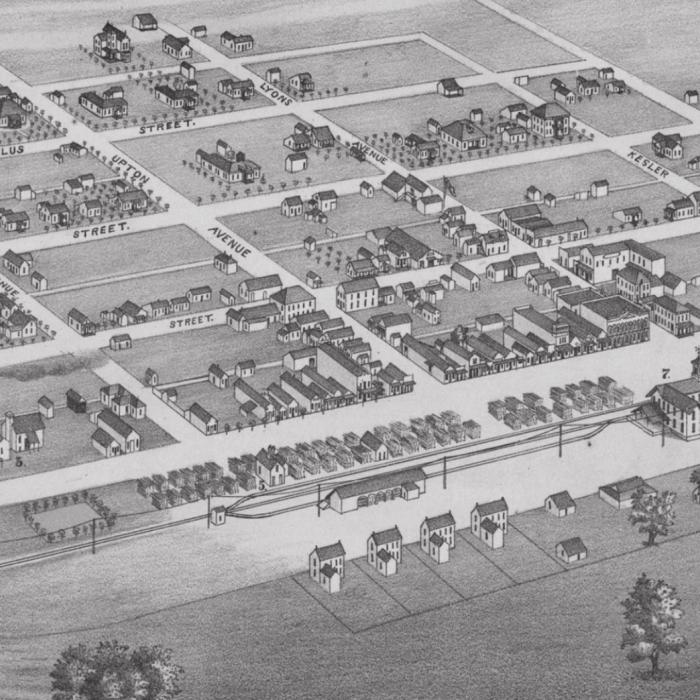
31. Schulenburg was established in March 1873 after the Galveston, Harrisburg, and San Antonio Railway Company purchased 450 acres from Louis Schulenburg. Christian Baumgarten, Franz and F. A. Stanzel, and John Wittbecker also offered land as an inducement to get the railroad and a town built. The railroad drew many High Hill businesses and residents into Schulenburg. The town was incorporated
The town was incorporated on May 24, 1875 and by 1885 its population was over 1000 and 90 per cent of the inhabitants being foreign-born.
32. Flatonia was established in October 1873, when a half interest in 160 acres of the W. A. Faires survey was conveyed to the president of the GHSA Railroad, T. W. Pierce, by F. W. Flato, John Cline and John Lattimer. When the rail arrived in April 1874, many inhabitants of older communities like Oso, Cistern and “old” Flatonia soon migrated to be near the new depot. The Flatonia Argus, the oldest operating newspaper in the county, was established in 1879 by P. E. Edmondson (see note below).
33. In 1876 Julia Lee Sinks compiled the first history of Fayette County.
The 1880 county population was 27,996—a 66% increase in ten years. There were 116 public free schools with 105 teachers and 3,525 white and black students.
In the 1880s, U.S. Post Offices were established at Colony, Dubina, Engle, Freyburg, Muldoon, Nassau, Oldenburg, O’Quinn, Plum, Waldeck and Walhalla.
The La Grange Journal began publication on February 18, 1880 and was in business until 1986.
34. 1880 was a watershed year for La Grange, because the first rail connection to the outside world was achieved when the GHSA Railway built a spur line from Alleyton to La Grange. A depot was built at the half-way point and the town of Ellinger was established when much of Live Oak Hill moved to the rail line.
The first train of the La Grange Branch arrived in town on New Year’s Eve 1880. A passenger and freight depot were built, and within five months over 2000 bales of cotton had been shipped out by rail
35. Precinct courthouses are unique to Fayette County. Seven were approved beginning in 1880 including Ammannsville, Winchester and Schulenburg which no longer exist and those which can still be found in Fayetteville, Flatonia, Muldoon and Round Top.
The communities of St. John, Gay Hill, Prairie Valley and Rek Hill were formed.
In 1882, the third Fayette County Jail, designed by the firm Andrewarthe and Wahrenberger, was built in the Victorian Gothic style of rusticated limestone. The same firm had designed the Casino Hall in La Grange.
36 Fayetteville was incorporated in March 1882.
Carmean was founded by Dr. Benjamin J. Thigpen in 1883. The spelling was later changed to Carmine due to postal confusion with another town.
In 1884, an 18-foot-tall marble and limestone shaft was placed on the courthouse square honoring the Mier and Dawson heroes.
In 1886 Gus Steenken established Oldenburg, southwest of Warrenton.
37. In 1887, the Missouri-Kansas-Texas Railway Company (MKT) was the third line, passing through Kirtley to La Grange and then on to Pisek before leaving the county.
The San Antonio and Aransas Pass Railway Company (SAAP) was the last rail line to enter the county, passing from Flatonia to Winchester along its 30.9-mile route.
The small communities of Halsted, Plum, Engle, and Muldoon all developed as a result of the railroads. By the end of 1888 passenger and freight trains were prevalent.
38. By August 1887 La Grange had a telephone connection with Schulenburg and, within three years, telephone lines were installed throughout the county.
A county poorhouse built in 1888 provided medical and housing services for the indigent.
In 1889, Dr. I. E. Clark laid out Bermuda Valley Farm Racetrack near Schulenburg. Clark traced the course free style in his buggy.
In March 1889, the KJT, Czech Catholic Union of Texas, was founded at Moravan/ Hostyn.
39. In 1890, the population of the county was 31,481, the 14th largest in the state.
That year the third courthouse was deemed unsafe yet required dynamite to demolish it.
Architect J. Riely Gordon of San Antonio designed the fourth courthouse. The Romanesque Revival three-story structure built with four types of native stone, including Muldoon blue sandstone, featured a clock tower and open atrium for lighting and ventilation. The building was completed by November 1891.
40. In 1892, water pipes connected the jail and courthouse, where electric lights were also installed. Infrastructure modernization was happening in larger communities throughout the county.
In 1893, major fires occurred in Schulenburg and Fayetteville, where the east side of the square was destroyed. The Schulenburg Sticker was established.
In 1894, August Loessin was elected sheriff and served for twenty-six years.
Note: The Argus was first published in Schulenburg in March 1877. Later research showed Edmonton then moved The Argus to Flatonia some time before March 1878.
Footprints Of Fayette
Fayette County is one of the most historic counties in Texas. In this weekly feature from the County Historical Commission, a rotating group of writers looks back at local history.