


Data Center Frustration Boils Over
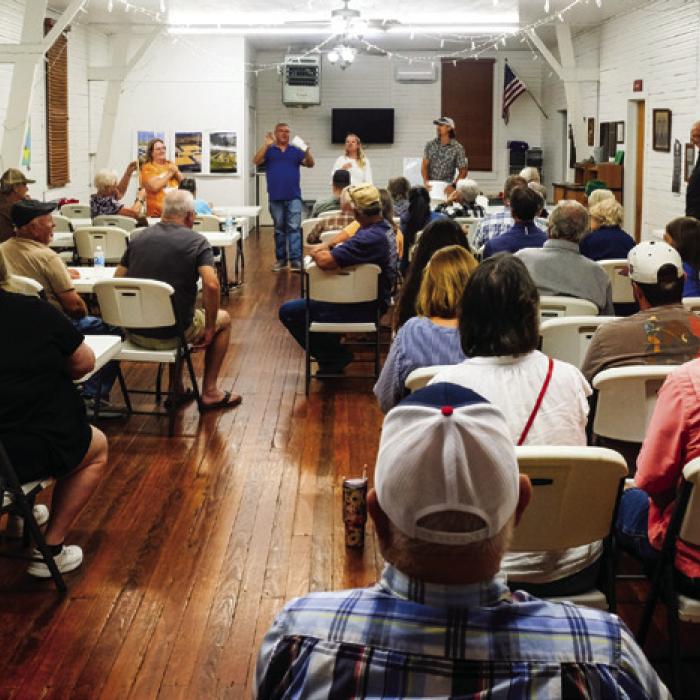
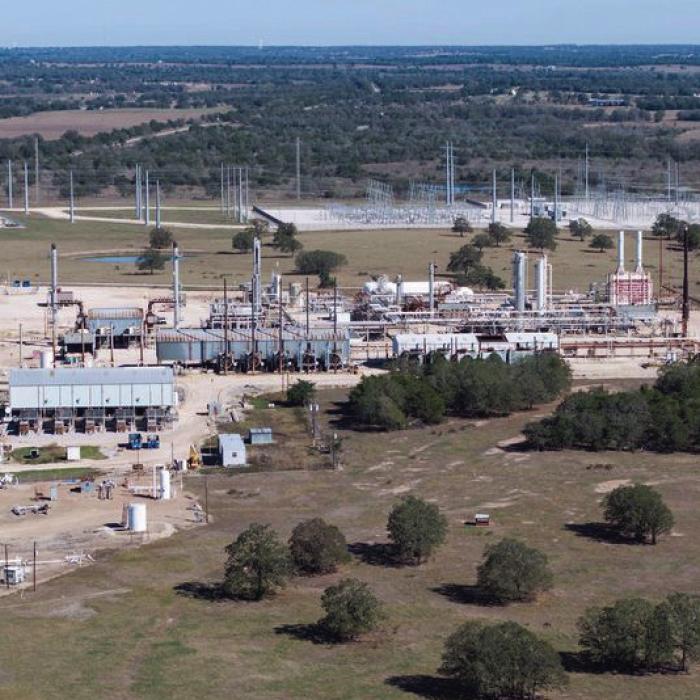
More than 75 people packed inside Zilss Hall in Winchester Monday evening for a community meeting about the proposed data center on FM 448 north of Winchester. Neighboring property owners Scott Parker and Derek and Kayli Head led most of the discussion. Photo by Andy Behlen This aerial photograph of the gas plant and nearby electrical substation on and near the FM 448 property in Winchester appears on the PlaceMKR website in an article from March 17 titled “What Normal Looks Like After the Reset.” The article does not mention the Winchester data center or the FM 448 property. Instead, it talks about the company’s investment focus. “For PlaceMKR, ‘normal’ does not mean sitting on the sidelines. We are actively targeting $200M in acquisitions this year. However, deploying that capital requires intense selectivity.” It goes on to describe some of its investment focus, including “powered land,” which it defines as “High-Power Industrial sites capable of supporting data centers and advanced manufacturing.”
A crowd of more than 75 people packed into Winchester’s Zilss Hall Monday night for a community meeting over a data center project in the area. Most of them strongly oppose the project.
Back in May, a company named La Grange-Winchester LLC leased with an option to purchase approximately 414 acres north of Winchester on FM 448 from the Jimmy Luecke Family Partnership. La Grange-Winchester LLC is a subsidiary of the Austinbased development company PlaceMKR.
According to PlaceMKR’s website, the company owns “strategic investments along high-growth Texas corridors, where we identify and capitalize on emerging market opportunities for maximum investor returns.” Some of those investments include data centers.
Property owners Scott Parker and Derek and Kayli Head own property neighboring the proposed site on FM 448. The three of them led the discussion at the meeting in Winchester Monday. They and many of the residents in attendance raised concerns about water and power usage, noise, light pollution at night, and the effects the project may have on property values.
“Can we stop it?” Parker asked the audience at one point during the meeting. “Honestly, I say no. Can we give them hell? Can we make them think twice? I say yes. And that’s the only leg we can stand on, in my opinion.”
Alot of folks at the meeting were concerned about water usage. Some data centers use massive amounts of water for evaporative cooling. If built, the facility would get water from Lee County Water Supply Corporation (LCWSC). Wade Dane, the corporation’s general manager, told the Record that the developer has inquired about obtaining water from LCWSC.
“They’ve discussed 50,000 gallons a day,” Dane said. “But there is nothing in writing anywhere. We’ve just had conversations.”
Dane said LCWSC water would be used for employees, building fixtures and irrigation. However, he said the project would not rely on LCWSC water for cooling purposes.
“It’s supposed to be a closed-loop system from what we understand through discussions with them,” Dane said. “That water wouldn’t come from us.”
Closed-loop systems use a water and chemical coolant system that recirculates. Unless there’s a leak, the coolant mixture can last for years.
Dane said that if the project moves forward, LCWSC may need to improve infrastructure to serve the property.
“It’s possible there may need to be some infrastructure updates because of where it is (located),” he said. “Anytime we build a system, we not only look at that, but also the ability to provide emergency-use water. So we’re looking at that.”
Dane said LCWSC operates under a Certificate of Convenience and Necessity (CCN) issued by the Public Utility Commission of Texas. Under the CCN, LCWSC is legally required to serve any customer within their service area. They may not discriminate based on neighbors who oppose the development.
“A subdivider, data center or for that matter an individual, where there is no water, they may have to pay for construction to get water to them, but we are bound to serve them,” Dane said.
Some at the meeting in Winchester asked whether LCWSC can simply deny service to the data center.
“No, we can’t, just like we can’t tell any customer no,” Dane said.
Dane said he was not aware of the meeting in Winchester on Monday. If he knew about it, Dane said he or another representative would have attended to answer questions.
Another topic at Monday’s meeting centered on whether the developer has been in contact with county officials and whether they have requested any tax abatements. Some of the residents also questioned whether any local officials have signed non-disclosure agreements (NDAs), which would prohibit them from speaking publicly about data center plans.
Kelly Blackwell of the Fayette County Permitting Office said her office has no knowledge of a tax abatement request. Nor have they been asked to sign an NDA, Blackwell said. The Record contacted each of the four Fayette County Commissioners.All of them said they have not signed NDAs. Only one of them, Pct. 1 Commissioner Jason McBroom, has been in conversations about the project. The project lies within his precinct.
McBroom said he attended one zoom meeting with County Judge Dan Mueller and representatives from the project. McBroom said he also discussed the project with LCWSC. McBroom said he told the developers that Fayette County citizens would likely oppose any tax abatements.
“I told them that’s probably off the table,” he said.
Folks at the meeting Monday had lots of other questions: How big would the project be? How much electricity would it use and would it affect residential rates? Would the facility generate sound or light at night? What about the effects on wildlife or livestock? Is there potential for pollution from water runoff at the site?
The Record reached out to PlaceMKR this week for answers to these questions. They have not responded. The company regularly posts market analyses and industry news articles on its website. Some of them are quite enlightening.
In an article published April 30, the company said developers can no longer rely on local utilities to provide power. It may take years for a local electric utility to build the level of infrastructure needed to power a data center.
“Development can no longer happen just where it is convenient,” the article said. “It must go where the power actually is. A site with secured utility infrastructure is no longer just a plot of dirt. It is a premium, highly sought-after, asymmetrical asset. In many cases, the power capacity itself is now worth more than the acreage beneath it.”
The article went on to say, “Traditional site selection used to start with market fundamentals—population growth, employment centers, transportation access—and assume the utilities would follow. That assumption is dead. The new site selection process starts with the substation. Everything else is secondary.”
Later in the article, the company drives home the point: “A site in a smaller Texas market with 50 megawatts of available capacity is, in practical terms, more valuable than a ‘better located’ site in Dallas that cannot get power for four years.”