


Book Scrutiny Draws a Crowd to Board Meeting
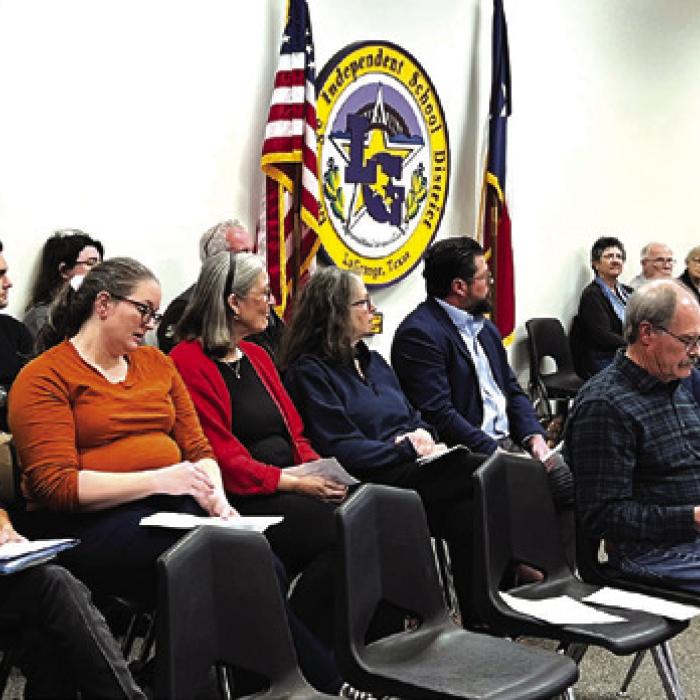
The La Grange ISD board room was full on Monday night.
Ten people citizens spoke with many others there to offer support – the topic on everyone’s mind was books.
There were four book purchases (Can I Touch Your Hair, Eyes of the Forest, Finally Seen and Class Act) that had been challenged at the last board meeting, and a vote on them was postponed until Monday’s meeting.
Seven people spoke in favor of purchasing the four books in question. They all mentioned having read some or all of the books. They all said that these books not only contain no profanity or sexually explicit content, but have merit in the message that is portrayed in the story.
Due to the large number of speakers signed up, board president Gary Drab told the group prior to their speaking that, as per board policy, he could and would limit their time to three minutes instead of the usual five minutes because of the large number of speakers.
Here’s a summary of the speakers:
• Wendy McCredie, current resident said, “I was deeply distressed when I saw that there were some books that the librarians had recommended that we needed to review.” She went on to quote several passages from the book “Finally Seen.”
• Annette Citzler, resident of La Grange and professor emeritus at Texas Lutheran University, told the board, “I read all of the books that you are considering tonight. I did so with pleasure and in some cases enthrallment.” She went on to talk about the number of books that were banned in Texas last year (625), and that the website booklooks. org is one of the sites that is used by groups to recommend banning. She stated that two of the books in question were not even on the list and the other two (“Can I Touch Your Hair?” and “Class Act”) were cited for racism. However, on further investigation she found that while there were comments in the books that may seem racist, “neither of these books should be banned for taking on race and teaching kids about it.”
• Jackie Elliott, retired teacher, told the board “I have read the four books and I found them to be not only age appropriate in their placement in the library, but also found them well-written and engaging. Coincidently one of the books, includes a school board meeting where a book ban is discussed where the majority of the parents agree that not every family has the same life experiences and one mom says, ‘I realize it takes courage to admit that I don’t have all the answers – none of us do. But if I’m afraid to have the conversations, if I’m afraid to read a children’s book, what possible hope do I have of giving my daughter courage to deal with life.’ She went on to speak about parental choice. She said, “Parents can choose what their children may check out and read from the library and there are procedures in place for that already. However, a parent cannot dictate what other children may check out and read. That would infringe on other parents’ rights.”
• Deanna Lowrey-Green, parent of LGISD students, reminded the board the Texas Association of School Boards Code of Ethics. It includes things such as asking for fairness, encouraging differing expressions of opinions, basing your decisions on fact, rather than opinion or supposition. I would like to ask where those things were when considering these books?” She went on to say “You cannot recommend that a book be banned without first reading it yourself. No amount of people with lists can substitute opening the page of the book and reading. I’m disappointed in the action of some of the school board members at the January meeting. Do better. Our students deserve better.”
• Laura Logan, current resident and former LGISD graduate, “I attended the last school board meeting and I was both pleased and disappointed. I was disappointed that books were being brought up for non-purchase without anything specific being mentioned. I was encouraged by the board members who spoke up and said let’s slow down, let’s take time to read these books. I ordered and read these books and these are good books – these are really good books. Not one of the four books has sex or explicit language in it. The four books in question tell stories with positive things. Things like loving families, friends working out conflicts, what it’s like to feel like you’re different and what it feels like to find out you’re not that different after all and you’re not alone.” She continued, “The lessons in these books are good lessons that are appropriate for all children.”
• Rebecca Schenker, resident of La Grange, stated “I cannot find anything objectionable about these four books. Literature is the only artform that can put us in someone else’s mind. It is critical to provide literature to our children. It is through literature that children learn empathy. Fiction helps us understand the many ways of being human, the many cultures and mindsets and circumstances other people live among. These books provide a wide variety of experiences, they describe a wide variety of cultures. They are very useful to children who live in a small community and are not exposed to those sorts of cultures. Let us provide them with the tools they need to navigate the adult world with empathy, understanding, and knowledge.”
• Elota Patton, Fayette County resident, told the board “My dad was career military. I grew up saying ‘yes ma’am, no ma’am’ and standing for ‘The Star-Spangled Banner. There were lot of things that were good growing up as an army brat. But one thing was quite challenging, following my father’s assignments. My family moved every 1-3 years the whole time I was growing up. From K-12 I went to eight different schools. When you start a new school, you’re not related to anyone in town, you don’t have the right clothes, you don’t look right, you don’t fit in. Maybe all of you were popular kids. Maybe you don’t know what this feels like. But I imagine you know what I am talking about. It’s really hard to be on the outside looking in. It’s hard not knowing the unwritten rules. Every place we moved, the thing that saved me, was I found the library. In books, I found my friends.”
The three others each spoke of concern about types of books being purchased.
• Zach Ezer, a parent of students at LGISD, said “My interest in the school libraries’ books started last March when I discovered that the elementary school library contained books that I did not want my son to read. I promptly placed the titles on a ‘Do Not Read’ list with the librarian. In one of the first school board meetings that I attended, a lady spoke to the board lamenting that our library was full of books written by dead white men. I think this is very troubling and it reminded me of a quote that Martin Luther King said. ‘I have a dream that my four little children one day will live in a nation where they will not be judged by the color of their skin, but by the content of their character.’ It’s hard to believe that just 55 years after MLK, we are now judging books not on the content of their ideas, but the color of the author’s skin and the author’s sexual orientation.”
• Jeff Parker, current resident of LGISD, “I am not speaking on the four books from the last meeting, but I am looking ahead to the 891 total books that are supposed to be vetted and voted on tonight. This system is not working. I took it on to try to vet some of these. I was reduced to googling like the board members were last time to see if anybody else had heartburn with them. How can you vet this many books in one month? Yeah they haven’t read them – how do you even get them? How do you know which ones to vet? I went by authors and I found an open transgender advocate writing graphic novels. I found a bi-sexual woman writing a book about kissing. I found a guy who thinks that America is horribly broken and totally racist. So those are ones that I would explore further.” He further reminded the board that they are responsible for: ensuring the balance of reading difficulty, viewpoint, controversial topics. The whole collection needs to be balanced. Those are your responsibilities too. I believe that the principals and the librarians need to do a better job of preparing the list of books to be purchased. How were they selected? What type of book? What influences came in? What are the viewpoints?”
• Jeremy Janda, resident of La Grange. He told the board, “I am Calvin’s socalled trusted source. Let me clear some things up. Calvin called me a couple of months ago and asked me if I’d had a chance to look over the first round of library books that would be ordered if approved at the next school board meeting and there were only 30 days to do it. I told him yes, I had and I identified four out of the 600 books that had either authors or titles that had been publicly and officially removed or protested by other school districts. He asked me why they are contested and I said I don’t know but maybe that question should be asked before we order them. Sounds pretty reasonable to me especially knowing the fact that we currently have books in our libraries that are appalling to say the least.” He went on to quote some of the objectionable passages in some of the books and then ended with, “I find it highly hypocritical that in your code of conduct, students can be suspended for using profanity or being in possession of pornography, but yet you are promoting and encouraging it by making it readily available to our children. But who am I to say what is best for our children, I’m not an expert, I’m only a parent. If at the end of all of this, we feel like this material is appropriate for our children, we have lost our minds. I’ve said it many times before and I will say it again. ‘Our children are only children for a short period of time and they have a lifetime to be exposed to adult content and ideas, so let them be children.’”
When the agenda item for determining whether or not to purchase the four books in question, Calvin Mersiovsky (who originally made the motion to not purchase the books) said, “I have read three of the four books and I want to be the first to tell you, there’s nothing wrongwiththem.TheyareOK to order. Why did we do that? Because of those four books, they had red flagged from the state of Florida, the state of Utah, and the town of Frisco, Texas. Why? I have no idea. I would be curious to find out. I think the system has worked. Do I feel we have books in our library that shouldn’t be there? Absolutely, and that’s what this is all about.”
Superintendent Andy McHazlett interjected, “There’s a policy to deal with those books that we have and it’s a process. We have to trust the process and let the process take place. It’s simple, if there is a book that is in our library that contains explicit and vulgar language, all you have to do is contact us. You don’t have to wait for a board meeting. We will look at it and if they need to be put on a reconsideration list, we will put them on there. As we find them, we are pulling them out.”
Anthony Wessels added, “When Calvin brought me the list with the red flags, there was never an attempt to ban books. We didn’t have much information on them. We were going with the information that we had at the time. We are here tonight thanks to Mary (Gunn) and Karen (Roberts) and the discussion that kind of vetted this all out into a different outcome, possibly that we didn’t even know that we had. I’ve studied the policy a little more and I think that the policy does state that information gathered about sources can be used to generalize ideas but not to make final decisions. So I think we did get it right at the end of the day. Everything I read was fine. I would have made the time to read them all had I not talked to Calvin and realized that I’d have been hard pressed and would have probably been walking in here reading to finish up. But if I am asked to make a decision without information, I am going to err on the side of caution in regards to our kids. I don’t think that’s going over the line, because I do think we need to move with caution. That being said, I have no problem with these (books) and I will gladly donate my copies to the library because I don’t need them anymore.”
Mersiovsky then made the motion that the La Grange ISD Board of Trustees allow the books in question to be added back to the new library materials order list for December 2023. The four board members present, Mersiovsky, Wessels, Ulrich, and Drab all voted to purchase the books. The other three members were unable to attend. There were four needed for a quorum.